
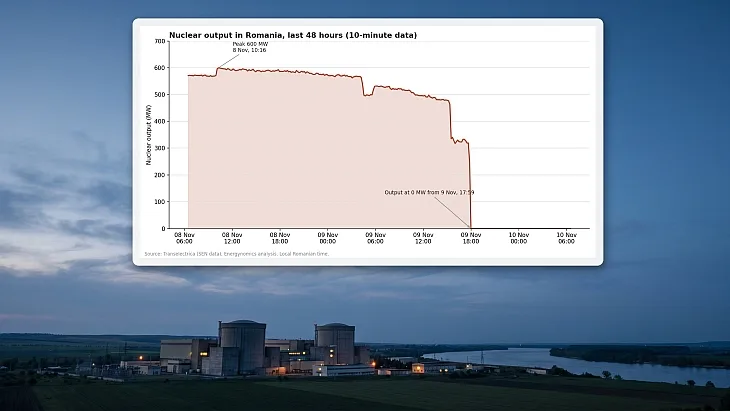
Romania’s nuclear generation fell back to zero on the evening of Monday, 9 November, after Unit 1 of the Cernavodă nuclear power plant had operated for just over three days following an interruption of almost three months. A fault in the turbine condenser’s vacuum control system caused the latest shutdown. According to Transelectrica data, Unit 2 is scheduled to be synchronised with the National Power System (SEN) on Tuesday, 10 November, at 14:00, while Unit 1’s outage is scheduled to end on Wednesday, 11 November, at 12:00.
Transelectrica data analysed by Energynomics show that nuclear generation fell on Monday from approximately 480 MW at midday to 330 MW at around 16:00, reaching zero at 17:59. At 06:28 on Tuesday, 10 November, the latest reading available when we checked, nuclear generation remained at 0 MW.
According to Transelectrica’s generating unit outage reports, Unit 1 began reducing output at 15:23 for checks on the turbine vacuum, and an unplanned shutdown was recorded at 17:57. The reported cause was a failure of the vacuum control system at the turbine condenser.
Nuclearelectrica confirmed that the problem occurred in the conventional, non-nuclear part of the plant and that the disconnection had no impact on nuclear safety, personnel or the environment. Plant specialists are working to repair the fault and prioritise the restart of Unit 1.
The company also announced the replacement of Cernavodă NPP’s technical director, effective 1 December, and a review of maintenance activities. The underlying causes of the incident will be addressed in a subsequent report.
From zero to 600 MW and back
Unit 1 had been resynchronised with the national grid on Friday, 6 November, after almost three months during which Romania had no nuclear generation. The reactor had been shut down in a controlled manner on 28 July, followed by Unit 2 on 13 August, because of a sharp decline in the Danube’s water level. Nuclear generation remained at zero from 14 August until the afternoon of 6 November.
According to a Nuclearelectrica announcement on 8 November, Unit 1 reached its rated power on Sunday at 10:07. Transelectrica data show an output of 600 MW at 10:16.
Daily averages calculated by Energynomics show the progression of the restart: 0 MW on 5 November, 62 MW on 6 November, 273 MW on 7 November and 554 MW on 8 November. These figures represent the average power delivered throughout each day, not the reactor’s maximum output.
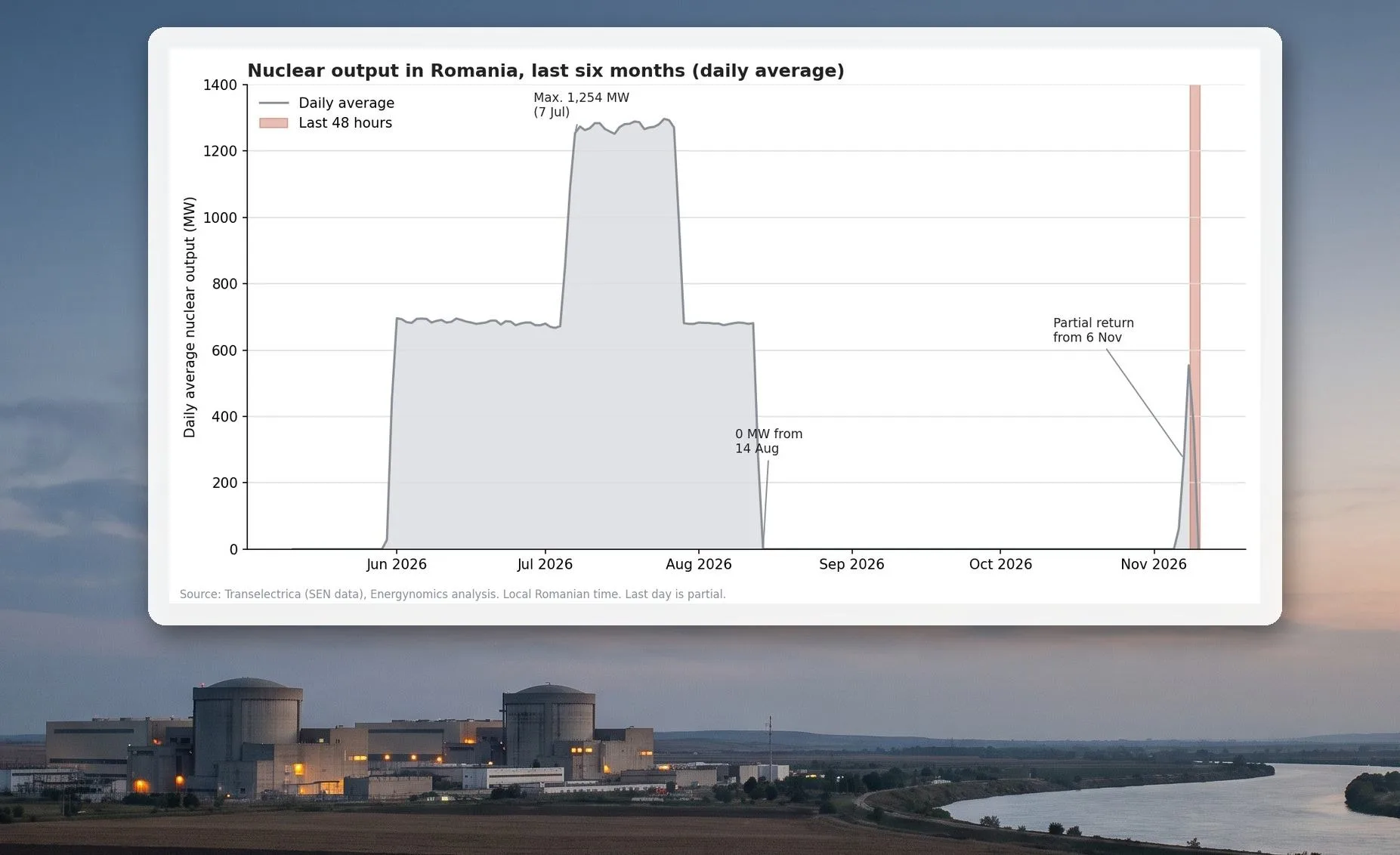
The latest shutdown follows a period of significant fluctuations in nuclear generation. The June average had been approximately 690 MW, while generation reached a daily average of 1,254 MW on 7 July, before both reactors were shut down during the summer.
Unit 2 scheduled to return on 10 November
While work continues to repair the fault at Unit 1, preparations to restart Unit 2 are also progressing, following an improvement in hydrological conditions.
Cernavodă NPP Director Romeo Urjan said on 7 November that the Danube’s water level stood at 2.08 metres, sufficient for Unit 1 to operate, but that restarting Unit 2 required a further increase of at least 10-15 centimetres. Unit 1’s cooling pumps lower the water level in the intake basin, affecting the operating conditions for the second reactor.
Start-up procedures for Unit 2 began at 00:42 on Monday, 9 November. Nuclearelectrica announced that synchronisation was expected on 10 November, with rated power to be reached on 11 November.
The detailed restart schedule provided by Transelectrica confirms that Unit 2 is scheduled to be synchronised on Tuesday, 10 November, at 14:00. Output is expected to increase to 335 MW by 17:00 the same day, after which the reactor will maintain a steady operating level until Wednesday at 15:00. The subsequent increase in output is scheduled to be completed on 11 November at 20:00, when the unit is expected to reach normal operation at approximately 620 MW.
For Unit 1, Transelectrica indicates that the outage is scheduled to end on 11 November at 12:00. Both deadlines remain estimates and depend on the completion of repairs and safe restart procedures.
Essential generation for the power system’s balance
Under normal conditions, Cernavodă’s two reactors supply approximately 20% of Romania’s electricity needs. Their unavailability reduces the system’s steady generation capacity and increases the need to meet demand through other domestic sources or imports.
Energy Minister Dumitru Chisăliță had said that the return of nuclear generation would help reduce imports, particularly during evening hours. However, the actual impact on net imports and electricity prices depends on demand and generation from other sources.
The prolonged shutdown also has implications for suppliers and traders holding electricity purchase contracts with Nuclearelectrica. In August, the company reported to the Bucharest Stock Exchange that it had obtained official opinions concerning the existence of a force majeure event, as it was unable to meet all its contractual obligations from its own generation.
The resumption of generation could reduce the need to replace undelivered electricity, but the actual effects depend on the duration of the outages, the quantities available and the applicable contractual provisions.
After almost three months without nuclear generation and a return that lasted only a few days, the main uncertainty is whether Cernavodă can bring both units back into operation and maintain stable output. Meeting the restart schedule for 10 and 11 November will be the first test.