

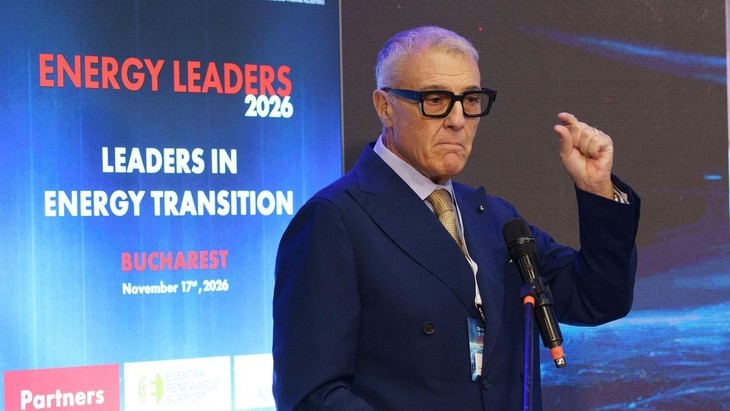
High energy prices have stopped being only a household concern and have become a question of industrial survival, with a blocked market and missing storage making the problem worse. That was the message of Roberto Musneci, President of the Italian Chamber of Commerce for Romania (CCIpR), who opened Leaders in Energy Transition – Bucharest, an event organised by Energynomics and the Italian Chamber of Commerce in Romania.
“If the energy price doubles, the impact is immediate and they go immediately into loss territory,” Musneci said, describing what an Italian metallurgy company with large energy purchases told him about its very thin margins. He added that Romania, in his reading, now pays some of the highest energy prices in Europe, and that the lack of a price cap makes the exposure sharper. The figure was his own estimate, hedged by himself, and he did not offer numbers.
Why industry is the first to feel it
Musneci said the same warning reached him from the owner of one of the largest Italian metallurgy groups present in Romania, who spoke of the risk of industrial desertification, a term he had not heard used in Romania before. For a plant whose profitability is already marginal, the gap between a viable and a loss-making year is the energy bill.
The gas price, he explained, ends up setting the electricity price, so every decision on gas supply flows through to industrial costs. That is why he places the price debate inside a wider frame. “The geopolitical frameworks are, I’ll tell you very frankly, rather worrying,” he said, noting that the technical projects discussed during the day cannot be separated from it.
The perception of that risk differs, he added, between Italians at home and Italians living in Romania, and the Black Sea dimension is particularly relevant here. The Italian Chamber plans to take the geopolitical theme to the Italian Chamber of Deputies, in front of deputies, companies and diplomatic authorities.
A market that cannot plan long term
Musneci reported a development he considers important for investors. About ten days before the conference, six chambers of commerce were invited by the prime minister, and the investors’ council argued that the overall structure of the Romanian energy market needs to be reviewed, or it risks becoming even less efficient.
At its request, accepted quickly by the prime minister and the energy minister, a small working group will look at the basic rules of the sector. In his account, internal regulations and windfall taxes currently block the market, preventing long-term contracts and impairing the optimal use of flexibility.
Bureaucracy in permitting adds a further brake on a market whose growth potential, he said, is clearly visible. The positive counterpoint came a day earlier at the annual event of the Competition Council, where a large share of the discussion he attended was about energy, with banks and other players looking at the sector with keen interest.
Storage as the practical answer
Musneci linked the market blockage to a very concrete cost. Renewable output is soaring, yet without storage the country sells when prices are low and buys when they are high. “The problem is the storage, because then we end up in a situation where we buy at a high price and we sell when the price is low,” he said.
He was glad, he added, to hear from storage-focused companies during the day, since storage is one of the solutions to a market that cannot yet use its own flexibility.
Despite all this, he described himself as an optimist about Romania, because pragmatic, implementable projects keep moving ahead at a fast pace. The condition is adaptation. “There are so many variables that are independent from us that we need to adapt,” he said, and he hopes a future meeting can take stock of both the projects and the environment they depend on.
Leaders in Energy Transition – Bucharest was organised by Energynomics and the Italian Chamber of Commerce in Romania, with the support of our partners: Elektra Renewable Support, Alive Capital, Ansaldo Nucleare, Big Store, Eaton, Elnos, Higeco More, Intesa Sanpaolo Bank, KSTAR, MyEnerji, Renew Storage Energy, Tremi Group, Walter Tosto.