

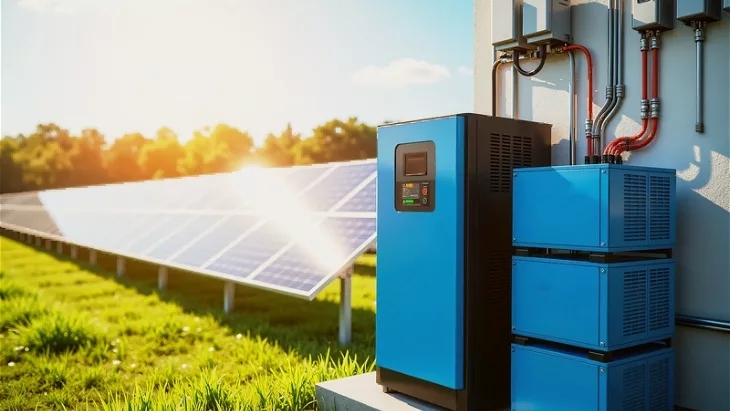
The latest Transelectrica report shows that the import-export balance in the first half of the year improved significantly. Compared with previous years, three additional resources are changing the equation: growing renewable capacity, almost 3.9 GW installed by prosumers and nearly 1 GW of batteries capable of making more efficient use of variable generation.
Prosumers reduce the amount of electricity drawn from the grid, while batteries shift generation over time. Their combined effect can free up electricity from centralised generation for the market and reduce imports during deficit hours.
Transelectrica’s data describe a national power system undergoing a difficult transformation, not one close to collapse. Net electricity generation increased by 7%, net domestic consumption remained almost unchanged, and the gap between physical imports and exports narrowed sharply compared with the same period of 2025. At the same time, renewables, prosumers and storage are gaining enough weight to reshape the structure of the system and, under certain conditions, bring Romania back towards a net electricity exporter position.

Transelectrica’s half-year report, the most direct source of information on the operation of the national power system, shows that between January and June 2026 net domestic consumption fell by only 0.1%, while net generation increased by 7%. Physical cross-border export flows rose by 52%, while import flows increased by only 0.4%.
The external physical deficit narrowed from around 2.5 TWh to below 0.8 TWh
The evolution of the physical balance is perhaps the most relevant indicator.
In H1 2025, Romania recorded approximately 5.75 TWh of physical import flows and 3.28 TWh of exports. In H1 2026, imports reached 5.77 TWh, while exports rose to 4.98 TWh.
This means, by calculation, that the net physical deficit fell from approximately 2.47 TWh to 0.79 TWh, a reduction of around 68% in a single year.
The difference is significant. Romania had not yet returned to being a net exporter in the first half of the year, but neither is it facing growing dependence on external supplies. On the contrary, the physical balance moved significantly closer to equilibrium.
Commercial data point in the same direction, although they should not be confused with physical flows. Transelectrica reports a 10% decline in commercial import exchanges and an 11% increase in commercial export exchanges for the first half of the year.
Generation increased in a year when consumption remained virtually flat
The improved balance is not the result of a massive contraction in demand.
Net domestic consumption was approximately 26.4 TWh in H1 2026, compared with 26.5 TWh in the same period of 2025. Over the same interval, domestic net generation increased from approximately 24 TWh to 25.6 TWh. The difference between these two trends explains much of the movement towards a balanced external position.
Individual months show a more nuanced profile. Consumption fell year on year by between 0.91% in March and 4.04% in May, but increased by 6.29% in January, a month with significantly lower temperatures than in 2025.
In other words, the stagnation in half-year consumption cannot be reduced to a single explanation and does not change the main conclusion: generation grew faster than demand.
The generation mix is shifting towards hydro and renewables
The most visible change in the first half of the year occurred in the generation structure. Compared with the first half of 2025, generation from renewable sources increased by 20%, while hydro generation rose by 18%. Thermal generation fell by 5%, and nuclear generation by 12%.

Hydropower became the largest component of net generation in H1 2026, with a 29% share. Thermal power plants accounted for 28%, renewables for 21%, and nuclear for 16%.
This structure needs to be viewed with one important caveat. Hydrological conditions are volatile, and Transelectrica notes that developments in 2026 differed significantly between the first and second quarters. A favourable half-year for hydropower offers no guarantee for subsequent periods, especially when they are dominated by drought, as seen in July and August, with a major impact on Nuclearelectrica’s generation.
Renewable capacity growth is here to stay
As of 1 July 2026, the national power system had 3,185 MW of wind capacity, 3,840 MW of solar PV and 136 MW of biomass capacity. Total gross installed capacity had reached 19,733 MW.
Transelectrica’s chart indicates approximately 7,162 MW of renewable capacity installed in H1 2026, compared with 5,657 MW a year earlier, an increase of around 1.5 GW.
This growth is taking place alongside a reduction in thermal capacity. Installed capacity in thermal power plants fell from 5,490 MW to 4,469 MW, a decline of approximately 19%.
An increasingly difficult element to ignore is distributed generation. Transelectrica reports 3,897 MW of installed prosumer capacity as of 1 June 2026.
This is already comparable in scale with some traditional generation categories in the national power system. The impact of prosumers, however, is not always directly visible in conventional consumption and generation statistics because part of the electricity is consumed locally.
The Transelectrica report even marks a relevant methodological change: for May and June 2026, net electricity generation includes provisional volumes injected into the grid by prosumers.
Batteries are already reducing vulnerability
Another new element is energy storage. As of 1 July 2026, storage installations totalled 924.43 MW of power and 1,762.50 MWh of storage capacity, according to Transelectrica. Their contribution could become decisive in a system with growing solar and wind generation: shifting electricity from surplus hours to deficit hours, reducing the need for imports during certain periods, participating in balancing and limiting situations in which available renewable generation cannot be used efficiently.

These figures cannot cover up, and should not obscure, the structural problems of Romania’s electricity sector. Romania still needs investment in dispatchable generation, grids, balancing capacity and storage. They do, however, put claims of a generalised and catastrophic deterioration of the system into a different perspective.
Greater flexibility also requires more flexible markets
The new structure of the national power system will be used more effectively as energy markets adapt to a system in which solar generation varies sharply throughout the day, prosumers can simultaneously act as consumers and producers, and batteries can respond within minutes to differences between supply and demand. More granular products are needed, along with effective access for storage assets and aggregators to all relevant markets, price signals that remunerate flexibility, and rules allowing consumers to respond to price variations. The direction has already been established at European level, including through RED III, Directive (EU) 2023/2413, which aims to accelerate the integration of renewables and improve energy system integration.
Romania is still in the process of fully transposing the new rules, after the European Commission opened an infringement procedure in 2025 over the failure to notify full transposition by the 21 May 2025 deadline.
About Schneider Electric
Schneider Electric creates impact by maximising the value of energy and resources, connecting progress with sustainability. We are a global leader in electrification, automation and digitalization, providing AI-driven IoT solutions for smart industries, infrastructure, data centres and buildings.
With 150,000 employees in over 100 countries we promote diversity and innovation. Schneider Electric România, with 27 years in business and more than 300 employees, runs operations in Armenia and Moldova and provides support in 17 languages for 26 countries through the Bucharest Hub.
