

Higher domestic gas production could turn Romania into an important contributor to Central and Eastern Europe’s energy security, but European decarbonisation policies need to be implemented in a way that does not discourage the investment required for both security of supply and the energy transition.
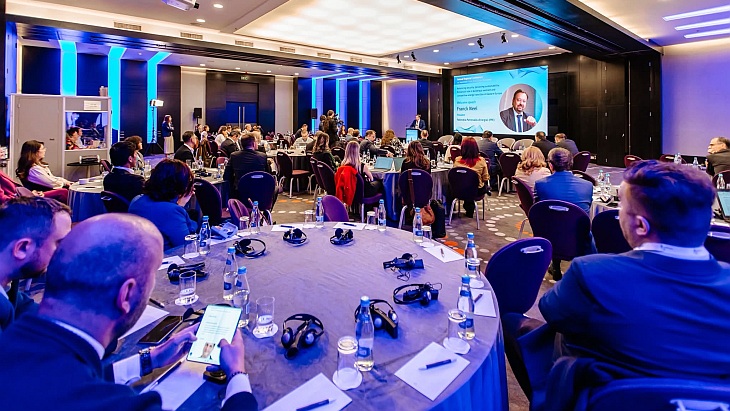
The 2026 Eurogas Annual Regional Conference, organised in Bucharest together with the Energy Employers Federation (FPE), brought three highly topical issues to the forefront: the development of Romania’s gas production, particularly through Neptun Deep, the impact of new European regulations on investment, and the role of gas, carbon capture and storage, and biomethane in a lower-emission energy system.
The common message was that energy security and decarbonisation cannot be built through policies that disregard costs, available infrastructure and differences between Member States. The stakes are particularly high for Romania, as the expansion of domestic production coincides with the implementation of European obligations that industry representatives and public authorities consider disproportionate to local circumstances.
A new regional role
The start of production at Neptun Deep, expected in the first half of 2027, could change Romania’s position in the regional gas market. The project could double national production, and conference participants presented domestic resources not only as an economic advantage, but also as an element of energy security for the region.
Cristian Signoretto, President of Eurogas, said the additional production could turn Romania into a net exporter to the European Union. The prospect is particularly relevant in a Europe that continues to meet most of its gas consumption through imports and remains exposed to developments in the global market.
Dennis Hesseling, a director at the International Energy Agency, placed the discussion in the context of international supply vulnerabilities, including disruptions that can affect global flows. New LNG capacity has reduced some of the impact of supply losses, but continued market volatility underlines the value of regional production sources.
For Romanian companies, the argument is also about investment. Alexandru Maximescu, Vice President for Corporate and Regulatory Affairs at OMV Petrom, said Neptun Deep is expected to be delivered in approximately four years, compared with an average of six years for similar projects. Răzvan Popescu, CEO of ROMGAZ, directly linked security of supply to energy policy and the costs borne by the market. “This year’s prices, this winter’s prices, next year’s prices are simply a consequence of these policies,” he said.
Regulation faces the implementation test
The conference also moved the discussion beyond the need for new gas supply. A significant part of the debate focused on how European decarbonisation objectives are being translated into concrete obligations for companies.
Two regulations dominated the discussions: the Net-Zero Industry Act, through its obligations related to the development of CO₂ storage capacity, and the European regulation on reducing methane emissions.
Under the NZIA, almost 10 million tonnes of Europe’s annual CO₂ storage obligation would fall to Romania. Industry representatives questioned the technical and geological feasibility of meeting the requirement within the established timeframe, particularly as transport and storage projects require infrastructure, permitting and investment that cannot be developed immediately. Some speakers described parts of the resulting requirements as “obligations that are technically and geologically impossible to meet”.
Implementation of the Methane Emissions Regulation raises another issue specific to Romania. According to data presented by FPE, the more than 60,000 wells in the country would entail estimated implementation costs of approximately 1.4 billion euros.
Cristian Bușoi, Secretary of State at the Ministry of Energy, said Romania would advocate in Brussels for a revision of the methane regulation and changes to the obligations under the NZIA. The debate did not challenge the objectives of reducing emissions, but rather the way costs and responsibilities are allocated between countries and companies.
For the industry, the central question is whether European regulation can simultaneously accelerate decarbonisation and maintain investment in EU energy infrastructure. Franck Neel, President of FPE, summarised the risk: “It seems to be becoming easier to invest outside Europe if we continue to impose so many constraints on the industry.”
From gas to transition infrastructure
The Bucharest debate also pointed to a broader perspective on the role of the gas sector. Natural gas, transport infrastructure, carbon capture and storage, and renewable gases are increasingly becoming part of the same discussion about reducing emissions without undermining industrial competitiveness.
For sectors where full electrification is difficult, CO₂ capture and storage could become one of the available decarbonisation solutions. Adrian Porfir, CCUS Programme Director at Holcim Romania, said Romania could use its geological resources and regional position to develop a CO₂ hub. Holcim’s carbon capture project has received 146 million euros in funding from the Innovation Fund.
Building such a value chain, however, requires more than capture facilities. CO₂ transport needs new infrastructure, access to land and a regulatory framework that enables the development of pipelines and storage sites.
Biomethane was presented as another way in which existing gas infrastructure could contribute to reducing emissions. Poland’s experience, presented at the conference by Michał Tarka, founder and CEO of the Polish Biomethane Organization, shows that market development depends above all on clear rules and a functioning economic framework.
For Romania, the three directions converge in the same energy-policy challenge. Higher domestic production could strengthen regional energy security, but the role of gas in the next stage of the transition will also depend on the ability to reduce associated emissions, develop infrastructure for CO₂ and renewable gases, and keep future investment economically viable.