
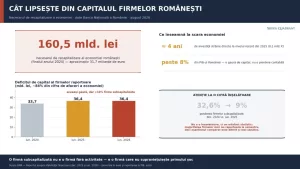
Romanian companies would need 160.5 billion lei for recapitalization, in other words to be able to operate on solid financial foundations and be able to absorb difficult periods without the risk of financial blockages or insolvency, shows a Sierra Quadrant analysis based on data from the National Bank. The amount of 31.7 billion euros represents the equivalent of almost four years of foreign direct investment at the record level reached in 2025.
According to analysts at Sierra Quadrant, an undercapitalized company is not necessarily a company without activity — it is a fragile company, which may not survive a shock that a better-capitalized company would go through without problems.
And in 2026, the shocks add up: high interest rates, five tax packages in one year, record energy costs, slowing domestic demand. The result is already visible in the records of the National Trade Register Office.
The capital deficit: a problem that is not being solved, but is being moved
For companies that reported results in mid-2025 — representing approximately 84% of the economy’s total turnover — the capital deficit amounted to 36.4 billion lei, an increase of 8% compared to the previous year.
A more recent report by the NBR, published in June 2026, shows that the number of undercapitalized companies increased by 10%, and the recapitalization requirement remained, again, at 36.4 billion lei.
In other words: more companies, the same hole. The deficit is not closing, it is redistributed across a larger number of companies — a sign that we are not talking about a cyclical phenomenon, but about a structural characteristic of the economy.
Beware of a Misleading Number
A technical detail is worth explaining, because it is exactly the kind of statistic that gives rise to fake headlines. The number of undercapitalized companies represented only 9% of the total in June 2025, compared to 32.6% at the end of 2024 — a seemingly spectacular improvement.
The real explanation, however, is not a recovery in the economy, but a statistical artifact: most small companies are not included in the mid-year reporting exercise, which means that the sample analyzed in June 2025 is different — and, on average, financially healthier — than the one at the end of the previous year.
The December 2025 Financial Stability Report is, moreover, clear: undercapitalized companies represent a significant structural vulnerability, with weak financial foundations, unable to cope with economic shocks or support long-term investments. The document adds a warning that goes beyond the prudential sphere: these companies present a high risk of insolvency and can be used in tax optimization or evasion schemes, affecting the business environment, the collection of budget revenues and the financial stability of the country.
The Romanian anomaly: companies are financed by suppliers, not banks
According to the Sierra Quadrant analysis, in June 2025, the structure of liabilities of non-financial companies looked like this: equity in first place, with 40% of liabilities; trade debts in second place, with 18%; and financing received from financial institutions in Romania — only 9%.
In other words, supplier credit is twice as important as bank credit in financing the Romanian economy.
“Romanian companies finance themselves by deferring payments to suppliers rather than by bank loans — a practice that works relatively well in periods of economic stability, but which becomes extremely risky when payment delays propagate in a chain throughout the entire economy,” explains Ovidiu Neacșu, Sierra Quadrant’s coordinating partner.
The increasing trend in supplier payment times and the term for recovering trade receivables represents, according to Sierra Quadrant, an increasingly serious challenge for companies’ financial stability.
The consequence is systemic: in an economy financed by trade credit, the insolvency of a large company does not remain an isolated event, but propagates upstream, to dozens of suppliers who no longer recover their receivables. The bank does not absorb the loss — the other entrepreneurs absorb it. It is the classic mechanism of financial blockage in a chain, and Romania has it incorporated into its liability structure.
Rising debt, declining repayment capacity
Statistics show that the debt-to-equity ratio reached 140.5% in June 2025, up 5.4 percentage points from the previous year, in a clear upward trend.
However, the top of the distribution is more relevant: the share of companies with a debt-to-equity ratio above the 200% threshold has increased to approximately 35%, both in terms of number of companies and as a share of the economy’s turnover.
This category usually includes most companies that subsequently end up in restructuring, composition with creditors or insolvency.
In parallel, repayment capacity is slowly eroding. The interest coverage ratio — the ratio of profit before interest and taxes to interest expenses — fell to 541% in June 2025, 32 percentage points below the previous year and 118 points below the level in June 2023. The value remains theoretically comfortable; the direction, constantly decreasing for over two years, is itself a signal.
Currency risk, focused exclusively on companies
An additional, rarely discussed vulnerability: 53% of the loan portfolio of non-financial companies was denominated in foreign currency in March 2026, compared to only 7% in the case of loans granted to the population.
“This is a remarkable asymmetry. After the 2008-2010 crisis, Romania almost completely “de-currencyized” its lending to the population, but not to companies. Practically, the entire exchange rate risk in the economy was transferred to companies’ balance sheets — precisely the most undercapitalized segment. In a year when the leu is under pressure due to fiscal uncertainty and negative rating prospects, this structure turns a currency depreciation into a direct shock to already fragile companies,” says Ovidiu Neacșu.
Banks are already feeling it: non-performing loans are only rising for companies
The deterioration is no longer a projection. According to the latest edition of the Financial Stability Report, approved by the NBR Board of Directors on July 6, 2026, the rate of non-performing loans granted to non-financial companies increased to 5.6%, 1.2 percentage points above the level of a year ago.
The contrast with the population is striking: in the same period, the rate of non-performing loans granted to individuals fell to 2.9%. Households are paying their installments better; companies, increasingly worse.
NBR identifies hot spots: loans granted to SMEs, especially micro and small enterprises, loans with state guarantees granted to companies and exposures to the commercial real estate market. The explicit mention of loans with state guarantees is worth remembering — it means that part of the risk that is now materializing reaches, through the execution of guarantees, directly into the budget.
What is seen in the registers: write-offs are back on the rise
Financial fragility translates, with a lag, into the demography of companies. And the data of the National Office of the Trade Register for the first half of 2026, cited by Sierra Quadrant, show a clear reversal of trend.
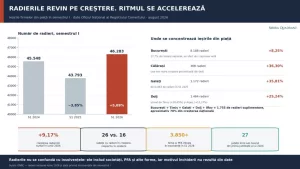
In the period January-June 2026, 46,283 write-offs were recorded, 5.69% more than in the similar period in 2025. Last year, in the same period, write-offs had decreased by 3.85% compared to 2024, from 45,548 to 43,793. In 2026, the total returned to growth and slightly exceeded the level of two years ago, by 1.61%.
More important than the level is the pace: in June 2026 alone, 7,145 deregistrations were recorded, compared to 6,545 in June 2025 — an increase of 9.17%, significantly above the semester average. The phenomenon is accelerating, not dying out.
Where is it concentrated
The capital reported 8,188 deregistrations in the first six months, 624 more than last year, an increase of 8.25%. Bucharest concentrated approximately 17.7% of the national total and generated alone about a quarter of the net growth compared to 2025.
Together with Timiș (+310 deregistrations), Galați (+309), Dolj (+295) and Ilfov (+217), the Capital generated 1,755 additional deregistrations — approximately 70% of the total growth at the national level.
In terms of percentage dynamics, the peaks are in Călărași, where deregistrations rose from 270 to 368 (+36.30%), and in Galați, from 863 to 1,172 (+35.81%). This is followed by Gorj (+25.37%), Dolj (+25.24%), Timiș (+18.45%), Argeș (+15.37%), Arad (+14.75%) and Ilfov (+13.56%). At the opposite end, there were significant decreases in Olt (−22.61%), Bistrița-Năsăud (−20.38%) and Vrancea (−19.50%).
The picture is not uniform: deregistrations increased in 26 counties and decreased in another 16, and in 27 counties the level remains below that of the first half of 2024. The phenomenon is concentrated in the major economic centers — exactly there where the density of companies is maximum and where the business life cycle is fastest.
A necessary clarification: deregistrations should not be confused with insolvencies or bankruptcies. The data includes companies, authorized individuals and other forms of organization, and deregistration from the Trade Register does not indicate, individually, the reason for closing the activity. They measure exits from the market, not failures. Separately, over 3,850 companies and PFAs entered insolvency in the first six months of this year.
The fracture line: corporations resist, SMEs do not
All the indicators converge towards the same separation. Large companies and multinationals display superior financial indicators compared to SMEs — in asset turnover, debt coverage by equity and return on assets.
The aggregate financial health indicator of non-financial companies was, in mid-2025, at a comfortable level, above the risk threshold, although slightly deteriorated compared to June 2024. The negative dynamics were present in both corporations and SMEs, but the gap in favor of premiums remains.
“The national average is reassuring precisely because it is pulled up by a small number of large companies. Below it, the segment that generates the majority of jobs in the private economy is financially thinning from year to year,” shows the Sierra Quadrant analysis.
What would closing the deficit mean, in concrete terms
The 160.5 billion lei will not be covered by the state or by banks. In an economy where bank financing represents 9% of companies’ liabilities, even a doubling of lending would solve a fraction of the problem.
There are three real sources, and all of them are blocked or insufficient today, from reinvested profits, to shareholder contributions and the capital market. The latter should be, in theory, the most suitable solution for medium-sized companies, practically accessed by a tiny number of Romanian companies, in the absence of a listing culture and adapted financing instruments,” says Ovidiu Neacșu.
According to the expert, undercapitalization is not an accident, it is the result of an incentive architecture.
“A tax system that taxes the capital remaining in the company in the same way as the one taken out of it, an undersized capital market and a banking sector that finances only 9% of companies’ liabilities inevitably produce companies that finance themselves by postponing payment to suppliers. And an economy built on trade credit functions flawlessly – until the day the first important link in the chain stops paying,” added the coordinating partner at Sierra Quadrant.
About Schneider Electric
Schneider Electric creates impact by maximising the value of energy and resources, connecting progress with sustainability. We are a global leader in electrification, automation and digitalization, providing AI-driven IoT solutions for smart industries, infrastructure, data centres and buildings.
With 150,000 employees in over 100 countries we promote diversity and innovation. Schneider Electric România, with 27 years in business and more than 300 employees, runs operations in Armenia and Moldova and provides support in 17 languages for 26 countries through the Bucharest Hub.