

The 8 cm “gained” means that we managed to redirect approximately 50 cubic meters of water per second to Cernavodă, but the danger has not passed, since at any moment the barges can be relocated from their current position and the redirection of the additional flow to the nuclear power plant can be reduced – or even canceled, the Secretary of State in the Ministry of Transport and Infrastructure Ionel Scrioșteanu posted on his Facebook page on Sunday evening.
“A battle won, a good result, but the danger is not over. I am very happy that our efforts in the last week for the intervention in the Bala area have had good results and Reactor 2 at the Cernavoda Nuclear Power Plant remains in operation. Basically, we have managed to reverse the downward trend with one of slight increase. According to estimates, the 8 cm “won” means that we have managed to redirect approximately 50 cubic meters of water per second to Cernavoda”, noted Scrioșteanu, quoted by Agerpres.
He stressed that the process of coordinating the intervention on the Bala branch was a “major challenge” and this will be continued.
“It has been one of the most demanding and difficult weeks since I have been Secretary of State. Coordinating the intervention at Bala was a major challenge and I am glad that I have been able to complete it up to this point. But the danger has not passed, the Danube currents are strong and can be unpredictable. At any moment, the barges can be dislocated from their current position and the redirection of the additional flow to Cernavodă can be reduced (or even canceled). To prevent such a scenario, at Bala, we continue the intervention and I will return tomorrow with details about the ongoing activities. I thank them, the crews on each ship, the AFDJ management and its representatives in the field, the representatives from ISU Dobrogea coordinated by Major Măcreanu Aurelian, the SMURD crews for permanent assistance, the representatives of Apele Române and everyone involved!” added Ionel Scrioșteanu.
The interim Minister of Transport, Radu Miruță, announced that the level of the Danube has risen by eight centimeters in the area of the Cernavodă nuclear power plant, which ensures its continued operation, following the operation carried out by specialists.
“8 cm gained at Cernavodă. At least another 9 days for Unit 2. This morning was the first measurement after the barges sank in the Danube and the dredging of some rapids: after yesterday the water level had dropped by 3 cm, this morning, at Cernavodă, the water level in the last 24 hours has risen by 4 cm. The forecast told us that we would also drop by 4 cm today. So, we have gained 8 cm net. That takes us to the operation of Unit 2 for at least 9 days, based on the current forecast”, Miruță wrote on Sunday in a Facebook post.
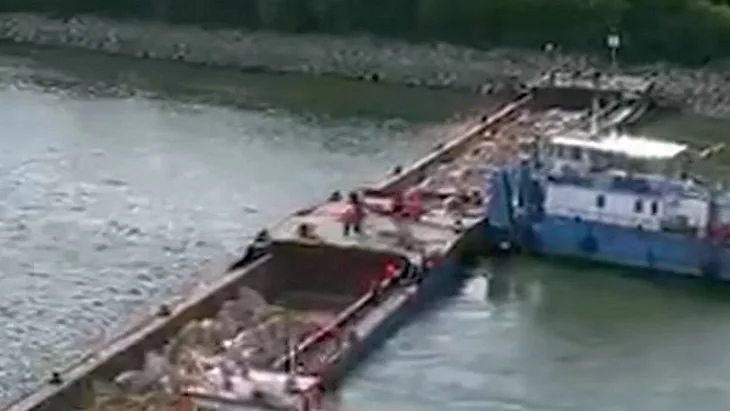
The operation to sink the last two barges was completed on Saturday evening, around 7:20 p.m., after 7 hours. The last two barges were placed 300 meters apart, the distance between the two midpoints. The second group of barges is upstream, more inclined to direct the current towards the Bala arm, according to a post by the National Administration “Apele Române” (ANAR), on its Facebook page.
On Friday night, around 01:00, the sinking of the second barge was completed, as part of the intervention to redirect part of the Danube flow to the Bala branch,
“The 4 barges sunk by controlled flooding will act as two artificial thresholds intended to favor the redirection of part of the flow to the branch that feeds the power plant.
The effects of the operation will be felt at the earliest tomorrow evening (Sunday evening – ed.) and during Monday. The specialists’ estimate would be that, immediately, on the Old Danube, after the intersection, a level increase of 6-7 cm would be felt and 2-4 cm at the Power Plant (60 km away). The goal would be to manage to reach a minimum level of -228 cm near the Cernavodă NPP”, ANAR noted on Saturday evening.
According to the cited source, the forecast of the National Institute of Hydrology and Water Management indicates that, after a period of stationarity (until August 12 inclusive), respectively around 1400 cubic meters/s, starting from August 13, the Danube flows will increase to around 1450 cubic meters/s and will reach 1500 cubic meters/s on August 15.
About Schneider Electric
Schneider Electric creates impact by maximising the value of energy and resources, connecting progress with sustainability. We are a global leader in electrification, automation and digitalization, providing AI-driven IoT solutions for smart industries, infrastructure, data centres and buildings.
With 150,000 employees in over 100 countries we promote diversity and innovation. Schneider Electric România, with 27 years in business and more than 300 employees, runs operations in Armenia and Moldova and provides support in 17 languages for 26 countries through the Bucharest Hub.