

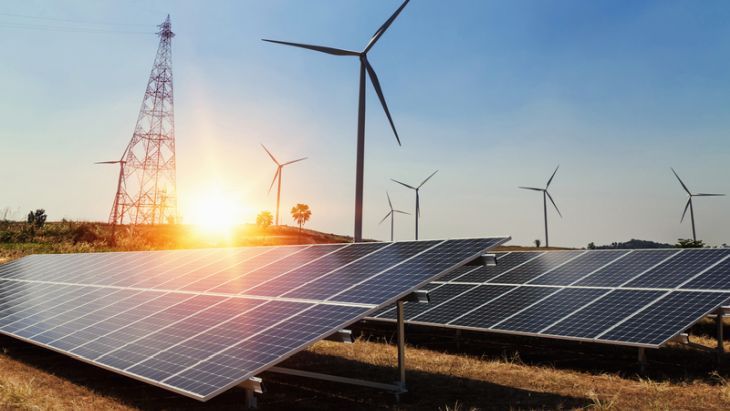
The summer of 2026 showed how vulnerable the Romanian energy system is. Renewable capacities have grown rapidly. The sun and wind are producing more and more. At the same time, storage and flexibility are lagging behind. When hydraulics decrease due to reduced flow on the Danube, when high temperatures push consumption into peak hours and when solar production decreases in the evening, the system feels the pressure. Imports and technical reserves must intervene. It is not a long-term generation crisis. It is a problem of synchronization between production, consumption and the ability to move energy over time, shows an analysis by the consulting company Frames.
On June 29, in the midst of a heat wave, Romania reached the top of the European ranking of prices on the day-ahead market, with values that exceeded 4,200 lei/MWh in the evening hours. A few weeks later, a prolonged drought led to the shutdown of both reactors at Cernavoda, one after the other—the first time in 23 years that the country was without nuclear power, a source that normally provides about a fifth of the country’s energy. The low Danube level also reduced the output of the hydroelectric power plants at Portile de Fier. On some critical days, out of nearly 19 GW of installed capacity, the system managed to produce only 6.9 GW, less than a third of its theoretical potential.
“The problem was not the lack of investment, but the imbalance in their structure. In just four years, solar and wind capacity has exploded: from around 0.6 GW installed by prosumers in 2022, to over 3 GW of photovoltaics, over 3 GW of wind and 3.7 GW of prosumers in 2026. It is a real success of the energy transition,” says Adrian Negrescu, Frames manager.
In contrast, investments in storage, backup gas plants and the modernization of transmission networks have progressed much more slowly. The National Integrated Energy and Climate Change Plan provided, until recently, for only 16.2 MW of storage capacity at national level — a symbolic figure compared to the thousands of megawatts of renewables. The European Commission highlighted, in its 2026 country report, that the transmission and distribution network represents one of Romania’s main vulnerabilities, unable to keep up with the pace of development of new capacities.
“On In short, we built the engine, but not the tank. The abundant solar energy at noon could not be stored for the evening peak hours, when consumption increases and photovoltaic production decreases,’’ Negrescu added.
Projects that change the logic: large-scale integrated storage
The solution is no longer theoretical. It is already being built on the ground. A relevant example is the hybrid project in Ogrezeni (Giurgiu County), developed by the Austrian company Enery, considered one of the largest solar-plus-storage projects in Europe. The photovoltaic capacity of 761 MWp is coupled with a storage system of 534 MW / 1,068 MWh. The total investment amounts to approximately 460 million euros — one of the largest private energy investments made in Romania. About 350 jobs are estimated during the construction phase, with a significant component of local execution and supply. Once completed, in 2027, the park would produce annually 1.4–1.5 TWh, equivalent to the consumption of about 684,000 households.
Ogrezeni illustrates the direction needed: projects that no longer just sell megawatts of gross output, but also flexibility — the ability to shift energy from peak periods to times of scarcity. Every month of delay at such sites translates into peak hours covered by expensive imports, instead of locally stored energy.
Demand is growing, and the mix must adapt
Net domestic consumption is estimated at about 53,600 GWh in 2026, with instantaneous peaks that have approached 7,000 MW in the height of summer. In the medium term, authorities anticipate adding almost 13 GW of new capacity by 2032, in a mix that includes natural gas, nuclear, wind, photovoltaics and about 2.25 GW of battery storage. The completion of units 3 and 4 at Cernavoda could raise the share of nuclear from 18–20% to about 30% of consumption. In parallel, coal-fired capacities (approximately 1,900 MW) are to be retired by the end of 2030 at the latest, according to the commitments in the PNRR. This timetable makes it urgent to replace them with flexible sources, not just with additional renewables.
Two structural bottlenecks remain unresolved
According to Frames analysts, the first is legislative and market-based. Demand response mechanisms — whereby large consumers are paid to reduce or shift their consumption during peak hours — are still hampered by regulatory barriers. ANRE announced that Romania is becoming the first EU country to adopt an explicit payment mechanism for demand reduction. However, it remains to be seen how quickly and attractively it will be implemented for large industries (steel, cement, chemicals), whose consumption cannot be stopped instantly, but can be scheduled if the rules are clear.
The second bottleneck is the network. Modernization of transmission and distribution lines remains, according to the European Commission, the main structural vulnerability. Without it, even storage and renewable projects already built risk not being able to be integrated effectively, and congestion may partially cancel out the benefits of upstream investments. From 2026, the allocation of grid capacity will move to a competitive mechanism, which brings more discipline but requires predictable implementation.
Flexibility on the consumption side: smart meters and hourly pricing
An important part of the solution comes from the way energy is consumed. The government has announced the installation of around 800,000 smart meters, capable of measuring consumption in real time. Once the project is completed, it will become possible to introduce dynamic pricing.
Consumers who schedule their household appliances or charge electric cars during hours with a solar surplus could save, according to initial estimates, between 10% and 20% of their annual bill. Prosumers — hundreds of thousands of households and companies — already contribute to covering local consumption during the day and can reduce pressure on the grid if they are equipped with batteries.
The summer of 2026 confirmed the diagnosis
“Romania has invested correctly and quickly in renewable production, but insufficiently, so far, in the capacity to use it at the right time. The direction has changed. Projects like Ogrezeni show that private investments can simultaneously bring capacity and flexibility, with local impact,” says Adrian Negrescu.
The stakes for the coming years are no longer whether the system can produce enough energy — the installed capacity exists and continues to grow — but whether it has the execution discipline and institutional framework necessary to complete storage, network modernization and consumption flexibility tools on time. These will decide whether the renewable wave turns into an energy security advantage or whether summer vulnerabilities are repeated year after year.
All opinions expressed in this Frames analysis are purely informative and do not represent an instrument associated with financial investments.
Frames is an economic think tank specialized in developing market analyses and studies on the economy. In its more than 20 years of existence, Frames has become one of the relevant players in the field of business analysis in Romania, his analyses addressed to investors and the general public offering a concrete perspective on business dynamics at the local and international level.
About Schneider Electric
Schneider Electric creates impact by maximising the value of energy and resources, connecting progress with sustainability. We are a global leader in electrification, automation and digitalization, providing AI-driven IoT solutions for smart industries, infrastructure, data centres and buildings.
With 150,000 employees in over 100 countries we promote diversity and innovation. Schneider Electric România, with 27 years in business and more than 300 employees, runs operations in Armenia and Moldova and provides support in 17 languages for 26 countries through the Bucharest Hub.