

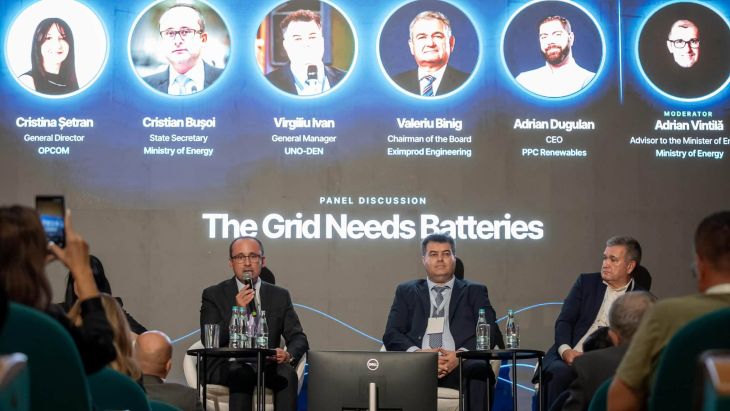
The target set for battery energy storage is 1,200 megawatts (with a capacity of 2,400 megawatt-hours) by the end of 2030, supplemented by 800 megawatts of pumped-storage capacity, Cristian Bușoi, State Secretary at the Ministry of Energy, stated on Monday at an industry event.
“The target set [for battery storage – Ed.] is 1,200 megawatts (MW) by the end of 2030—with 2,400 megawatt-hours—plus an additional 800 megawatts from pumped-storage facilities. We are already close to the 2030 target. We already have 1,100 megawatts installed, compared to 137 megawatts in mid-2025. We are moving at an accelerated pace; since June, with the involvement of DEN, Transelectrica, and ANRE, significant capacities have been added to the national energy system,” the State Secretary said.
According to him, the Ministry of Energy supports the target proposed by Transelectrica regarding battery storage capacity.
“We support the target put forward by Transelectrica—that of 5,000 megawatts of installed capacity. And, of course, we are not talking only about batteries; we are also referring to pumped-storage hydroelectric plants,” Bușoi emphasized, according to Agerpres. He added that “it would have been beneficial to have had sustained investment and an acceleration of the permitting processes for battery storage.”
“So far, the Ministry of Energy has undertaken several initiatives to co-finance storage capacity. There was that call for proposals under the NRRP [National Recovery and Resilience Plan] that closed in August. We have seven investments co-financed through the NRRP. Almost all of them are already in the system; only one is still awaiting funding,” the energy official noted.
In his view, there is significant market interest in storage capacity.
“Investment funds and investors from all corners of the globe come to the Ministry of Energy—almost on a weekly basis—expressing interest in investing in Romania, whether in hybrid projects combining generation and storage, or in standalone battery storage systems,” the state secretary mentioned.
He also noted interest from banks in providing financial support for battery storage capacity.
“There is also interest from commercial banks, which are looking much more closely at batteries—especially standalone ones. This wasn’t the case a year ago. (…) I am convinced that by next year, we will have at least double the installed megawatt capacity, if not more. Four-hour duration systems are already appearing. However, we likely won’t have pumped-hydro storage capacity in place by 2030,” Cristian Bușoi added.
On Monday, Alive Capital organized the “GET ALIVE!” conference in the Aula of the “Carol I” Central University Library in Bucharest. 2026 – BESS, dedicated to battery energy storage systems.