

Ovidiu Costea, CEO, ROCAS Energy
ROCAS Energy is proposing an integrated approach to energy storage projects, covering everything from engineering and financing to construction, operations and the commercial use of energy. Ovidiu Costea, CEO of ROCAS Energy, explains a financing model in which clients contribute no more than 30% of the investment, outlines a development pipeline of approximately 5 GWh being offered to investors, and discusses the benefits of immersion-cooled batteries. In this interview with Energynomics, he also cautions against overly optimistic assumptions about future storage revenues.
To begin, could you tell us about your professional background, how you entered the energy sector and what led you to ROCAS Energy?
I began working in energy efficiency in 1996. Since then, my career has taken me through several stages of the industry’s development, from solar thermal systems for hot water and heat pumps to photovoltaics and, more recently, energy storage. For me, it has been a natural progression. Throughout these stages, the underlying challenge has remained the same: how can we generate, use and manage energy more efficiently?
With photovoltaics, we focused on energy generation. Storage allows us to manage when that energy is consumed or sold. Bringing generation, consumption and flexibility together is fundamental to the projects we develop today.
ROCAS Energy is a continuation of that journey. My experience has taught me that a project’s value depends on how well technology, engineering, financing, construction and operations work together. That is the principle guiding our company’s development.
What gap in the market is ROCAS Energy seeking to fill? Who are the clients you are currently developing solutions for?
ROCAS was established to bring five essential services together under one integrated platform: consulting, EPC, operations and maintenance, trading, and financing. A client can source equipment, designers, contractors, operators and financing separately. The challenge is coordinating all these parties and ensuring that the project remains technically sound and commercially viable throughout its operating life.
We wanted to take responsibility for that integration, from structuring the investment and arranging financing to construction, maintenance and bringing energy to market. We start with the client’s objectives and bring all five areas together to support the project’s long-term performance.
We also identified a need for more rigorous, project-specific engineering than many of the standard solutions available on the market could offer.
That is why we define the technical architecture, control systems and cybersecurity requirements from the earliest stages of a project. We integrate a fully Romanian-developed energy management system (EMS) and a European power conversion system (PCS), with the aim of meeting all applicable NIS2 requirements. We consider cybersecurity, access control and data management to be fundamental design requirements that must remain a priority throughout implementation and operation.
Our clients today are private companies. We also work to address the needs of state-owned enterprises, local authorities and investors interested in energy projects. In each case, we tailor the solution to the client’s financial objectives, consumption profile, safety and security requirements, and long-term performance expectations.
You describe ROCAS as an integrated platform, covering project structuring and financing, construction, operations and maintenance, trading and optimisation. Which activities do you handle in-house, which are delivered through partners, and what are the benefits of this approach for investors?
The five pillars determine how we structure each investment. During the consulting phase, we establish the project’s objectives, technical configuration and feasibility. Through EPC, we coordinate engineering, procurement and construction. We also plan for operations and maintenance, while assessing the trading and optimisation strategy against the asset’s technical capabilities. Financing is structured to support the entire implementation process.
We have our own engineering team in Bucharest, responsible for technical architecture, equipment selection and system integration. Our units are currently manufactured in China in collaboration with our production partners, although our development plans include establishing an assembly facility in Romania.
We source batteries from leading manufacturers. For system control and power conversion, we combine a fully Romanian-developed EMS with a European PCS.
Financing is arranged through our financial partners. Construction, operating services and access to energy markets involve both our own capabilities and specialised partners, with responsibilities clearly defined in each contract. ROCAS coordinates these different components.
For investors, the main advantage is consistency in decision-making throughout the project. Battery sizing, equipment selection, warranty conditions and commercial strategy cannot be treated as separate decisions. The trading strategy, for example, must take account of technical operating limits, battery degradation and warranty provisions. An integrated approach allows us to assess these relationships before construction begins and monitor them throughout the asset’s operating life.
You mentioned a financing model. How does it work in practice?
Under our proposed structure, the client contributes no more than 30% of the investment, while ROCAS arranges the remaining funding through its financial partners, subject to the terms approved for each project.
We build the project and, once construction is complete and the asset reaches its commercial operation date (COD), we assist the client with refinancing. The aim is to help the client move through the construction phase and reach the point where the project is operational and can be assessed for long-term financing.
Creditworthiness is the key requirement. Having a project and being willing to invest does not automatically make a client eligible. We assess the client’s financial position alongside the proposed investment structure. Where a project is developed through a special purpose vehicle (SPV) without a financial track record, the financial strength of its investors and any supporting companies becomes particularly important.
Our assessment criteria are similar to those used by banks. We aim to make the process simpler and faster without compromising financial and technical due diligence. The model is available to eligible energy project investors, with the exact equity contribution, guarantees and other terms determined on a case-by-case basis. Refinancing after COD remains subject to approval by the financing institution.
What has ROCAS Energy achieved so far? Can you give us some examples of projects, capacities or transactions, and explain the company’s specific role in them?
We have projects in the 2.5-5 MW range and at 15 MW. We are also at a very advanced stage of discussions on larger projects, including a 64 MW system with two hours of storage, a 66 MW system with three hours of storage, and projects of 80 MW and 120 MW. For the projects currently in preparation, we are targeting implementation in 2027, depending on their individual schedules.
ROCAS’s involvement includes engineering, system configuration and integration, and coordinating project implementation, according to the responsibilities agreed for each project. Where the contractual arrangements allow, we also provide financing solutions and prepare the operating, maintenance and commercial arrangements.
Separately, our development pipeline includes storage projects totalling approximately 5 GWh, which we are offering to investors for acquisition once they reach COD. Further information about these projects is available on our website.
We make a clear distinction between projects already underway, those under advanced discussion and our broader development pipeline. Our objective is to bring projects to the operational stage, with a clearly defined framework for managing and operating the assets.
In an earlier discussion about battery energy storage, you mentioned immersion cooling. What challenges does this technology address, and where do you see its economic or operational advantages over conventional cooling systems?
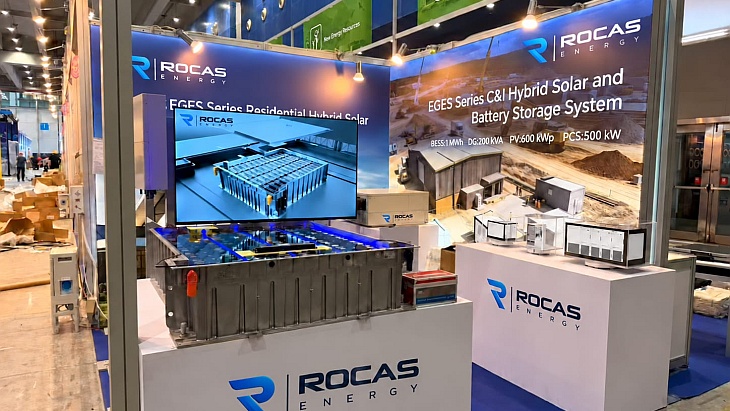
For investors taking a long-term view, the choice of cooling technology is a strategic decision. It affects safety, the battery’s ability to retain its capacity, system availability and operating costs. That is why immersion cooling plays a central role in ROCAS’s approach.
The key difference between cooling technologies lies in how heat is removed from the battery cells.
With air cooling, heat removal depends on airflow and how effectively air circulates around the modules. Maintaining a consistent temperature can be more challenging in certain system configurations and under demanding operating conditions.
With cold-plate liquid cooling, heat is transferred to the cooling circuit through contact surfaces and intermediate materials. Performance depends on the system’s geometry, the quality of thermal contact and the distribution of the coolant.
With immersion cooling, a dielectric fluid comes into direct contact with the cell surfaces designed for cooling. Heat can be removed across a larger surface area, potentially allowing more uniform temperature control. Actual performance depends on the system design, the properties of the fluid and how it circulates.
An important part of our approach is our partnership with Shell. We use Shell dielectric fluid in ROCAS’s immersion-cooled systems. Fluid selection, material compatibility and cooling circuit design are all addressed as part of the engineering of the complete system.
From an investor’s perspective, we see four main advantages.
The first is preserving battery capacity over time. Effective temperature control helps reduce thermal stress and temperature differences between cells. The objective is to maintain performance and usable capacity for as long as possible. The economic benefit is reflected in the total energy delivered over the asset’s operating life, as well as in the frequency and cost of maintenance or component replacement.
The second is safety and asset protection. Preventing localised hot spots is important during normal operation. In the event of a fault, a properly designed and tested immersion-cooling system may help delay or limit the propagation of heat. Any such performance claims must be supported by tests on the specific system being supplied. For investors, protecting their capital and reducing the risk of a major operational interruption have direct financial value.
The third is operational availability. A battery needs to be available when the owner requires energy or when a commercial opportunity arises. A properly designed thermal management system can reduce temperature-related restrictions on power output, within the battery’s specified operating limits.
The fourth is total lifetime cost. We assess the initial investment alongside auxiliary energy consumption, maintenance costs, degradation and downtime. Savings on the initial purchase price can quickly disappear if the asset delivers less energy over its lifetime or requires more costly interventions. Any economic advantage offered by immersion cooling therefore needs to be demonstrated through measurable performance and reflected in contractual commitments.
For an investor, the central question is: what will each MWh actually delivered cost over the lifetime of the investment, and how effectively is the capital protected?
We believe immersion cooling can offer decisive advantages in projects where safety, sustained operation and long-term performance are priorities. That is why we are giving this technology particular attention as we develop ROCAS solutions for long-term investments.
How do you expect Romania’s battery storage market to develop over the next two to three years?
In my view, the main opportunities lie in storage paired with renewable generation, industrial applications that optimise electricity consumption, and standalone projects capable of combining several revenue streams.
For industrial consumers, the business case must be built around actual consumption patterns, electricity supply contracts and the company’s operating requirements. For projects designed to participate in energy markets, the key considerations are access to viable revenue streams, grid connection and the flexibility to adjust the operating strategy as market conditions change.
I expect competition to place increasing emphasis on the quality of the asset and how well its components are integrated. Cooling technology, safety, cybersecurity, degradation, warranties and maintenance will all have a direct bearing on performance after commissioning.
I would be cautious about financial models that assume revenues achieved during favourable market conditions will continue throughout the entire life of an investment. As more batteries enter the market, growing competition in ancillary services could put pressure on revenues and margins. Investors in Romanian storage projects need to factor that risk into their calculations.
Financial models must also reflect the battery’s actual physical availability. We cannot count revenues from different services simultaneously if they require the same capacity to meet incompatible commitments.
For ROCAS, a sound project must remain financially viable even under less favourable market conditions. We focus on system integration, technology designed for long-term performance and operating strategies that can adapt to the market. I believe these are the factors that will ultimately separate projects that attract investor interest from assets that deliver sustainable results.