

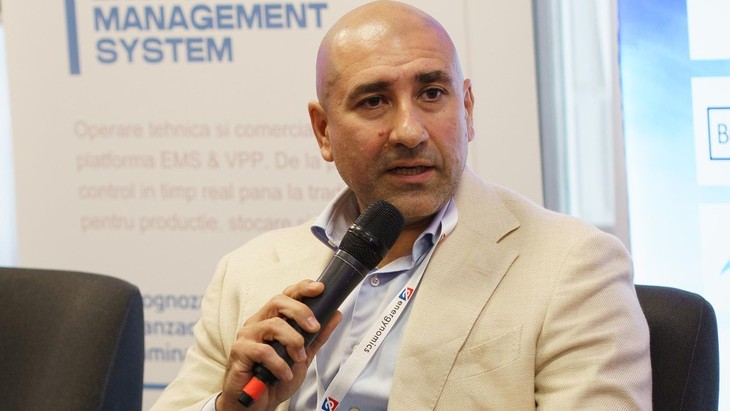
Romania’s battery storage market is at an early stage in which marginal revenues can be very high, but should not be confused with the sustainable average revenues of a BESS portfolio, said Nicolas Pleșea, Managing Director of Adrem Asset Management, at Romanian BESS on the Fast Track, a workshop organised by Energynomics.
Nicolas Pleșea, Managing Director of Adrem Asset Management, looks at the BESS market from an energy trader’s perspective: not through the maximum revenue a battery can produce in an exceptional month, but through average revenue, risk and the repeatability of results at portfolio level. “I think Romania is today a market where you can make a lot of money from opportunistic trades,” Pleșea said.
Based on its trading results, Adrem observed that in a single month the annualised figure would have pointed to about 358,000 euros per MW a year; just one month later, the same annualisation method pointed to below 150,000 euros per MW a year. At such levels an investor could recover the money in four or five years, he said, but that is not a story a bank will finance. Like the UK in its first years, Romania remains a market in which an important part of BESS value comes from monetising flexibility, including through ancillary services and the balancing markets.
Models the market contradicts
Adrem Asset Management approaches BESS first of all from the perspective of an energy trader. The company runs its own trading and risk management models at 15-minute resolution and tracks asset performance directly in the day-ahead, intraday and balancing markets. For Nicolas Pleșea, the value of a BESS does not come from a single spread or from the marginal performance of one battery, but from the ability to continuously manage a flexibility portfolio under different market conditions. “We are doing a lot of financial models only to be contradicted by the market the moment the BESS starts to be operational,” Pleșea said. “Definitely, this is a market for risk takers.”
Negative prices are visible, but for a BESS the more important economic problem is the amplitude and unpredictability of spreads. More dangerous, he argued, are prices close to zero and the scale of the swings. “We are talking about a high volatility, ranging from, let’s say, minus €100 to plus €1,000 in a matter of hours. Try to calculate this in a model,” he said.
Turning volatility into certainty is, in his words, a contradiction in terms. The only two certainties, he joked, are death and taxes.
Tolling and the price of certainty
Adrem’s answer is to combine active trading with a controlled transfer of risk. Tolling is one of the structures through which the company tries to turn part of a BESS’s volatile revenues into bankable cash flow. “We are trying to transform this volatility, slash high profits, into bankable cash flows, and we are offering tolling,” Pleșea said. The lack of tolling offers is, by his account, the gap most often mentioned in the market.
Negotiations become difficult because owners and investors also want to keep the upside. Banks assess first of all the creditworthiness of the counterparty that takes on the long-term payment obligation. For now, the advantage lies with international players with strong balance sheets, large trading limits and access to credit, which allows them to offer bankable tolling structures without a disproportionate level of guarantees.
Two hours, and not on your own
Adrem’s best results in Romania today come from a two-hour battery, Pleșea said, although he sees no single correct answer on duration: early markets reward speed, while mature ones need more hours for arbitrage and peak shaving.
Standalone storage suits utilities, traders, companies with a portfolio to balance and investment funds. For investors without their own energy portfolio or advanced trading and risk management capabilities, hybrid PV+BESS projects can offer a more robust risk profile than standalone merchant exposure, he argued.
He is also cautious about how much storage Romania can absorb, against the pipeline of around 10 GW at various stages of development. Bulgaria is already moving towards cannibalisation, and Adrem sees in its daily trades the effect of the capacity installed so far.
Romanian BESS on the Fast Track was organised by Energynomics, with the support of our partners: Elektra Renewable Support, ADEX Energy, Adrem Asset Management, BLU Capital, Dongfang Electric, Electroalfa, Enery, Enexus, Gotion, ING Bank, Marsh Romania, Softenerg WEBUS 4 ENERGY.