

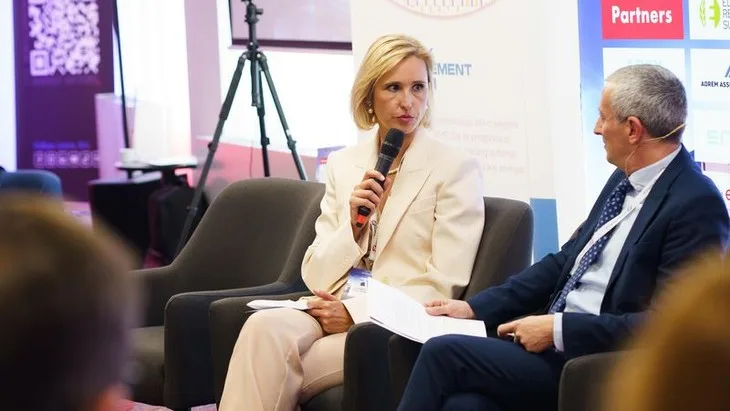
Stacking battery revenues does not mean adding up arbitrage, system services, balancing and the benefits of co-location, because the same energy and the same cycles cannot be sold twice, said Iulia Meiroșu, CFO and Board Member of Enexus Renewable Energy, at Romanian BESS on the Fast Track, a workshop organised by Energynomics. Each revenue source has to be modelled on its own, and the owner has to choose.
“You cannot sell the same energy, or the same state of charge, or the same capacity or the cycles in more markets than one. You have to choose,” Meiroșu said.
The choice is where the asset manager and the optimizer earn their role, she argued: they have to stay flexible, change strategy when needed and weigh revenues against battery degradation. For its two projects at Titu, which total 50 MWh of storage (Titu 1, completed and awaiting grid connection, and Titu 3, under development), Enexus models arbitrage first and system services second, with different assumptions for summer and winter. In summer, the battery mainly captures solar output that would otherwise be sold at negative prices or curtailed.
Early revenues will not last
Romania still has a flexibility deficit, but that does not make every project on the market profitable or bankable, Meiroșu said. More than 335 MWh of storage were added in August alone, and with the projects already announced the open room for flexibility will fill up quite soon, she said.
For investors, the pace is a warning: the revenues earned by early adopters will be compressed and cannot be carried into a 10 or 15-year financial model with the same assumptions. Bulgaria has been through the cycle already. Its batteries made excellent profits on Romanian imbalances this summer, an opportunity she expects to end as Romanian capacity comes online.
“Everybody cooks with the same water. So everybody will do more or less the same kind of moving and arbitrage,” Meiroșu said. She expects the gap between the daily peak and the lowest price, now as high as a thousand lei, to narrow within a few years, while midday prices could improve as batteries take energy out of supply.
Meiroșu believes operating data, not simulations, will make the difference. In 2024 Enexus delivered one of the first hybrid projects in Romania, in Gorj county, with 20.4 MW of solar and 2.5 MW of storage, and most of the projects the company has contracted for 2026 include batteries, either from day one or at a later stage.
From investment decision to operation
Enexus accompanies its investors from the investment decision through acquisition, construction, operation and energy trading. Many of them make their first energy investment in Romania through the company, she said.
Operational performance starts in design, Meiroșu argued. What counts for revenue is how the plant works in real life, not in simulations: how much downtime it has, how good the communications and the cybersecurity are, and how well the risks are covered by insurance.
Meiroșu believes the battery supplier has to be brought into the project from the development phase, not at the end. In the two Titu projects, Enexus uses an integrated LONGi ecosystem (solar modules, liquid-cooled BESS and medium-voltage equipment), so that responsibility for performance does not get lost between several suppliers. For financiers, she argued, this removes a significant part of the operational risk.
How much revenue should be contracted depends on where the capital comes from. First movers put their own capital at risk and could go fully merchant, without contracted revenues. A project with bank debt needs enough certain income to pay the instalment even in a bad winter month, and the figure changes with the level of leverage.
Enexus has also started to invest its own capital in solar projects with storage, on its own or in partnership. Moving from builder to owner changes the perspective, Meiroșu believes: the question is no longer how big the battery should be, but what risk the owner wants to manage and what value the owner wants to get out of it.
Romanian BESS on the Fast Track was organised by Energynomics, with the support of our partners: Elektra Renewable Support, ADEX Energy, Adrem Asset Management, BLU Capital, Dongfang Electric, Electroalfa, Enery, Enexus, Gotion, ING Bank, Marsh Romania, Softenerg WEBUS 4 ENERGY.