

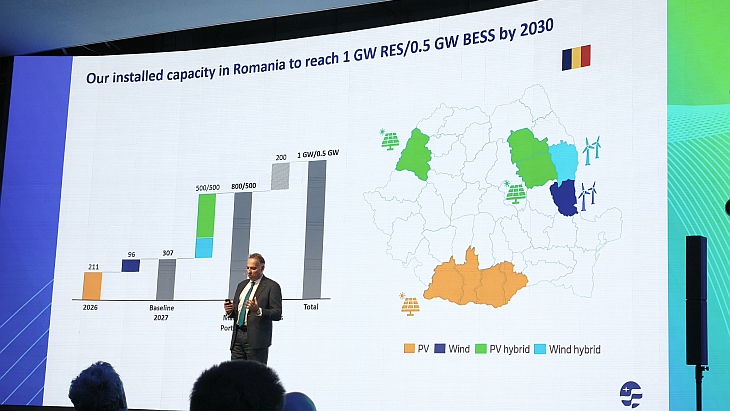
The Greek energy group has formally launched HELLENiQ Renewables Romania, confirming plans to develop 1 GW of renewable generation and at least 500 MW of battery storage capacity by 2030. Romania is expected to attract 60% of the group’s regional power investments over the coming years. Company executives also described the grid constraints already affecting operating solar parks and explained why batteries are becoming an integral part of new projects.
HELLENiQ ENERGY officially presented HELLENiQ Renewables Romania on 9 November, after approximately three years of developing its local operations. The group has already invested around 400 million euros in Romania and plans investments exceeding 1 billion euros by the end of the decade, making the country its most important renewable energy growth market outside Greece.
Speaking at the launch, George Alexopoulos, Deputy CEO of HELLENiQ ENERGY, outlined the scale of Romania’s role in the group’s transformation into an integrated regional electricity and natural gas supplier.
“By 2030, 40% of our capacity will be in Romania,” he said, adding that Romania would account for more than half of the group’s combined renewable generation and battery capacity. Approximately one-third of its electricity production and 60% of its planned investment between 2027 and 2030 are also expected to be concentrated in Romania.
The strategy reflects both the potential for electricity demand growth and the relatively favourable development conditions compared with more mature renewable markets, particularly Greece. According to company executives, Romania offers a more predictable project development process, a substantial industrial customer base and opportunities for further renewable capacity before grid congestion becomes as severe as in some neighbouring markets.
From 211 MW of solar to a diversified generation portfolio
HELLENiQ Renewables Romania currently operates four photovoltaic parks with a combined capacity of 211 MW, developed under an agreement signed with METLEN in 2023. According to the company, their annual generation is equivalent to the electricity consumption of more than 155,000 households.
The operational portfolio has expanded rapidly during 2026. In October, the group reported 180 MW of operating capacity, following the commissioning of projects in Teleorman, Olt, Giurgiu and Dolj counties. The latest announcement indicates that the full 211 MW portfolio is now operational.
The next projects will add wind generation to the existing solar capacity. A 96 MW wind farm in Galați County is scheduled to enter operation in the second quarter of 2027, followed by a 186 MW hybrid wind project in Vaslui County, currently planned for the second quarter of 2029.
The Galați project also illustrates the group’s approach to commercialising renewable electricity. More than half of its expected output is already covered by a virtual power purchase agreement (PPA) with international retailer Ahold Delhaize, according to information previously published by HELLENiQ ENERGY.
The company’s longer-term objective is to reach approximately 1 GW of renewable generation and 500 MW of battery storage power capacity in Romania by 2030.
Grid reinforcements can limit production even after commissioning
Despite the favourable assessment of Romania’s development environment, HELLENiQ executives identified permitting and grid connection as significant challenges.
During a discussion before the presentation, company representatives revealed that two of their recently completed photovoltaic projects had initially been unable to inject electricity into the grid at their full installed capacity.
The plants began operating at reduced injection levels while additional network reinforcement works were being completed. Some of the reinforcement requirements and associated difficulties had not been fully anticipated at the beginning of the investment process.
The experience highlights an important distinction for renewable developers: obtaining grid connection terms and completing the generating facility do not necessarily guarantee the immediate ability to deliver electricity at maximum capacity.
Reinforcement works may increase investment costs, affect project schedules and reduce revenue during the initial operating period. HELLENiQ representatives indicated that similar constraints could arise in upcoming developments, including the wind projects.
The company considers Romania’s permitting process more predictable than Greece’s, but grid reinforcement remains a technical and financial risk that developers need to incorporate into project planning.
Batteries become part of the investment model
Energy storage is central to HELLENiQ’s response to these challenges and to the changing commercial conditions for renewable generation.
The group is planning at least 500 MW / 1,500 MWh of battery storage capacity in Romania. Its future renewable projects are being designed with storage, while the company is also evaluating the addition of batteries to existing photovoltaic parks.
Executives described hybrid solar projects incorporating approximately four hours of storage and wind projects with around two hours of on-site storage, depending on project characteristics.
The option of retrofitting existing solar assets is particularly relevant. HELLENiQ’s current 211 MW photovoltaic portfolio was developed without integrated batteries. The company is now assessing whether storage could improve its operating profile and commercial performance.
In an announcement published in October, HELLENiQ identified a potential 170 MW / 680 MWh battery investment associated with its existing photovoltaic assets. Mihai Darie, Country Manager of HELLENiQ Renewables Romania, also explained that hybrid configurations had already helped the company obtain more favourable grid connection conditions in certain cases.
The commercial reasoning extends beyond grid access. As photovoltaic capacity increases, more electricity enters the market during the same daylight hours, putting downward pressure on prices and increasing the risk of curtailment.
Batteries allow part of that production to be shifted to periods when electricity is more valuable, reducing exposure to low daytime prices and improving the ability to manage the generation profile.
The experience of Greece provides a warning. According to HELLENiQ executives, the much higher penetration of photovoltaics has already resulted in substantial curtailment and frequent periods of very low or negative wholesale electricity prices.
Romania has so far experienced relatively limited curtailment, but the company expects the risks to increase as renewable capacity expands. Storage can mitigate some of these effects, although it cannot replace the network reinforcements necessary to accommodate additional generation.
From development portfolios to projects that can deliver
HELLENiQ’s approach also reflects a broader change in how renewable investment opportunities are assessed.
Company executives argued that the nominal size of a development pipeline is less important than the maturity of the projects, the availability of grid connections, the ability to finance and construct the assets, and the arrangements for selling the electricity.
They contrasted Romania with Greece, where the combined volume of permitted renewable projects substantially exceeds the capacity likely to be built. In Romania, HELLENiQ says its mature project portfolio consists of operating, under-construction and ready-to-build assets, rather than predominantly early-stage development opportunities.
For the Romanian market, the group’s expansion illustrates two parallel developments. International investors continue to see substantial opportunities for renewable generation and energy storage, but the conditions for successful investment are becoming more demanding.
Installed megawatts remain an important measure of progress. Increasingly, however, the decisive factors will be how much electricity projects can actually inject into the network, when they can deliver it, and under what commercial conditions they can sell it.