

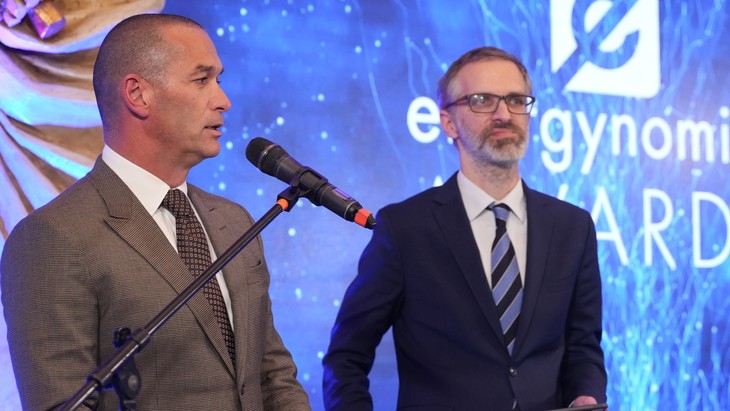
Those who invest in and finance Romania’s energy sector need data that can be checked, including where official plans look too optimistic. That is the purpose of the second edition of REMARC, the Romanian Energy Market Annual Report by CIGA Energy, launched at Energynomics Awards 2026, organised by Energynomics in Bucharest on 25 November.
“A report that only repeats published plans is of little use to those who have to invest against them,” said Zoltan Nagy-Bege, Managing Partner at CIGA Energy Advisory. The report does not tell readers what to think: it puts the data on the table, says when figures are contested and says when official timelines look optimistic against the evidence.
Data for investment decisions
CIGA has again prepared the report with the Hellenic Association for Energy Economics (HAEE), with BCR as a partner for the second year in a row. One year after the first edition, the company intends to make REMARC an annual tradition.
Konstantinos Sfetsioris, representative of HAEE, said the aim is to give investors, banks and policymakers verified and transparent data, something that is not so obvious in an era of artificial intelligence. The association, founded in Athens in 2015, works as an independent, non-partisan knowledge hub linking research, business strategy and policy.
The partnership also places Romania in a regional picture. “As Europe phases out Russian pipeline gas, Southeast Europe is becoming a single integrated energy corridor,” Sfetsioris said. The HAEE representative expects the ramp-up of Neptun Deep to turn Romania into a major net gas exporter by 2030, while the Vertical Gas Corridor is set to nearly triple its transfer capacity, carrying Greek LNG north towards Romania, Central Europe and Ukraine.
A system being tested
The new edition also records a change of context. “If last year’s report described a system preparing for change, this year’s describes a system being tested,” Nagy-Bege said. In the summer of 2026, low water on the Danube took both Cernavoda units out of service, and hydro output fell for the second year in a row.
According to Sfetsioris, evening peak prices rose above 250 euros per MWh. Rapid solar growth has also doubled the number of negative price intervals. Greece is seeing the same dynamic, with record curtailments and zero prices that have made storage a top priority.
Romania keeps one of the lowest energy import dependencies in the European Union, at 30%, but Sfetsioris argued that domestic assets are only half the equation and that security of supply also needs diversification and system resilience. “So for both our markets, the lesson is clear. We need faster grid modernization and utility scale battery storage,” the HAEE representative said.
The gap between plans and delivery
This year’s special chapter is devoted to nuclear energy. “The distance between plans and delivery is the widest, and the decisions of the next few years will matter for decades,” Nagy-Bege said about this part of the system.
The execution problem goes beyond nuclear. Grid connection agreements in Romania now exceed 50 GW, more than twice the installed capacity, according to Nagy-Bege, while battery storage has grown from under 150 MW at the start of 2025 to more than 1 GW. “What decides the outcome now is delivery, permits, grid works, and projects completed on time and at predictable cost,” the CIGA representative said.
Sfetsioris reached the same conclusion from a different indicator, an 86 GW pipeline of renewable connection permits, and warned that capacity on paper differs greatly from commissioned assets. “Capital is not the bottleneck here. Project execution is,” Sfetsioris added. The issue grows more pressing as the region retires coal and takes older baseload units offline for long refurbishment.
For investors and banks, the test is therefore which projects can move from documents to operation, and on what timeline. Nagy-Bege invited the market to use the new edition critically: “Take REMARC, read it, challenge it and use it.”
Energynomics Awards 2026 was organised by Energynomics, with the support of our partners: Elektra Renewable Support, 4P Renewables, ABB, Alive Capital, BCR, Capalo AI, CBRE, Colliers, Distribuție Oltenia, Dunext, Eastship, Electroalfa, Elnos, EnergoBit, Electrica Furnizare, Enery, Energopower, Enerta, Enexus, ENEVO Group, Enson, European Energy, Eurowind, Exim Banca Românească, Global Technical Systems, Hagag Energy, Hidroelectrica, ING, KSTAR, Marsh, Monsson, MBK Power Energy, MyEnerji, Nofar Energy, OX2, Petroconst (Parapet), RENOMIA Gallagher, Scatec, Schraubram, Sigenergy, SSG Group, Taliva BV, Think Blu Solution, Transelectrica, WALDEVAR Energy, WTW, Aqua Carpatica, Artesana, Domeniile Sâmburești, Editions de Parfums Frédéric Malle, Imsol, Kilian. Mobility Partner Sixt.