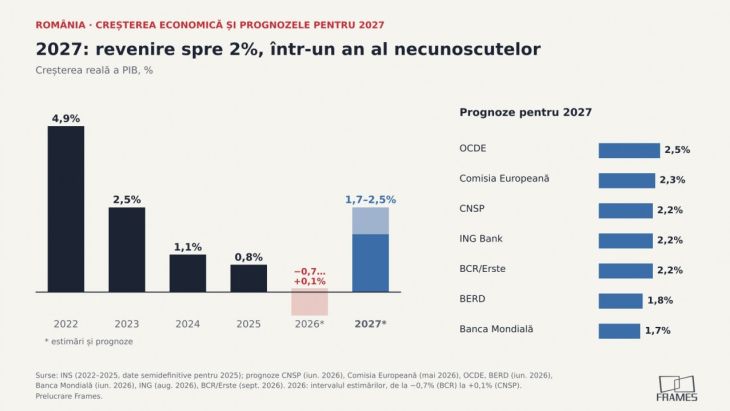
New statistical data released by the National Institute of Statistics (INS) regarding key economic sectors reveals Romania’s standing in the autumn of 2026. Construction activity is at a multi-year high. The services sector has stagnated. Industry is experiencing its longest slump of the past decade. Forecasts for 2027 point to a rebound in economic growth toward 2%. However, according to an analysis by Frames, the quality of this growth hinges on a fact clearly illustrated by the figures: Romania can no longer move forward relying solely on European funds poured into concrete.
2025: The year the engine began to seize up
Data published today by the INS shows that GDP grew by 0.8% in real terms last year—slightly above the provisional estimate of 0.7%. In nominal terms, the economy reached 1,929.9 billion lei, exceeding initial calculations by 13.5 billion. Yet, this upward revision does not alter the overall trend. It marks the third consecutive year of slowdown—following growth rates of 4.9% in 2022, 2.5% in 2023, and 1.1% in 2024—with last year’s pace being the weakest since 2020.
The most significant insight from the new data is just how concentrated that growth was. The construction sector alone contributed 0.7 percentage points of the total 0.8% growth, driven by a 6.9% increase in activity volume. At the same time, its share of GDP was revised from 8.6% to 10.7%, meaning the sector now accounts for nearly two-thirds the size of the industrial sector. Other sectors showing growth included IT&C, with a 4.3% rise and a 0.3-point contribution, and agriculture, with 6.9% growth and a 0.2-point contribution.
The rest of the economy stagnated or contracted: the industrial sector, which generates 16.7% of GDP, fell by 0.1% and made no contribution to growth. Trade, transport, and the hospitality sector (HoReCa) declined by 0.4%. Professional, technical, and administrative services fell by 4.1%, dragging GDP down by 0.3 points.
On the demand side, investment was the primary driver. Gross fixed capital formation rose by 3.6%, contributing 0.9 percentage points. Household consumption expenditure increased by only 0.5%, while net exports reduced GDP by 0.4 points, as imports (+4.5%) grew faster than exports (+4.2%).
“2025 was the warning we failed to take seriously. Essentially, all economic growth came from construction. Industry contributed nothing, consumption barely budged, and foreign trade came at a cost. When a single sector—largely supported by public and European funds—generates almost all the growth, the economy is vulnerable. By 2026, that same model had reached its limit,” says Adrian Negrescu, manager at Frames.
What the 2026 data shows
Real industrial value added fell to approximately 74% of 2019 levels in the second quarter of 2026. In other words, the industrial sector is generating about a quarter less value than it did before the pandemic. Production output reported by companies declined less sharply, dropping by around 14%. This discrepancy suggests that firms are still producing volume but earning less from it, squeezed by energy, labor, and financing costs. In the first seven months of 2026, industrial output fell by 3.7%, while manufacturing output dropped by 4.8%; the energy sector was the only segment to record growth.
At the other end of the spectrum, construction activity stands roughly 60% above 2019 levels, with the sector’s value added up by nearly 30%. In the first half of the year, the construction sector grew by 12.3%—nearly double the pace seen in 2025—and remained the largest positive contributor to GDP. Private services, the economy’s largest sector, saw strong growth between 2020 and 2023 before stalling and beginning a slight decline. Trade, transport, and the hospitality sector (HoReCa)—already in negative territory in 2025—contracted by 3.9% in the first half of the year, driven by a VAT hike and declining purchasing power.
The result is an economy that stagnated in the second quarter and contracted by 0.7% over the first half of the year. It was kept afloat by the same engine as in 2025: investment—up by 10.9%—funded largely by European funds. Household consumption, which had barely grown the previous year, fell by 2.5%.
“We have an economy running on a single engine. Construction projects funded by the NRRP and cohesion funds have kept GDP afloat for two consecutive years. But a country cannot develop sustainably if its industrial sector loses a quarter of its value in seven years. Every factory that closes means lost exports, a wider trade deficit, and fewer well-paid jobs in regions that already have few alternatives,” says Adrian Negrescu.
Outlook for 2027
Almost all macroeconomic forecasts, including those by Frames, predict a recovery in 2027, with estimates ranging from 1.7% to 2.5%. For the current year, these same institutions anticipate stagnation or a slight contraction. The IMF and European Commission autumn forecasts, due in October and November, will reveal whether this optimism for 2027 holds up.
Growth of around 2% would break the four-year streak of slowdown and stagnation, yet it would remain half the pace seen prior to 2020. The difference between 1.7% and 2.5% depends almost entirely on four factors. First driver: investments, with a shift in funding sources
The NRRP (National Recovery and Resilience Plan) concludes on August 31, 2026, with Romania still due to receive approximately €7.5 billion under the plan. Investments will not come to a sudden halt, as payments for completed projects will continue. However, the primary role shifts to the 2021–2027 cohesion funds, which can be spent through 2029. The National Commission for Strategy and Prognosis projects average annual investment growth of 2.7% for the 2027–2029 period—a rate below that of 2025 and well below this year’s level. The construction sector will remain in positive territory but will no longer be able to single-handedly drive the entire economy, as it has done over the past two years.
Second driver: defense, a real opportunity for industry
Romania has access to €16.7 billion in SAFE loans for defense—the second-largest allocation in the EU—with the first tranche of €2.5 billion already received in August. Contracts for helicopters, Piranha armored vehicles, radars, and drones include industrial cooperation requirements. This marks the first major program in recent years capable of bringing orders directly to Romanian manufacturing plants, rather than just to construction sites. “SAFE could be for industry what the NRRP was for construction, but only if the state seriously negotiates for local production. If the funds are spent entirely on imported equipment, the impact on GDP will be minimal, and the trade deficit will widen. If a portion translates into production lines, Romanian suppliers integrated into European supply chains, and jobs, then we can speak of genuine reindustrialization,” says Adrian Negrescu.
The third driver: cheaper energy
The first gas extraction from the Neptun Deep field is scheduled for 2027. The project is expected to double domestic gas production and make Romania the largest producer in the EU. For the industrial sector—which has lost competitiveness precisely due to energy costs—this could be the most significant structural development of the decade. The impact on utility bills will be gradual, but the signal sent to investors matters as early as 2027.
The fourth driver: the recovery of consumption
Inflation dropped from over 10% in June to 6.17% in August as the impact of VAT, excise duty, and energy price hikes fell out of the calculation. The National Bank of Romania (NBR) projects that inflation will return to the target range by the end of 2027. This implies that real wage growth could turn positive again, while the key interest rate—held at 6.5% since August 2024—has room to decrease. Cheaper credit and recovering purchasing power would restore consumption as a growth driver, directly benefiting the retail and services sectors—areas currently in negative territory for both 2025 and 2026.
What could derail the scenario
The risks are well known: political instability, pressure on the exchange rate and credit ratings, ongoing fiscal consolidation into 2027, a sluggish Eurozone, and potential loss of PNRR (Recovery and Resilience Plan) funds due to unmet milestones. Entrepreneurs confirm these concerns.
In a recent study of 300 companies with revenues between €1 million and €50 million, 44% of managers cited fiscal and legislative instability as their primary concern, while 40% pointed to tax increases. On the other hand, half of them anticipate higher revenues in 2027, and 36% plan to invest in equipment and production capacity.
Do we stand a chance of economic recovery in 2027?
According to analysts at Frames, economic growth of 2–2.5% in 2027 is realistic, while exceeding 3% is possible only under specific conditions.
Data from the last two years reveals the limitations of the current model: growth driven almost entirely by construction cannot surpass 1% when industry, trade, and consumption are stagnating. The deciding factor is not European funding—which arrives regardless—but rather fiscal predictability and a committed industrial policy; this entails cheaper energy, local orders stemming from defense programs, and genuine dialogue with the business community prior to any tax changes.
“The figures from the past two years are, in fact, a wake-up call. Construction has saved us, but we cannot build indefinitely without producing anything. If we fail to halt the industrial decline by 2027, growth will be fragile and dependent on external funds, which are set to decrease significantly after 2029. We currently have—perhaps for the last time—a window where SAFE, cohesion funds, and Black Sea gas resources overlap. It is time for the government, regardless of its composition, to place industry at the heart of its economic strategy,” concludes Adrian Negrescu.
Frames is an economic think tank specializing in the development of analyses and market studies regarding the economy. Over its more than 25 years of operation, Frames has become a key player in the Romanian business analysis sector; its analyses, aimed at investors and the general public, offer a concrete perspective on business dynamics at both local and international levels.