

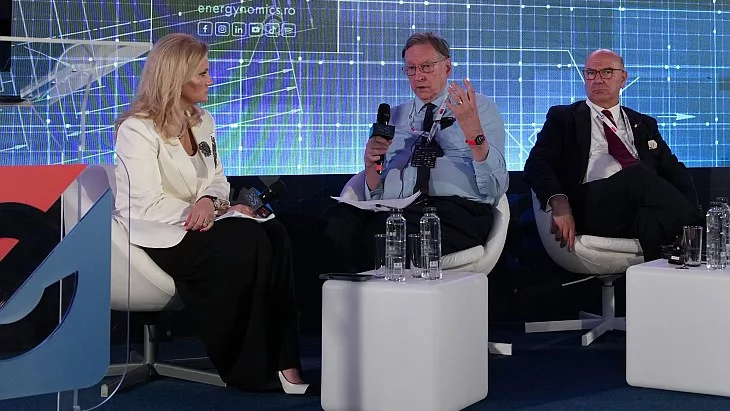
The closure of the Strait of Hormuz is forcing Europe to rethink its energy supply from the ground up. John M. Roberts, energy security specialist at Methinks Ltd, sees the crisis as a brutal accelerator of a transformation already underway.
“If in 2021 you had said that within two- or three-years Europe would have no Russian pipeline gas whatsoever, people would have looked at you in amazement. We are adapting much faster than we think.”
At Energy Strategy Summit 2026, organized by Energynomics, Roberts pointed out that most European countries already operate within an interconnected energy system under the EU umbrella and that this integration is precisely what allows the continent to absorb shocks. When Romanian Black Sea gas comes online, it will not merely balance Romania’s own energy needs, but will cover regional demand across southeastern Europe.
As the Gulf becomes increasingly unpredictable, attention shifts to the Black Sea. Roberts explicitly identifies the Neptune project (Romania) and Sakarya (Turkey) as genuinely significant production sources for the coming decade. Bulgaria could yet add a discovery of its own, while Norway is actively pushing new investment in the Barents Sea to keep output at elevated levels.
Northern and western Europe, however, have no new answers. The North Sea, whether British, Danish, or Norwegian in its traditional sectors, no longer holds significant new production potential. The real stakes lie on the eastern and northern periphery of the continent.
Then there is the long-term contracts paradox: Europe has operated in recent years on the assumption that the free market alone is sufficient. Norway, for instance, has sold its gas without long-term contracts and managed perfectly well. But that model does not work for peripheral producers. Azerbaijan, for example, is reluctant to invest in new production precisely because it has no guarantee that the European market will absorb its gas throughout the 2030s, when demand will likely begin to decline.
The solution Roberts proposes is not a simple one: energy distributed as locally as possible, yet backed by a continent-wide integrated grid. Two principles that appear to contradict each other but which together build the resilience Europe needs now more than ever.
Energy Strategy Summit 2026 is organised by Energynomics, with the support of our partners: Elektra Renewable Support, 4P Renewables, ABB, Alive Capital, Atmoce, Baringa, BCR, Big Store, Capalo AI, CBRE Romania, Distribuție Energie Electrică România, Eastship, Distributie Oltenia parte din Evryo, Eaton Electric, Electrica Furnizare, Electroalfa, Electroprecizia, EnergoBit, Enery, Enexus, Eurowind, Evryo, Exim Banca Romaneasca, Hagag Energy, KStar, LONGi, MBK Power Energy, MET Romania Energy, Monsson Trading, Nextpower, OX2, Romgaz, Schraubram, Sigenergy, Softenerg WEBUS 4 ENERGY, Solar Today, Sunotec, TBEA, Think Blu Solution, Transelectrica, Waldevar Energy, WTW Romania. Coffee Break Partner Enerta. Lanyard Partner Monsson Operation. Beverage Partners Aqua Carpatica, Alexandrion. Digital Partner Imsol. Mobility Partner BlackCab.