

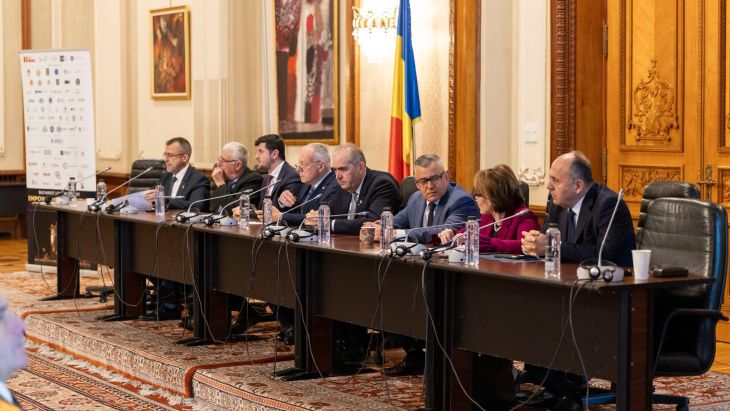
Romania has a unique opportunity-through the Neptun Deep project-to become an indispensable player in the region, including by serving as a provider of energy security. However, it must identify a way to generate added value from the natural gas that will be extracted from the Black Sea, stated Antal Istvan-Lorant, Chairman of the Senate Committee for Energy, Energy Infrastructure, and Mineral Resources, on Wednesday at the IRE 100 anniversary gala.
“The challenge: Neptun Deep produces natural gas. We are set to become the largest producer in Europe. We have a unique chance to become indispensable players in the region-effectively acting as providers of energy security for the entire region-but we must find a way to generate added value from this Romanian natural gas. The next challenge concerns the railway system. When it comes to railway electrification, Romania is lagging behind. According to CFR [the national railway operator], the rail network is about 40% electrified, while Eurostat puts the figure at 20%. I will stick with the 40% figure, but even so, that still represents a gap of about 30% compared to the European average. What does this mean in terms of consumption? Currently, the electrified portion of the railway network accounts for roughly 1% of Romania’s annual electricity consumption. There is significant potential to reach 5-7% of national consumption if we electrify the railways. We want to connect the Black Sea to the European Union. Today, a train…” “…freight takes between 7 and 12 days to reach the Hungarian border. A semi-truck-a lorry-takes, at most, one day,” stated Antal.
In the senator’s view, not only Romania but all of Europe faces a major challenge in the energy sector.
“We essentially have significant potential to once again become an extremely important player for the entire region. But what do we need? Unity in our external approach, perseverance, and shared objectives. I believe we have reached a point where not just Romania, but all of Europe, faces a major energy-related challenge: whether we will have the strength to reinvent ourselves and become a unified European economy that truly carries weight. And, naturally, in the economic sphere-specifically within the industrial sector-energy is indispensable. The entire economy is built upon energy,” he explained.
Antal Istvan-Lorant emphasized that a healthy economy is reflected in its energy consumption, particularly its industrial energy consumption.
“I often say that a healthy economy is mirrored by its energy consumption. Where there is industrial consumption, there is a healthy economy. We face substantial challenges in this regard, but I believe our national energy system functions well. However, we must have the strength to form alliances with other states in the region and, if necessary, approach the European Commission with the message that-ultimately-if we succeed in reinventing ourselves as a Union, we stand a chance on the global stage,” he conveyed.
The senator also touched upon the evolution of the Romanian energy sector, noting that we are, in effect, experiencing the peak of the energy transition. “In 1938-though this is not an official figure-it is said that Romania’s consumption was 1.1 terawatt-hours (TWh), and by 1950, it had reached 2.11 TWh. In 1950, the electrification plan for Romania was launched through the IRE (Institute for Energy Research/Electrification). Between 1950 and 1960, the National Energy System was effectively established. By 1970, consumption reached 35.09 TWh. A critical moment occurred in 1977 with a national blackout-an event the press did not cover, overshadowed by the tragedy of the earthquake that also struck in March 1977. This blackout made it clear that the system needed to be rethought and that greater preparedness-achieved through investment-was essential. Consumption reached 67.5 TWh in 1980 and peaked historically at 75.85 TWh in 1989. By 2000, it hit a post-1989 low of 43 TWh; in 2005, it was 50 TWh; and since 2005, consumption has remained in the 50-55 TWh range. Now, let’s turn to the challenges. We are currently living through the era-and the peak-of the energy transition. What does this energy transition entail? The Green Deal. The Green Deal means phasing out conventional fossil-fuel-based assets and replacing them with renewable alternatives. Ultimately, we are not opposed to the energy transition; however, we maintain that it must be fair, coherent, and logical-because, at the end of the day, the entire European Union requires cheaper energy to sustain a competitive economy,” stated Antal.