

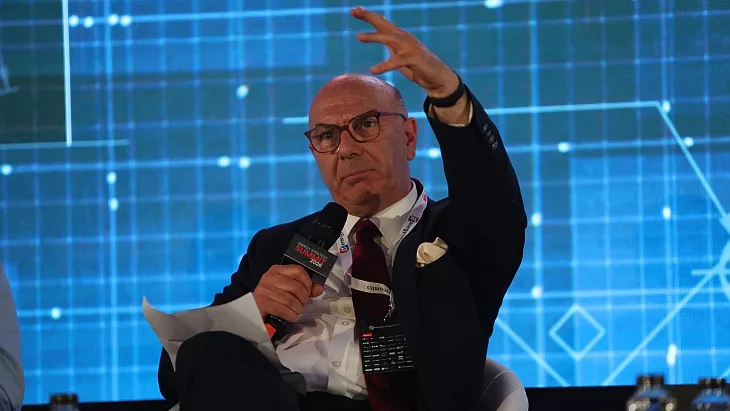
Private companies in the energy and infrastructure sectors face a set of national security obligations that most overlook in their day-to-day planning. The warning comes from Bernard Siman, Senior Associate Fellow at the Egmont Institute in Brussels, who urged chief executives to look beyond daily operations and understand what Article 3 of the NATO Treaty specifically requires of them.
“Resilience is not a bolt-on. It has to become part of the ordinary budgeting and operations of any business. A drone does not make a distinction between a private facility and a public facility”, Siman stated, at the Energy Strategy Summit 2026, organized by Energynomics.
Unlike Article 5 (the collective defense clause more familiar to the general public) Article 3 of the Washington Treaty obligates each ally to maintain and develop its individual capacity to resist armed attack. Of the seven baseline requirements agreed at the 2016 NATO Warsaw Summit, two are directly relevant to the energy and infrastructure sector: continuous energy availability with backup plans to manage disruptions, and transportation infrastructure capable of supporting military mobilization.
Siman stressed that if a facility is struck by a drone, operational continuity is no longer merely a responsibility toward shareholders, but it becomes a national security obligation.
Siman warned that foreign information manipulation and interference, known in EU terminology as FIMI, is already affecting companies’ ability to obtain permits, maintain public support for projects and avoid prolonged legal challenges or political blockages.
“We have moved from the risk zone to that of real threats,” he said, adding that the issue no longer belongs exclusively to national security institutions but is a concrete operational problem for any company building infrastructure.
His third warning addressed companies’ internal security structures. In most organizations, physical security, cybersecurity and site security are managed separately, along distinct reporting lines, a model Siman considers inadequate for the current environment. His proposed solution is to unify all three under a single management line, with a board-level director explicitly responsible for security as a whole.
“Cybersecurity is no longer a matter for the IT department. It is about business continuity, crisis management and human-centric security. One negligent engineer with their password and your entire system is compromised”, Siman said.
Closing his remarks with an assessment of military tensions in the Gulf, Siman warned that the current situation represents an escalation trap. US naval forces, two and a half carrier groups and approximately 10,000 amphibious troops, cannot remain indefinitely on battle-ready status, implying an imminent decision point.
Beyond the direct impact on oil and liquefied natural gas prices, Siman drew attention to less visible consequences: sharply higher fertilizer costs with severe inflationary effects across Africa, regional currency depreciation and potential migratory pressure toward Europe. He also flagged disruption to helium supplies from Qatar, a critical raw material for semiconductor manufacturing.
“My concern is that the secondary and tertiary consequences of this conflict, both geopolitical and economic, may not be confined to west of Iran but could extend toward Central Asia and the South Caucasus,” Siman concluded.
Energy Strategy Summit 2026 is organised by Energynomics, with the support of our partners: Elektra Renewable Support, 4P Renewables, ABB, Alive Capital, Atmoce, Baringa, BCR, Big Store, Capalo AI, CBRE Romania, Distribuție Energie Electrică România, Eastship, Distributie Oltenia parte din Evryo, Eaton Electric, Electrica Furnizare, Electroalfa, Electroprecizia, EnergoBit, Enery, Enexus, Eurowind, Evryo, Exim Banca Romaneasca, Hagag Energy, KStar, LONGi, MBK Power Energy, MET Romania Energy, Monsson Trading, Nextpower, OX2, Romgaz, Schraubram, Sigenergy, Softenerg WEBUS 4 ENERGY, Solar Today, Sunotec, TBEA, Think Blu Solution, Transelectrica, Waldevar Energy, WTW Romania. Coffee Break Partner Enerta. Lanyard Partner Monsson Operation. Beverage Partners Aqua Carpatica, Alexandrion. Digital Partner Imsol. Mobility Partner BlackCab.