

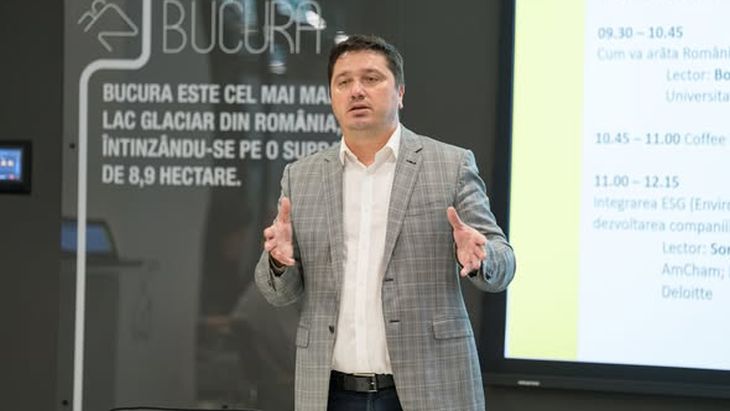
Infrastructure should become a priority; our aim for future funding programs is to shift the focus slightly away from financing renewable energy sources and instead direct the majority of support toward infrastructure, stated Sorin Elisei, Secretary General at the Ministry of Energy, on Thursday.
“I believe that, specifically regarding grid infrastructure-distribution and transmission-around two billion euros have been committed through the Modernization Fund. To my knowledge, the projects submitted to the Fund by distribution system operators also included components for digitalization and cybersecurity. Moving forward-and particularly as a priority for the next funding period, 2028-2034-our goal is to shift the focus slightly away from financing renewable energy sources and direct the bulk of support toward infrastructure. And when we speak of infrastructure, we aren’t just referring to power lines or facility upgrades; we are also talking about digitalization-which must include a cybersecurity component. This is the policy that the Ministry of Energy has been promoting thus far. We reviewed a sectoral analysis prepared by consultants for the 2028-2034 Cohesion policy, which-once again-allocated hundreds of millions, or perhaps even billions, of euros toward solar panels; we argued that the underlying logic needs to change. Infrastructure should become a priority,” Elisei said at the Cybersecurity in Energy Forum. He added that, as a secondary measure, one proposal would be to make compliance with security standards an eligibility criterion for any energy-related projects.
“Furthermore, in our discussions-not only with the Ministry of Investments and European Projects (MIPE) but also with other ministries-we would propose that meeting specific security standards become an eligibility criterion for any future energy-related financing. Additionally, the costs incurred in implementing such security solutions should be recognized as eligible expenses,” said Sorin Elisei.
In his view, given the projected capacity set to be installed, directing hundreds of millions of euros toward new generation sources is no longer justified. This does not mean halting funding, but rather prioritizing the allocation of capital toward infrastructure.
“At this moment-looking at the projected capacity to be installed, the initiatives currently being launched under the ‘Green Transition,’ the more than 10 gigawatts of solar photovoltaic capacity, the planned wind capacity, and the new battery storage capacity-and considering our projected electricity consumption from 2028 onwards, I do not believe it makes sense to direct hundreds of millions or billions of euros more toward new generation sources. This does not mean that funding is being cut off; rather, it means that the priority-the primary allocation of funds and the largest share of investment-must be directed toward infrastructure,” the official from the Ministry of Energy explained. On the other hand, regarding emergency situations, he emphasized that Romania has a regulatory framework that was introduced in August.
“Romania has a regulatory framework-an emergency preparedness plan-that was introduced in August of last year. It served, in fact, as a precursor to the Government Decision regarding the implementation of safety measures by the transmission and system operator. This plan, which underwent various rounds of discussion for at least a year, identifies cybersecurity and related incidents as one of the top three risks. In principle, the initial response within the first 60 minutes is handled by Transelectrica, in coordination with the security team of the affected asset. Detailed procedures are in place, and to my knowledge, exercises have been-or are beginning to be-conducted, including at the county level. Therefore, in the event of an emergency affecting the system, there is a regulatory framework in place that dictates how to respond. The Ministry plays a coordinating role-through an operational council-regarding information management and decision-making, particularly when it comes to establishing priorities for restoring power supply to specific types of consumers; hospitals and critical infrastructure are, naturally, among the assets prioritized for restoration.” “The Ministry of Energy must carry this out through that operational council-an operational council which, in fact, consists not only of representatives from the Ministry, but also from the transmission and system operator (TSO), distribution system operators, and producers that qualify as ‘national critical infrastructures’ (NCIs),” Elisei further stated.