

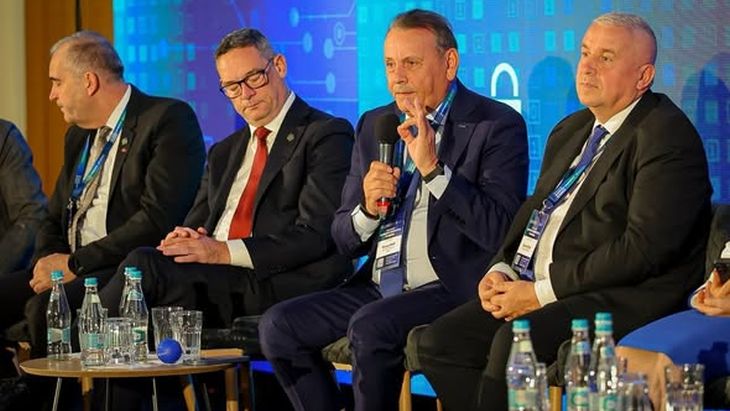
The situation at this moment is not among the best, and all stakeholders must get involved to find solutions to get through this winter, stated Mircea Man, Secretary General of the National Energy Regulatory Authority (ANRE), on Thursday.
“There has been a lot of debate lately, and looking at the daily data, energy prices in Romania are the highest. I would say that the situation right now is not among the best. Leaving aside issues regarding Cernavodă or lower renewable energy production-which is expected during the winter-it is clear that all relevant stakeholders-the Ministry of Energy, grid operators, suppliers, and ANRE-must work together to find solutions to get us through this winter,” Man said at the Cybersecurity in Energy Forum.
He emphasized that it is not the political sphere that sets tariffs; rather, ANRE follows a very clear methodology. This framework includes criteria established by experts, as well as a specific formula. Each operator submits their data to the authority, and based on the methodology approved last year, tariffs are determined for each individual operator. “I said it last year, and I’m saying it again now. It has never been the case that we couldn’t find solutions for cybersecurity investments when discussing matters with an operator-within the limits of what is feasible. We started with a rate of return of 6.94%-even though the operators wanted double that-but the methodology itself dictates that we strike a balance. (…) If today we-the Ministry of Energy, ANRE, and the operators-are to talk about anything, it must be ‘investments, investments, investments’ in infrastructure; that is the only viable solution for Romania. The bottom line is that we are open to this; we have received requests from the Romanian Parliament, and I understand that there is legislation in the works that will bring about changes in this regard,” the ANRE official explained.
He added that every request submitted by the operators is discussed, and if the arguments are sound, tariff adjustments are made.
On the other hand, Mircea Man pointed out that while Romania’s power generation capacity stood at 14,000 megawatts before 1990, it is currently at 7,000 megawatts; furthermore, during evening hours, the country imports more than 40% of its electricity-a fact that speaks volumes about the health of the Romanian economy. “We can all see this. The fact that ANRE has received over 600 applications for new production capacities does not mean that every entity obtaining an establishment authorization will go on to secure an operating license. We have over 400,000 prosumers, yet only 113,000 have storage capabilities. These are issues that all of us-those in positions of responsibility-must address to find solutions, rather than looking for someone to blame. It is simply unacceptable to have a price of 5 euros at midday and 520 euros at 7:00 PM. That is the reality. If we do not face it head-on, we will not find solutions. And, to reiterate, we are not discussing the formula itself, but rather the components that each operator submits to support their tariff-setting requests,” Man pointed out.
High-level representatives from central and regulatory authorities, leaders from energy sector companies, IT/OT and cybersecurity specialists, and members of the academic community are gathering this Thursday and Friday in Cluj-Napoca for the fourth edition of the Cybersecurity in Energy Forum-an event organized by Distribuție Energie Electrică România.
The first day of the Forum focuses on policies and regulations concerning critical infrastructure security, cyber risk governance, technological solutions for IT and OT environments, and incident response. The second day will highlight the training of future specialists, collaboration between universities and the energy industry, the impact of artificial intelligence on professional skills, and the presentation of specialized technical solutions.