

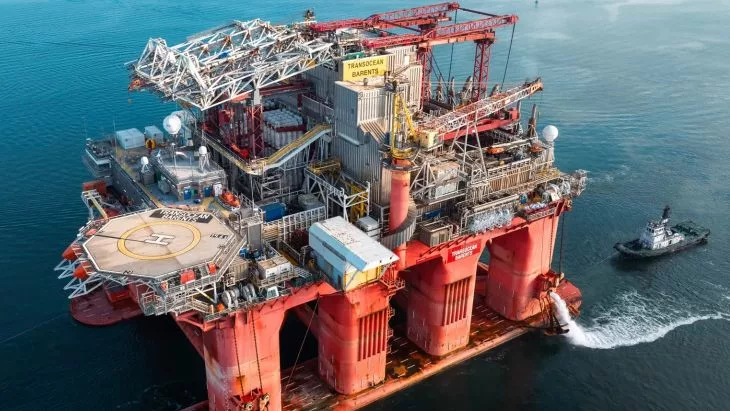
The increase in gas production in Romania after the entry into operation of Neptun Deep could be combined with Ukraine’s large underground storage capacity, claim the authors of an analysis published by CEPA. The proposal aims to transform any excess volumes into a regional reserve for Central and South-Eastern Europe, according to 2eu.brussels.
The gases that will start to be produced from the Neptun Deep perimeter in 2027 could be used, together with Ukraine’s large underground storage capacity, to constitute a strategic reserve for Central and South-Eastern Europe, according to an analysis signed by Petroslava Bratanova and Aura Săbăduș and published by the Center for European Policy Analysis. The proposal starts from the perspective of a significant increase in Romanian production in a regional market where demand may not automatically absorb all the additional volumes.
Romania is preparing for the most significant increase in its natural gas production in decades with the entry into operation of Neptun Deep, the offshore project developed by OMV Petrom and Romgaz in the Black Sea. Production is scheduled to start in 2027, and the project is expected to add approximately 8 billion cubic meters per year when it reaches the planned level, significantly changing Romania’s gas balance and its position on the regional market.
The analysis published by CEPA starts from the question of where the volumes that exceed domestic consumption could end up. The authors estimate that, even if Romania maintains its current consumption and uses additional gas for new power plants and for a possible increase in industrial activity, it could still have volumes available for export. However, this estimate depends on the evolution of demand, the actual pace of Neptun Deep production and the development of domestic consumption and does not represent an already existing or guaranteed surplus.
Neighboring markets are the first possible destination, but the analysis identifies limits to their capacity to absorb significant volumes in the long term. Hungary has a relatively large market, but exports may be limited by interconnection capacity, existing contracts and geopolitical factors, while the development of renewables, electricity storage and nuclear power in Bulgaria may reduce future growth in gas consumption.
In this context, the authors propose changing the way in which the potential Romanian surplus is viewed: instead of the entire volume being treated as a commodity that needs to find a buyer immediately, a part could become part of a regional strategic reserve. Ukraine would have a central role in this model due to its underground storage infrastructure, built when the country was a major hub in the gas transport system between Russia and Europe.
Ukraine’s total underground storage capacity exceeds the country’s domestic needs, and Ukrainian operators have in the past offered European companies around 10 billion cubic meters of space. The size of the infrastructure allows for much larger storage volumes than in most individual facilities in Central and South-Eastern Europe and offers the possibility of withdrawing gas during periods of high consumption or supply disruption.
The proposal would link this capacity to additional production in the Black Sea. Romanian gas could be transported to Ukraine when regional demand and prices do not justify immediate sale, stored in underground storage and later brought back to regional markets as needed. In this configuration, the Ukrainian storage would function both commercially and as an energy security instrument.
The infrastructure required for such a relationship is not starting from scratch. Romania is connected to the regional system linking Greece, Bulgaria, Hungary and other markets in Central Europe, and the old Trans-Balkan pipelines, used in the past to transport Russian gas to South-Eastern Europe, can operate in directions and configurations different from those for which they were originally built.
This reorientation is one of the components of the so-called Vertical Gas Corridor, developed to allow gas to move from southern Europe to Bulgaria, Romania and further to Central Europe and Ukraine. The route can transport gas from LNG terminals in Greece, including gas imported from the United States, as well as volumes from Azerbaijan and, in the future, Romanian production from the Black Sea.
The Romanian-Ukrainian connection became more important in 2026 after the European Commission approved the modification of the commitments previously made by Transgaz in a competition case. The change allows the Romanian operator to offer export capacity to both Bulgaria and Ukraine on the relevant infrastructure, contributing to the diversification of Ukrainian supplies and the development of a more integrated regional market.
This does not mean that there is already an agreement to send Neptun Deep gas to Ukrainian storage facilities. The CEPA analysis builds on a possible future use of the infrastructure and production, and turning the idea into a strategic mechanism would require commercial decisions, agreements between operators and possibly a framework established by governments or the European Union.