

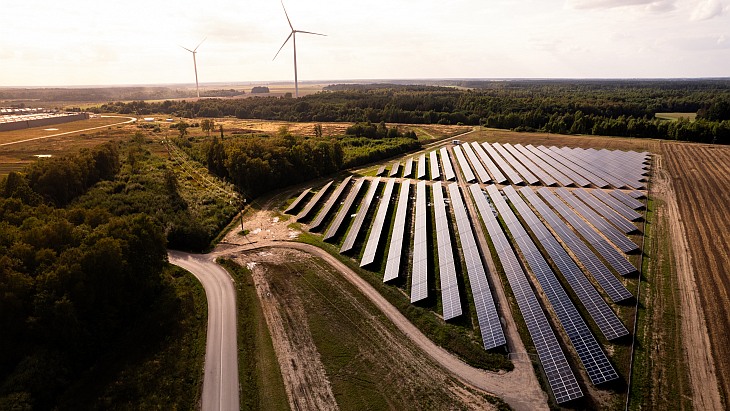
Between 2011 and 2018, 1,122 photovoltaic projects were commissioned in Romania, while installed capacity increased from less than 50 MWp to more than 1,300 MWp. The installations built during that period are still operating today and are now more than ten years old. In markets that adopted photovoltaics earlier, this stage has a name: repowering, meaning the modernisation of an operating installation by replacing the modules with higher-performance ones while retaining the existing infrastructure. In practice, repowering is generally carried out after 20 to 25 years of operation, allowing the economic life of the installation to be extended to 35 or 40 years. Romania’s first wave of photovoltaic installations has not yet reached this stage. It is nevertheless worth thinking about it well in advance, because some of the relevant decisions are made long before the actual modernisation takes place.
We publish an article provided by Enzeit Technik, a European manufacturer of mounting systems for photovoltaic installations and part of the GTV Group. The company is conducting research into the corrosion resistance of protective coatings in collaboration with the University of Warmia and Mazury in Olsztyn, Poland.
Why an older installation can be attractive
The most valuable element of such a project is its grid connection. The connection capacity has already been approved, the medium-voltage infrastructure is in place, and the legal status of the land has been settled. In new projects, these are precisely the factors that determine whether an investment can proceed and, more often than not, extend the development timeline.
The second factor is module efficiency. Modules available today provide significantly more power per square metre than those manufactured a decade ago. The same land area can therefore generate considerably more output without requiring new permits or restarting the grid connection process from scratch.
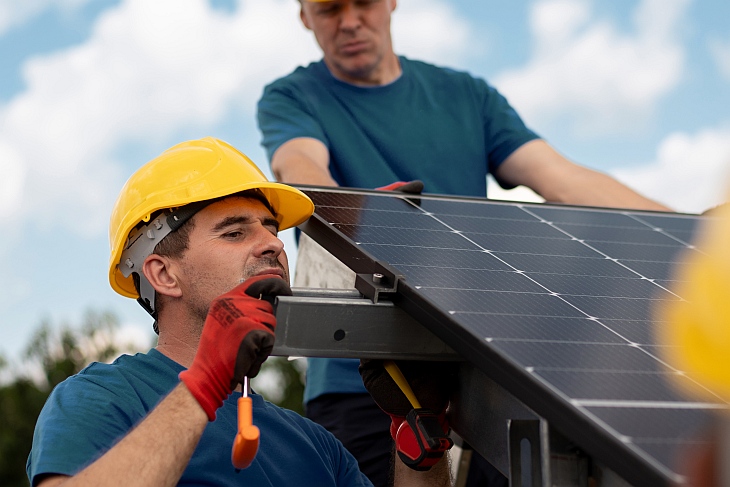
Module degradation does not, in itself, make replacement necessary. With a typical decline in output of around half a percentage point per year, after 25 years an installation still operates at around 90 percent of its nominal capacity. What becomes essential in the modernisation decision is the economic calculation, since substantially more output can be obtained from the same area of land.
Where the complications arise
Replacing only the modules appears to be the simplest option and is usually planned that way. The structure remains in place and the modules are replaced.
The structure, however, was designed for the modules installed at the time of construction. Today’s modules are larger and heavier. A larger surface area means greater wind loads, and those forces are transferred through the structure’s purlins, columns and foundations. The load distribution also changes because the mounting points and module stiffness are different.
A long-established principle of structural engineering applies here: the load-bearing capacity of the system is determined by its weakest link, not by the average. Reinforcing the purlins while retaining the original foundations merely shifts the problem rather than solving it.
It is also worth noting that the structural design calculations prepared for the original project can be reused only if the terrain exposure category, reference wind speed and geometry of the system remain unchanged. Once the modules are replaced, the geometry changes by definition.
What needs to be checked before making a decision
The starting point is the original documentation, namely the information on the loads for which the structure was designed and the modules considered in the original design. If the documentation has been retained, recalculation largely comes down to entering the new input data.
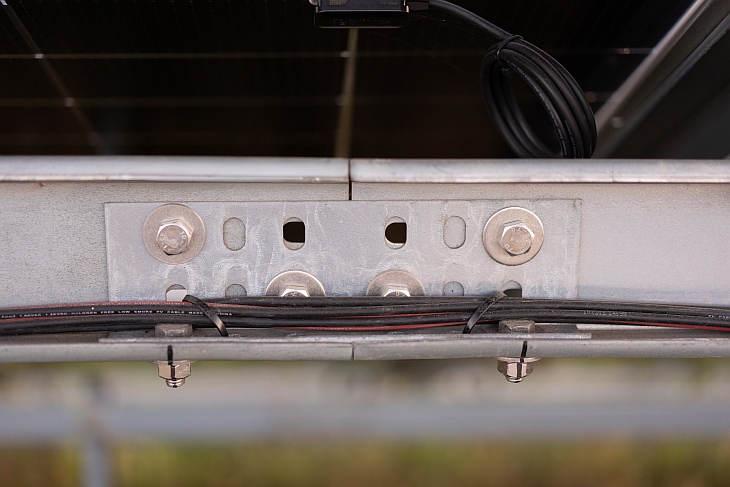
The second step is to assess the condition of the structure. After more than ten years, the areas that cannot be seen during a routine inspection become particularly important: where the columns enter the ground, bolted connections and contact points between different metals, an issue we examined in detail in another article. A structure viewed from a few metres away may appear to be in good condition while its cross-section has been reduced by corrosion precisely where it enters the ground.
The third step concerns the foundations. Higher wind loads mean greater uplift forces, while the bearing capacity of the soil remains unchanged.
On this basis, one of three options can be selected: replacing only the modules while retaining the structure; replacing the modules together with part of the structure, most commonly the purlins and mounting system; or replacing the structure while retaining the grid connection and electrical infrastructure.
The role of the mounting structure supplier
In a modernisation project, the supplier works with an asset that already exists, together with its history, documentation and limitations. The task is to recalculate the structure for the new modules, determine which elements can be retained and propose a solution that can be installed on the existing foundations.
This requires an in-house engineering team and experience in markets where modernisation has already become established practice. The first wave of installations in Western and Central Europe has been going through this process for several years, and working methods developed there can also be applied in Romania.
It is worth noting that the scope for future modernisation is determined to a large extent by the original design. The reserve load-bearing capacity, the choice of corrosion protection and the foundation design are all established when the installation is built, and these decisions also determine which options will remain available a decade and a half later.
Providing sufficient reserve load-bearing capacity to allow larger modules to be installed in the future requires more steel and therefore a higher initial cost. The decision belongs to the investor, while the manufacturer’s role is to make a recommendation and explain the consequences of each option. The question worth asking when a new installation is built is therefore: how much reserve capacity has been allowed for, and what will that mean for a future modernisation?
The earlier this calculation is made, the more options remain open.
Enzeit Technik designs and manufactures mounting systems for photovoltaic installations, with coatings selected according to the environmental conditions at the site.
