
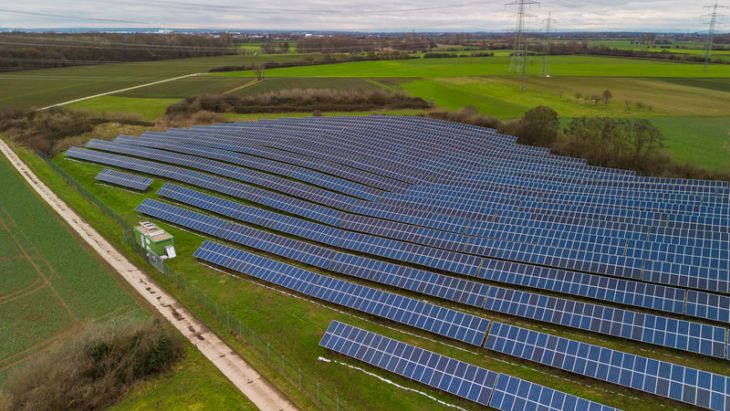
Germany’s photovoltaic energy production is rapidly approaching a record level of over 100 terawatt-hours in a single calendar year, reports DPA.
As of September 27, photovoltaic energy production had already reached 90.2 terawatt-hours, surpassing the total of 90 terawatt-hours generated throughout the entirety of 2023, according to the German Solar Association (BSW-Solar). An unusually high number of sunshine hours and the continued expansion of photovoltaic capacity have contributed to these high figures, the association stated, citing an energy production update published on Saturday by the Fraunhofer Institute for Solar Energy Systems (ISE).
By comparison, 20 years ago, Germany’s photovoltaic energy production stood at just 2.2 terawatt-hours for the entire year.
This imminent record marks an important milestone for the energy transition, said BSW-Solar director Carsten Kornig. “Photovoltaic energy has evolved from a niche technology into a fundamental component of our electricity supply. Society as a whole benefits from this through cheaper electricity, reduced dependence on energy imports, and significantly less climate damage,” said Carsten Kornig.
An output of 100 terawatt-hours of electricity represents a massive amount. One terawatt-hour is equivalent to one billion kilowatt-hours. To put this into context, last year, the city of Hamburg consumed 10.7 terawatt-hours of electricity. In Germany, households typically consume between 2,000 and 4,000 kilowatt-hours per year.
According to data from Germany’s Federal Statistical Office, 59.1% of the total electricity produced nationwide in the first half of 2026 came from renewable sources. Photovoltaic panels accounted for 17.8% of the total volume of electricity, making them the third most significant source of domestically produced energy-following wind power (the primary source) and coal.