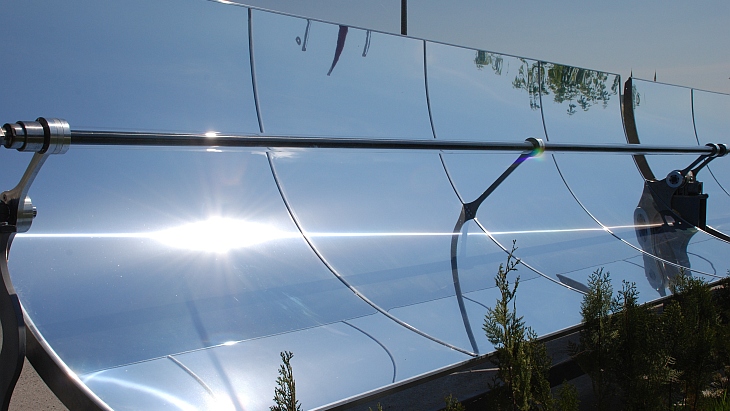
The Romanian-German Chamber of Commerce and Industry (AHK Romania) and the German Energy Agency (dena) will launch in Bucharest a new technology for producing heat for industrial processes, by using concentrated solar energy. This innovative technical solution has significant potential for increasing energy efficiency and reducing CO₂ emissions in industry.
The equipment, which uses solar heat to produce thermal energy, is developed by Soliterm Group GmbH, one of the European pioneers in the field of solar thermal energy for industrial applications. The system uses parabolic mirrors that concentrate solar radiation and generate heat at high temperatures, which can be directly integrated into industrial processes, thus reducing dependence on natural gas and other conventional energy sources.
The launch event will include the presentation of the project, carried out at the Beko Ulmi washing machine factory, recognized by the World Economic Forum as a Sustainability Lighthouse. Here, the plant is designed to generate over 600 MWh of renewable thermal energy annually and reduce CO₂ emissions by approximately 158 tons per year.
The project demonstrates that the transition to a low-emission industry is no longer just a future goal, but an accessible and economically viable technological reality. In sectors with high thermal energy consumption, such as the food, construction materials, chemical, textile or consumer goods industries, the integration of solar heat can generate significant savings and contribute to achieving the sustainability objectives assumed at European level.
In the context in which energy efficiency, reduction of operational costs and decarbonization objectives are becoming strategic priorities for industry, the identification of alternative sources of thermal energy represents an important competitive advantage. Solutions based on solar thermal energy offer companies the opportunity to increase their resilience to fluctuations in the energy market and to accelerate the transition to more sustainable production models.