

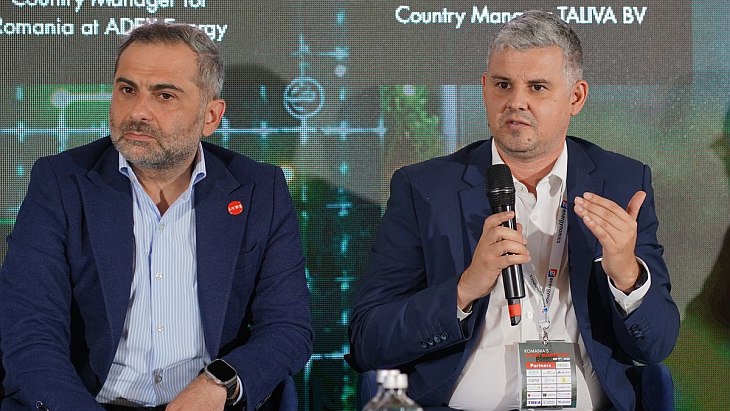
SCADA systems, asset management platforms and optimisation tools need to be integrated from the development stage of energy and storage projects, rather than added when the project is already approaching compliance testing, said Mihai Necula, Country Manager for Romania at ADEX Energy, at the Romania’s Green Momentum conference, organised by Energynomics. Without the right technology architecture, an asset may be built and operational but still unable to deliver the value the investor expected.
ADEX Energy, a technology company founded in Bulgaria, has spent the past five years developing a technology platform specifically for energy-sector players. It includes a next-generation, cloud-based SCADA developed entirely in-house, an integrated management system, or IMS, for asset management, as well as forecasting, optimisation and dispatching tools. According to Necula, more than 13.5 GW of assets in Bulgaria are running on the company’s technology platform, giving ADEX experience with problems that the Romanian market is only now beginning to encounter.
Necula described cases in which assets had already been built, were operational and had passed testing, but their SCADA/DMS systems proved limited, and “the operator discovers that they cannot do what they expected to be able to do”. The result is an asset that is not being used to its full value, with the software limitations discovered only after it is too late to address them easily.
The issue is not limited to the functionality available at commissioning. The technology also needs to evolve with the market, including changes in latency requirements, cybersecurity, product maintenance and permanent customer support. Necula described ADEX’s SCADA as designed to be open to the market and the grid while remaining “fully secured, fully compliant”. For investors, the technology platform therefore becomes part of the design and long-term operation of the asset, rather than a secondary purchase made at the end of the project.
ADEX’s experience in Bulgaria also points to another conclusion: expanding storage capacity does not automatically eliminate the commercial opportunities available to batteries. As the market becomes more predictable and imbalances decrease, industrial consumers can regain the confidence to invest in their own generation and in solutions that give them more control over their consumption profile.
“Consumption started to grow because, when the market becomes more predictable, consumers regain the confidence to invest in their own production,” Necula said. In Bulgaria, smaller market imbalances have also begun to revive interest in new renewable generation capacity. At the same time, price spreads flatten but do not disappear completely, meaning batteries can continue to generate revenue even in a market where storage deployment has expanded significantly.
For commercial and industrial users, the business case can also become more flexible than simply maximising self-consumption. Necula gave the example of a project ADEX is working on with farmers in Romania. During the irrigation season, the battery and IMS would focus on self-consumption, limiting the amount of electricity imported from the grid and providing cost management and cost optimisation. Outside the agricultural season, the same C&I battery could become trade-oriented and market-oriented, including participation in system services. The same asset can therefore perform different functions depending on the season and market opportunities.
Necula’s broader message is that the energy market is moving through successive stages. The initial focus was on project development, followed by M&A and, increasingly, construction and operation. The market will quickly reach the point, he argued, where the critical question becomes who manages the asset and on what technology platform.
As the number of projects grows, the way a battery is operated, the technology platform into which it is integrated and the platform’s ability to evolve with market requirements will increasingly make the difference. In a market facing a significant shortage of know-how and information, while very different technologies are often presented under the same labels, Necula summed up the message to investors in simple terms: “Be careful who you buy from and what you buy.”
The Romania’s Green Momentum conference was organised by Energynomics, with the support of Elektra Renewable Support, ADEX, Adrem Asset Management, Big Store, CBRE, Elnos Romania, Eximprod, Global Techniques for Energy, SAJ, Sermatec, Sigenergy, Solar Today, Sunotec, TBEA, Think Blu Solution, WALDEVAR Energy.