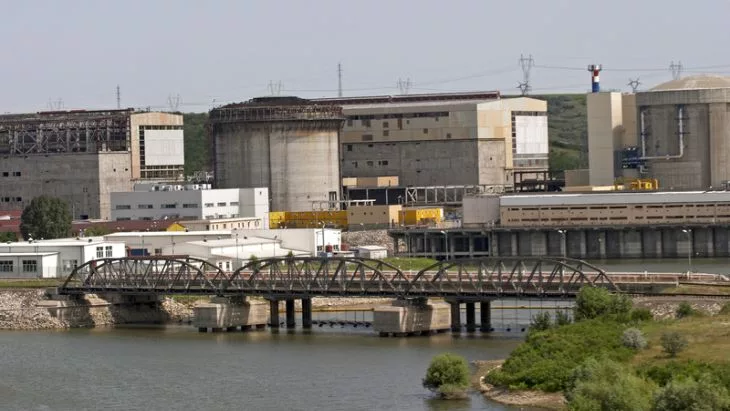
Romania would have had solutions, including by carrying out some mixed circuit works, to avoid the crisis at CNE Cernavodă, but reactors stopped not only in Romania, nuclear energy experts say.
These days, heat waves and a severe drought have led to a decrease in flows and an increase in the temperature of the main European rivers (Rhône, Garonne, Seine, Meuse, Moselle, Danube), claims Cerasela Urjan, nuclear engineer and safeguards inspector at the International Atomic Energy Agency (IAEA).
Because nuclear power plants use water from rivers for cooling, and environmental regulations limit the temperature of water discharged back, and/or the river level is too low, several countries have had to stop or reduce the production of their nuclear reactors, says Cerasela Urjan on her social media page.
“So far, 10 reactors in Europe have been temporarily shut down or reduced their production in June-August, most of them located in France,” she says.
Emergency situations:
🔸️Romania: Prime Minister Ilie Bolojan instituted a state of alert for the entire month of August 2026, as a result of the decrease in flows on the Danube and reduced energy production.
🔸️Hungary: Prime Minister Péter Magyar has warned of a possible energy crisis, given that the Paks plant provides almost half of the country’s energy production (Unit 3 shut down).
🔸️Bulgaria: The authorities have warned that the nuclear sector may have to stop entirely if the situation does not improve.
🔸️Authorities and operators (EDF in France, for example) emphasize that these shutdowns do not represent a nuclear safety risk, but are environmental protection measures (aquatic fauna and flora) imposed by regulations. Electricity supplies generally remain secured through reserves and imports from neighboring countries, although the situation is being closely monitored as the drought continues.
At the same time expert Călin Radu Vilt, currently a scientific advisor within the World Energy Council (CNR-CME), says that such a crisis could have been avoided if the works and solutions presented by engineers over the years had taken place.
“Since 1983, when Ceaușescu imposed U5 at CNE Cernavodă, it was known that in these periods of drought the water of the Danube is not enough even for two Units and the concept of cooling in a mixed circuit was introduced, i.e. to supplement cooling with cooling towers. There are several important parameters that give the cooling solutions. The flow rate matters, but also the temperature of the water, because in the condensers a delta t is needed (difference – n.r.) of at least 7 degrees between inlet and outlet. The outside temperature and wind speed or the unit are also important to ensure the cooling (condensation) of the steam at the exit from the turbines.
The important problem is very well known and has several complementary solutions. The premium with the increase in the flow rate of the Cernavodă arm is very clearly established by the thresholds at the Bala arm. Another solution was and was achieved with the lowering of the suction pumps. The mixed circuit works were not carried out. These provided for either cooling towers or Heller-type batteries”, says Călin Radu Vilt.
“In 2003, when the U1 was shut down for almost a month, it was very clearly decided to start the work to solve this common problem for both the plant and navigation.
At the level of the Ministry, the solutions with the three complex developments on the Danube are known, for Cernavodă the Măcin one is essential, which would reach the tail of the lake between Cernavodă and Călărași, with an important increase in the permanent elevation of the lake that would ensure a constant level at the suction of the pumps”, says the expert, on his social media page.
About Schneider Electric
Schneider Electric creates impact by maximising the value of energy and resources, connecting progress with sustainability. We are a global leader in electrification, automation and digitalization, providing AI-driven IoT solutions for smart industries, infrastructure, data centres and buildings.
With 150,000 employees in over 100 countries we promote diversity and innovation. Schneider Electric România, with 27 years in business and more than 300 employees, runs operations in Armenia and Moldova and provides support in 17 languages for 26 countries through the Bucharest Hub.