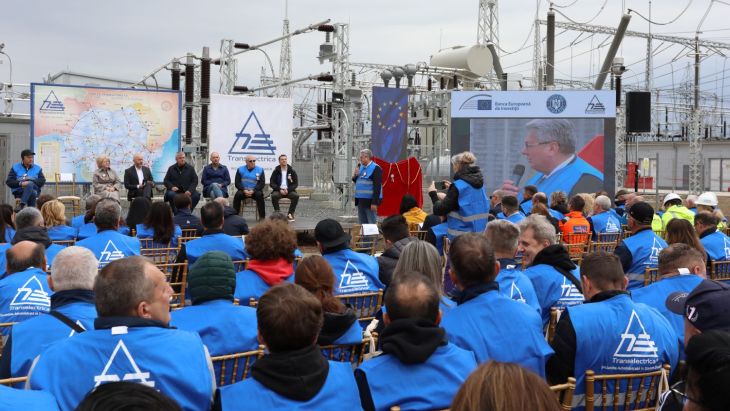
On Thursday, at the Sibiu Sud electrical substation, Transelectrica marked the inauguration of a STATCOM (Static Synchronous Compensator) unit. The event celebrated the completion of an investment project titled “Installation of two modern reactive power compensation systems at the 400/220/110/37/20 kV Sibiu Sud and 400/220/110/37/20 kV Bradu substations,” which was financed through the Modernization Fund.
With a total value of approximately 260 million lei, the project received 254.65 million lei in non-reimbursable funding from the Modernization Fund. The investment was fully completed in August 2026, ahead of the deadline stipulated in the financing agreement—namely, May 2027.
“The security of the National Power System is built through investments that concretely address the challenges of a grid undergoing continuous transformation. The completion of this project demonstrates the capacity to manage grid fluctuations more efficiently, reduce instability risks, and strengthen the Electricity Transmission Network. At the same time, this investment creates optimal conditions for responding to increasingly complex operational requirements. The final result is the product of sustained effort, expert knowledge, and consistent progress in delivering strategic projects for Romania—from the initial conception of the idea to its handover to the National Energy Dispatch Center,” stated Ștefăniță Munteanu, President of the Transelectrica Directorate.
State-of-the-art technology for grid stability
The project involved the installation of two modern reactive power compensation units—STATCOM systems, each with a nominal capacity of ±150 MVAr—at the Sibiu Sud and Bradu electrical substations. Together, these two installations form a unique reactive power compensation system within Romania’s Electricity Transmission Network, designed to respond rapidly to fluctuations in grid parameters and to support the safe and stable operation of the National Power System, even during periods of low consumption. STATCOM technology contributes to increasing transmission capacity safely, reducing the risks of instability, and optimizing grid operations during periods of congestion, rapid fluctuations in consumption, or other challenging operating conditions. This investment addresses key needs of the current energy system: enhancing the grid’s operational flexibility, strengthening its resilience, and facilitating the integration of renewable energy sources—whose variable output creates additional requirements for balancing and controlling operational parameters.
The design and construction contract was signed on August 16, 2023, with the work carried out by the consortium of Siemens Energy SRL and Electromontaj SA. Both installations were energized and commissioned ahead of their contractual deadlines: the one at Sibiu Sud in December 2025, and the one at Bradu in May 2026.
The full completion of the project underscores Transelectrica’s commitment to accelerating the modernization of the Electricity Transmission Grid through the implementation of advanced technological solutions, which directly enhance the operational safety of the National Power System. Financed via the Modernization Fund, this investment supports Romania’s goals of upgrading energy infrastructure, bolstering energy security, and developing a transmission system capable of sustaining the long-term energy transition.
Why modern reactive power compensation equipment is important
STATCOM is an advanced technology that stabilizes grid voltage and directly contributes to increasing the security of electricity supply for both residential and industrial consumers. Its implementation strengthens the National Power System’s (NPS) capacity to integrate increasingly large volumes of renewable energy and to respond flexibly to rapid load variations.
The STATCOM installation provides dynamic, continuous voltage regulation at the grid node; continuous reactive power compensation; enhanced voltage stability under both normal and contingency conditions; greater flexibility for the NPS as the share of renewable energy grows; and the damping of inter-zonal voltage oscillations that occur within the ENTSO-E interconnection.
This investment has a direct impact on national energy security by increasing transmission capacity, reducing the risks of instability, and optimizing grid operation during periods of congestion, unforeseen events, or rapid fluctuations in consumption. At the same time, the project contributes to meeting Romania’s objectives regarding the modernization of energy infrastructure, enhancing the resilience of the transmission grid, and facilitating the accelerated integration of renewable energy sources into the National Power System (SEN), TEL officials further stated.