

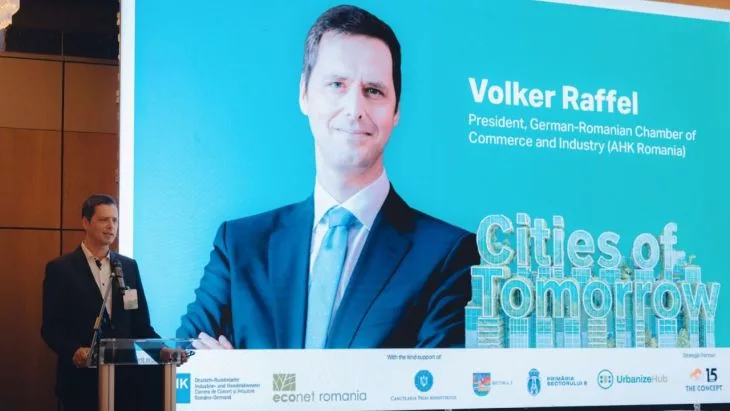
The price of energy in Europe is too high, and in Romania it is even higher, compared to purchasing power, said Volker Raffel, president of the Federation of Associations of Romanian Utility Companies (ACUE) and CEO of E.ON, on Thursday at a specialized event.
“The price of energy in Europe is too high, we all know that. The price in Romania is even higher. We recently saw statistics that in Germany industrial production has decreased by 10% in recent years, but energy-intensive production has decreased even more, by 20%. Then you can imagine what this means for the European environment. Industrial production in Romania has decreased even more. Then, an energy price that is too high is a huge risk for all of us, for the budget income, for the well-being of the economy. The price of energy, compared to the purchasing power, is the highest in Romania. I pay almost 40 cents per kWh. So, in absolute terms, the price here is the highest in Europe, for domestic consumers. If we don’t do something, this will continue for industry, intensive energy, but also the rest. We are not the ones who are increasing the costs of the bills,” said Raffel, quoted by Agerpres.
The ACUE representative emphasized, at the same time, that Romania has an extremely low distribution tariff compared to other European countries.
“We said three years ago that we have to invest outside the crisis. And we proposed to invest in renewables, to see that this is what we can do the fastest. Nuclear reactors are beautiful, but they are not built quickly. A photovoltaic panel is installed very quickly. You can imagine where we would be today if we didn’t have investments in renewables… Without renewables it would have been a complete disaster. That’s not all: we see that especially in the evening we have these price peaks, because we don’t know where to come from let’s take energy. But that means we don’t connect 2,000 consumers every month. Now we need to connect all the storages, which are the biggest ones. If we have the chance to have them dynamics, smart meters and finally batteries, we can reduce “price spikes”, these peaks, also during the evenings”, said the head of E.ON.
He argued, on the other hand, that the most expensive solution “is not to continue to invest more in networks”.
“The second most expensive solution is if we only connect renewables, but we don’t have money to connect batteries, new prosumers, new consumers, data centers and we risk that. We talked about the problem, but I also come with a solution that I propose. If we reach a package with the authorities to improve the situation, we, as a private sector, can also mobilize private money to invest outside the crisis and in the networks. Very often I hear: “If you invest more, these are costs. We don’t want to have costs.” Like the heating network in Bucharest, it does not want to have costs, but then it ends up with a network that loses 40% of the transported energy. The proposal is that if we do all these storage connections, of new consumers, next to the Autostrada in Moldova, which is in our area, that means a controlled distribution tariff. At the same time, if we avoid the price peak in the evening, we can reduce the price of the wholesale electricity market in Romania by more than 42%, in 2035″, explained the specialist.