

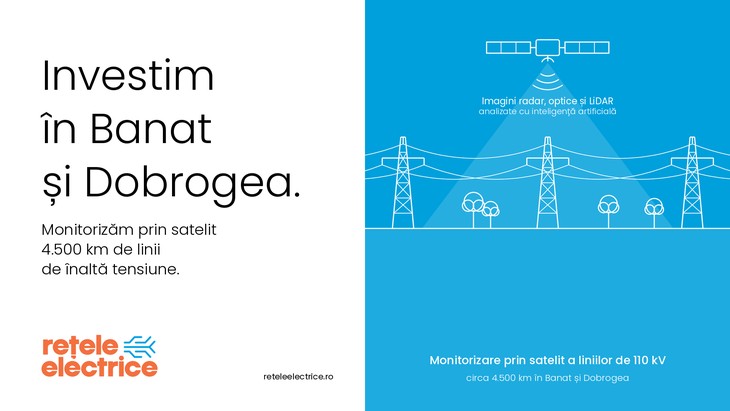
Rețele Electrice România, part of the PPC Group in Romania, has launched a tender for the procurement of satellite monitoring and analysis services for 110 kV overhead power lines (OPLs) in the Banat and Dobrogea operational regions, with an estimated value of 2,457,360 lei (excluding VAT).
The satellite monitoring project will cover approximately 4,500 kilometers of high-voltage overhead lines-about 2,000 kilometers in Banat and 2,500 kilometers in Dobrogea. Consequently, IT systems that leverage artificial intelligence to identify high-risk areas and the potential for imminent incidents will be integrated into the company’s network maintenance operations. This initiative is part of the company’s broader program for network digitalization and automation, designed to prepare the distribution infrastructure for the energy transition. “If we continue to maintain our network exactly as we have for the past few decades, we will not be able to meet the needs of an energy system that is evolving year by year. With the help of satellites and artificial intelligence, we can identify the risk of outages in advance and take preventive action. This results in a more predictable network that is more resilient to extreme weather events-ultimately leading to fewer interruptions for our customers. Technology does not replace the role of an electrician-which remains indispensable-but rather provides our colleagues with the information they need to intervene precisely where it matters most,” stated Mihai Pește, General Manager of Rețele Electrice România.
Through this new service, we are transitioning from scheduled, manual ground-based inspections of 110 kV overhead lines to satellite-based analysis. This allows us to pinpoint, on a map, specific areas within the lines’ safety corridors that require intervention. Consequently, Rețele Electrice România teams will be deployed to the field to address the identified issues, while the time and resources saved can be redirected toward other network maintenance tasks.
The analysis will integrate various satellite sensor technologies to inventory vegetation and detect structures within the line corridors-including monitoring ground movement or shifts in pylon foundations. Additionally, LiDAR measurements will be used for sections with dense vegetation, enabling precise calculation of the distance between power lines and trees. Each identified issue will be categorized into one of three risk levels-ranging from low risk to immediate danger-with the findings made available via a digital platform in the form of an interactive risk map. At the same time, the service increases the predictability of maintenance work. In the first year, the analysis will be carried out in four stages: identifying risks and planning vegetation clearing, verifying the outcomes following interventions, tracking vegetation growth rates, and producing an integrated annual report-complete with an updated risk map and recommendations for prioritizing interventions over the subsequent 12 months. Ongoing monitoring will take place on a quarterly basis, with the option for more intensive analysis during periods of heightened risk.
This project complements other initiatives through which Rețele Electrice România is digitizing its network and introducing new operational technologies. The company is currently implementing the AADMS platform-an advanced system for real-time monitoring and control of the electricity distribution network-which will enable “self-healing” automation functions. Furthermore, by the end of 2026, the company expects to have approximately 2.2 million smart meters installed.
Through AI-assisted satellite monitoring, Rețele Electrice România is shifting from periodic inspections to predictive maintenance: risks are identified well in advance, interventions are planned and prioritized based on data, and the high-voltage network in the Banat and Dobrogea regions becomes safer and more resilient.
Bids may be submitted until 3:00 PM on December 8, 2026. Rețele Electrice România operates networks with a total length of approximately 136,000 kilometers across three key regions of the country-Muntenia (including Bucharest), Banat, and Dobrogea-covering one-third of the local distribution market. The company is also implementing an investment program aimed at enhancing service quality, network safety and performance, and adopting the PPC Group’s environmental standards locally. The electrical networks operated by Rețele Electrice România comprise 293 transformer substations and over 26,000 distribution transformer stations.