

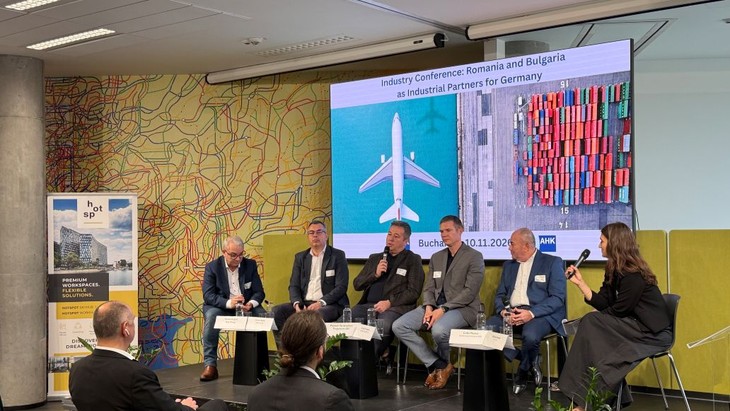
European companies-German ones in particular-are placing increasing importance on suppliers capable of offering quality, flexibility, and reliable delivery, driven by geopolitical shifts and risks affecting global supply chains, according to officials from the German-Romanian Chamber of Commerce (AHK). In this context, Romania and Bulgaria stand to benefit from the shift toward geographically closer suppliers, thanks to their industrial capacity, know-how, and investments in modern technology and workforce development. “The corporate perspective has shifted from ‘where can I find this part at the lowest price?’ to ‘where can I find the right technical capacity, quality, reliable delivery, supplier flexibility, and trustworthy partners with whom I can collaborate for the next five to ten years?’ From this standpoint, Romania and Bulgaria have a great deal to offer; they are no longer just ‘low-cost’ locations, but rather possess production capabilities and know-how, having invested in automation, modern technology, and the professional development of their workforce,” stated Ruxandra Dumitrescu, Deputy Director of AHK Romania, during a conference on cooperation in Southeast Europe-an event organized by the bilateral German Chambers of Commerce and Industry in Romania and Bulgaria. The conference is part of the “Sourcing Tour,” a business delegation organized from November 9-13 for German companies looking to identify new suppliers and partners in Romania and Bulgaria.
Romania and Bulgaria: Partners for German Industry
During the debate titled “Romania and Bulgaria as Partners for German Industry: Nearshoring and Strategic Sourcing,” representatives from German, Romanian, and Bulgarian companies highlighted the advantages offered by these two markets as sources of supply and production for German industry. The discussion participants included Călin Mesea (KUKA Automatizare SRL), Adrian Belbe (Autonova SA), Daniel Anghel (RAP Group), Plamen Tyutyunkov (Torgoterm JSC), and Georgi Yonevski (Techno-yota 2001 Ltd.).
In the international competition for suppliers, companies in Eastern Europe benefit from several key advantages: proximity to Western European markets, flexibility, rapid responsiveness, a skilled workforce, and the potential to build shorter, more predictable supply chains.
The elimination of internal land-border controls within the Schengen Area for Romania and Bulgaria has also helped reduce transport times, while uncertainties surrounding long-distance maritime shipping have increased interest in suppliers located closer to European production facilities. The discussions also addressed the challenges posed by competition from Asian suppliers. In this context, participants emphasized the importance of consistent quality, the protection of know-how, flexibility, and relationships built on trust. For German companies seeking long-term partnerships, suppliers in Romania and Bulgaria can deliver through quality, fast response times, adaptability to client requirements, and competitive costs.
Investments in skills, automation and sustainability
Another advantage of the region is the constant investment in workforce development. Both in Romania and in Bulgaria, companies support professional training programs and dual education, to ensure the skills necessary for modern industry.
For the coming years, the participating companies indicate the automation of production processes and the adoption of sustainable solutions as important directions for strengthening competitiveness.
Direct meetings between suppliers and German companies
After the conference, Romanian and Bulgarian companies had a series of B2B meetings with German companies looking for new partners and suppliers in the two countries. The participants talked directly with representatives of German companies, presented their production capabilities and explored prospects for long-term collaboration.
The event is part of the Markterschließungsprogramm (External Market Access Program) of the German Federal Ministry of Economics and Energy, which supports German small and medium-sized enterprises in identifying and developing opportunities in international markets.
The delegation brings together companies active in fields such as mechanical engineering, machine and equipment construction, electrical engineering, medical technology, plastics, metal processing, plastics & rubber, industrial plastic foils, carpentry/metal doors and windows, wiring, agricultural industry and specialized industrial solutions, namely: ALD Vacuum Technologies GmbH, BGE Elektrotechnik GmbH, ECOPack-Folien GmbH, Gyptech GmbH, Krinner Schraubfundamente GmbH, Müthing Technik GmbH &Co. KG, provita medical GmbH & Co. KG, Schwarz Systems GmbH, Stahlbau März GmbH.