

OMV Petrom announced a net profit of 1.21 billion lei in the first half of this year, nearly three times higher than in the first half of last year. Three factors have contributed to this result: the increase in the reference price for crude oil (+32%), the improvement of refining margins (+8%) on a 95% refinery use rate, and higher demand for fuel, which allowed for an increase in sales (6.4% in retail and 12% in the commercial segment).
Some of the figures provided by OMV Petrom invite us to have a deeper look at the idea launched recently by the Ministry of Finance, and supported by PM Mihai Tudose, regarding the reintroducing of over excise duty on fuels.
“In 2016 the excise duty has been removed and the price did not decrease. Companies did not make any profits. Let’s see, if we reinforce it do they [prices] go up? I think they will not. However, that period when they [the companies] did whatever they wanted around here is gone”, said Mihai Tudose in a televised interview, referring to oil companies.
The graph provided by OMV Petrom to the press shows how the gasoline prices evolved in the last 12 months.
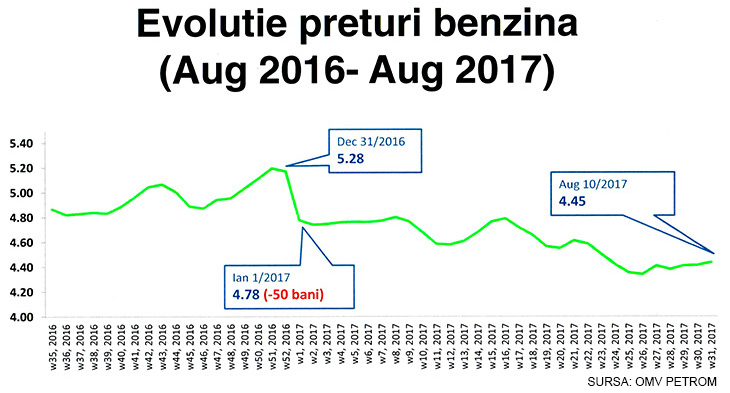
The decision to take out the duty adopted in 2016 and entered into force on January 1, 2017, meant a 0,5 lei price-drop per liter of gasoline (-9.4%). The cheapening trend – supported by other factors – continued, and on August 10th, the price of gasoline was at 4.45 lei per liter, 15.7% lower than on December 31, 2016.
“The total sales of refined products were significantly higher compared to Q2/16 (13%)” explains OMV Petrom. “The volume of retail sales of the Group, representing 53% of total sales of refined products, increased by 7% compared to Q2/16 as a result of increased demand caused by fiscal relaxation measures implemented in Romania at the beginning of 2017″. The measures referred to by the OMV Petrom’s board are the special construction tax (an asset taxation), the reduction of VAT by one percentage point and the elimination of the over excise duty (turnover taxation). The same situation applies to the semmestrial evolution :”total sales of refined products increased by 6% compared with 1-6/16. The Group’s quarterly retail sales were 6% higher due to increased demand as a result of favorable market conditions” .
Excise duty was removed, the price dropped, sales increased.
What happened to the profits?
Profit increased almost three times, which led to an increase of 170 million lei in profit tax. OMV Petrom’s total contributions to the state budget situated at 4.59 billion lei, up by 225 million lei, an increase derived “from tax, dividends and VAT (higher sales).”
The General Director of OMV Petrom, Mariana Gheorghe refused to comment on the plans and statements made by politicians, and repetreadly said: “We have been and we will remain open to a normal, respectful relationship with the authorities.”
KEEP IN MIND
Low(er) toll rates on larg(er) volumes are more effective than higher tax rates on a lower (or zero) tax base. In other words, it is better for the state budget – but also for society as a whole – to encourage (through a wise fiscal regime) a healthy turnover of goods and money, rather than risking to block or slow down economic activity by over-taxation, bureaucracy and legislative or regulatory inconsistency chasing for illusory returns.
