

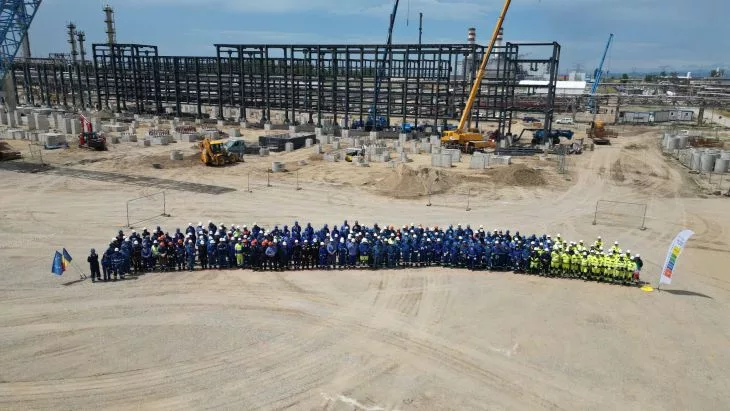
OMV Petrom, the largest integrated energy producer in South-Eastern Europe, has commissioned a new aromatics unit at Petrobrazi, following an investment of approximately 140 million euro.
“We are expanding our processing capacity for products that can be used as feedstocks in the petrochemical industry, thus strengthening the role of the Petrobrazi refinery in the petrochemical value chain. The completion of this project represents a key moment in the refinery’s modernization process and in fulfilling a strategic commitment to optimize the production mix, by integrating high-value-added products. At the same time, the project reflects our firm commitment to operational excellence and sustainability, by adopting the most advanced technological solutions available,” said Radu Căprău, member of the OMV Petrom Management Board responsible for Refining and Marketing.
The new unit integrates the most advanced available technologies (BAT) and replaces a plant in operation since 1961.
The aromatics unit allows the separation of benzene from gasoline, ensuring the production of high-octane fuels, according to European standards. This investment also expands the production capacity of aromatics, such as toluene, a high-value-added product used as a raw material in the petrochemical industry – in the production of paints and adhesives. In addition to improving the production mix, the plant contributes to increasing the refinery’s energy efficiency and reducing its environmental impact.
After a complex commissioning process, the new unit will allow the increase of toluene production capacity at Petrobrazi, by 50,000 tons/year, to approximately 100,000 tons/year. The project was implemented in safe conditions, respecting the highest quality and environmental protection standards.
OMV Petrom has invested over 2 billion euro in the modernization of the Petrobrazi refinery since privatization, with a focus on operational efficiency and reducing environmental impact. The company is currently developing a major new project, worth approximately 750 million euro, to build a sustainable fuels production unit (SAF/HVO), which will also include a green hydrogen component.