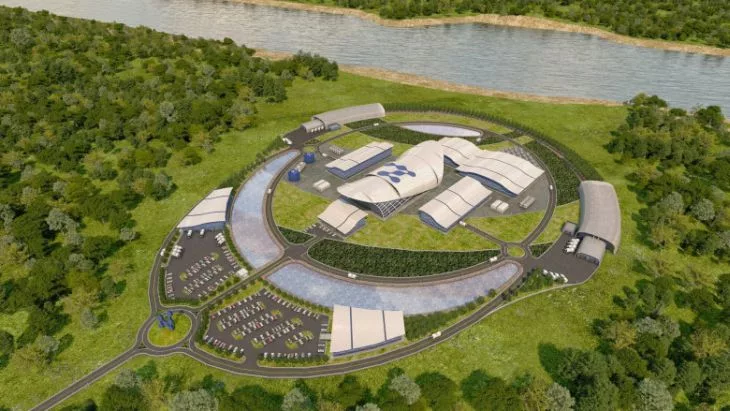
The Doicești SMR project was developed in compliance with legal provisions, and its development will take place in stages, under market conditions, say Nuclearelectrica officials.
The selection of the location of the Doicești small modular reactor project was independently evaluated by the IAEA (the UN International Atomic Energy Agency), and the postponement of the project schedule is conditional on the completion of the successive stages of design, engineering and technical validation, claim Nuclearelectrica officials, in response to the summary of the Prime Minister’s Control Body Report, published in a report submitted to the Stock Exchange.
“Regarding the status of the SMR (Small Modular Reactor) Project – The SMR Project development calendar was developed together with the technological partners NuScale and Fluor, based on the information available at the time of project initiation and represented, from the beginning, an estimated calendar, susceptible to updating as engineering, authorization and technological maturation activities progress. Regarding the difference between the initial estimated calendar and the current evolution of the project, it must be taken into account that the SMR Project represents the first European implementation of this technology (“first-of-a-kind”), its development being conditioned by the completion of the successive stages of design, engineering and technical validation. In this context, updating the calendar estimates is an inherent characteristic of such projects and does not represent a deviation from the obligations assumed, given that the documents approved within the project do not establish firm and binding contractual terms. The engineering stage has the role of objectively documenting and validating the technical solutions, costs and implementation calendar, representing the foundation of all subsequent stages of development”, say Nuclearelectrica representatives.
“Regarding the site selection – The Doicești site was selected based on technical studies and analyses. The site selection was independently assessed by the IAEA (International Atomic Energy Agency of the United Nations), through the conduct of assessment missions, the confirmation of Nuclearelectrica’s approach being public”, they add.
The first IAEA SEED mission was carried out in August 2022 and aimed to verify the SMR site selection study in Romania. A series of recommendations were formulated. After resolving all recommendations, an IAEA SEED follow-up mission followed (April 2024) which found that all recommendations were met and concluded that the site selection was carried out according to international standards (i.e. in full compliance with IAEA standards), claim company officials.
In May 2025, another IAEA SEED mission reviewed chapters of the Initial Nuclear Safety Assessment Report (ISAR) and the methodologies to be used for detailed studies of external hazards that could affect the site, including the hazard associated with the presence of natural gas. The results of this IAEA mission confirmed all methodologies and steps taken and further proposed by RoPower to complete the detailed studies related to the site.
Beyond compliance with specific nuclear safety requirements, the Doicești site presents objective advantages resulting from the existence of an already developed energy and industrial infrastructure, a characteristic specific to a brownfield site, with a favorable impact on both the implementation duration and the project costs compared to development on a greenfield site.
Additionally, the alternative Iernut site presents additional constraints generated by the legal regime of the lands, which are owned by a very large number of owners (over 100 owners) and classified as agricultural land, elements that would have required complex procedures for property consolidation and, implicitly, additional risks regarding the duration and costs of implementation.
Therefore, the selection of the site was carried out correctly in terms of the analyses, their independent verification, and the analysis of the differences from the first-place site.
Regarding the establishment of the project company – the selection of the joint venture partner in this project was mainly made objectively, based on the location criterion. The structure of the Project Company was built in such a way as to allow for the phased development of the investment and the subsequent attraction of new investors, in line with the practices applicable to large-scale nuclear projects. The conclusions of the Prudent Private Investor Test (PIPT) confirmed that the investment structure and the decisions adopted are compatible with the way in which a private investor in similar conditions would have acted to develop a comparable project. For the financing of the Project, the co-optation of new shareholders in the Project Company (RPN) was envisaged at a later stage.
The obligations assumed by SNN in relation to NPG take into account precisely the supreme interest of the Project Company, namely that of not allowing — in relation to the strategic importance of the investment — that NPG can assign the receivables held to any actor on the free market. The respective clauses, approved by investors/shareholders, were adopted to protect the interest of the shareholder, the Romanian State, through the Ministry of Energy, and constitute an advantage for it — which is why the EGMS Decision approving the Investors’ Agreement (from September 2022) was adopted.
“Regarding the acquisition of the site by the project company – The determination of the transaction structure regarding the acquisition of the site was based on a prudent and phased analysis, carried out by reference to the specifics of the nuclear project, the available assessments and the need to protect the interests of SNN. The site has a distinct strategic relevance, being analyzed not only from the perspective of a regular real estate transaction, but by reference to the specific requirements of the development of a nuclear project, including the works, conditionalities and technical particularities necessary for the preparation of such a project. The acquisition of the land was carried out at market value, in accordance with the applicable legal provisions, implicitly the lowest market value considering the various assessment reports, some values reaching 60 million Euros. SNN (which is not a party to the transaction) cannot investigate / censor regarding the market value established by the appraiser, this being the exclusive professional attribute of the authorized appraiser, based on the legal framework and applicable professional standards”, say Nuclearelectrica officials.
In the same context, no payment has been made under the Re-Invoicing Agreement to date, precisely as an expression of the prudent approach adopted by the company in order to protect the interests of the company and its shareholders.
The same logic also applies to the steps, initiated and supported by the executive management of SNN, regarding the performance of a forensic audit, prior to the finalization of the CCPM report.
Consequently, to date, SNN has not validated the capitalization or loan financing of these activities, such validation being to be carried out only after obtaining the necessary comfort that the respective amounts are fully documented, justified and correlated with the nature of the transaction regarding the ownership of the site, implicitly to protect SNN from any potential risks generated by the transaction. At the time of the finalization of the forensic audit, SNN will act in accordance with the results of the audit.
The Doicești SMR project was developed in compliance with legal provisions, for reasons related to the development of a strategic project for Romania, one that would allow for long-term associated development.
The position expressed by S.N. Nuclearelectrica is based on the technical documentation related to the project, independent assessments carried out by international bodies, corporate governance mechanisms and the applicable legal framework.
The Doicești SMR project represents one of Romania’s strategic investments in the energy sector and aims to strengthen energy security, develop a competitive nuclear industry and position Romania as a regional center for small modular reactor technology.
“S.N. Nuclearelectrica reaffirms its commitment to developing the project under conditions of legality, transparency, technical substantiation, decision-making prudence and good corporate governance, for the benefit of shareholders, the national energy system and the public interest.
When assuming the SMR project, SNN’s vision was (and continues to be) to become a regional center, which is why SNN has acted in this regard. SNN’s quality as a regional center implies, among others: Romania will obtain a leading position and multiple socio-economic benefits, including a hub for supporting the production and assembly of SMR components, a training and education center for future operators and specialists, as well as a catalyst for the implementation of SMR in the region and a preferred operator for the next SMR projects to come; the opportunity for Romania to become a regional center by developing the production, assembly and maintenance capacity of SMR components, as well as the importance of developing the supply chain of the Romanian nuclear industry. This offers the opportunity to become the regional leader in the operation and development of nuclear technologies and to support Romania’s objectives of becoming a regional leader in the nuclear industry. Thus, the development of projects similar to the one in Doicești, from the perspective of revitalizing decommissioned classic sites, can be done through the development of hybrid nuclear-renewable energy platforms, an aspect considered of great impact in such areas and supported in the EU. The program could economically relaunch affected areas, support new/latest generation technologies and develop a national and international operating center in the country”, conclude the representatives of Nuclearelectrica.