

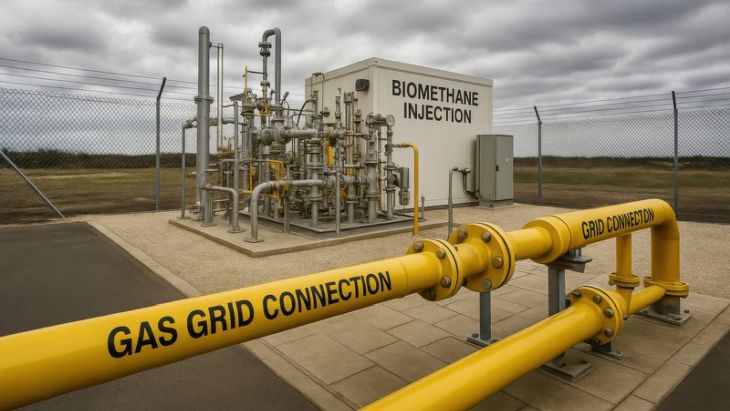
The Hungarian MOL Group has inaugurated its first biomethane production unit in Szarvas, following an investment of over 2.7 billion forints, according to a company press release.
The new facility is capable of producing biomethane from biogas at a purity level suitable for injection into the national natural gas grid; consequently, more than seven million cubic meters of natural gas will be replaced annually with renewable energy.
“The investment marks a significant milestone in MOL Group’s long-term ‘Shape Tomorrow’ strategy by further expanding the company’s green energy portfolio, strengthening energy security, and contributing to the region’s sustainable energy supply. Locally produced energy is no longer just an advantage but a strategic factor. In Central and Eastern Europe, biomethane is considered a promising solution, as it can leverage the strong agricultural sector, the existing gas network, and genuine industrial demand. Biogas is a renewable energy source generated through the decomposition of organic materials such as plant residues, manure, and food waste. It consists primarily of methane, alongside carbon dioxide and other compounds. The new facility purifies the biogas by removing CO2 and other components, producing high-purity biomethane with high energy content,” the statement reads, according to Agerpres. According to company representatives, biomethane is suitable not only for replacing natural gas—a fossil fuel source—but also represents a product with significantly higher added value due to its associated green certificate (ISCC); the seven million cubic meters of gas correspond to the annual consumption of approximately 8,500 average households.
“Furthermore, biomethane can be used directly in public and freight transport as bioCNG or bioLNG, enabling renewable energy produced from organic waste to serve as fuel for more sustainable mobility. This is MOL Group’s first biomethane plant and the third facility of its kind in Hungary. The technology required for the project was supplied by the Italian company Gruppo AB,” the oil company notes.
MOL Group acquired the biogas production facility in Szarvas in 2023. In recent years, the 11–12 million cubic meters of biogas produced there have been utilized through cogeneration, generating nearly 24 GWh of renewable electricity and a significant amount of thermal energy annually. “Through this investment, the facility’s production utilization capabilities have been further expanded to include the production of biomethane suitable for injection into the natural gas grid. The plant processes over 40,000 tonnes of waste annually from the region’s meat industry, alongside another 53,000 tonnes of residual waste—such as liquid manure and turkey litter—supplied by nearby livestock farms and meat processing facilities. Additionally, approximately 18,000 tonnes of agricultural substrate serve as feedstock for the production of biogas and, currently, biomethane derived from its purification. MOL’s agricultural partners and feedstock suppliers play a vital role in ensuring a stable and efficient supply of raw materials; consequently, the company intends to further strengthen its robust and reliable collaboration with the agricultural sector,” notes the cited source.
MOL Group is an international, integrated oil, natural gas, petrochemical, and retail company headquartered in Budapest, Hungary, with operations in over 30 countries. The company operates a network of nearly 2,400 service stations across ten countries in Central and Southeast Europe.
MOL Romania has been present on the local market for over 30 years; it employs 296 people directly and operates 239 service stations, two fuel depots (in Giurgiu and Tileagd), and an LPG terminal in Tileagd.