

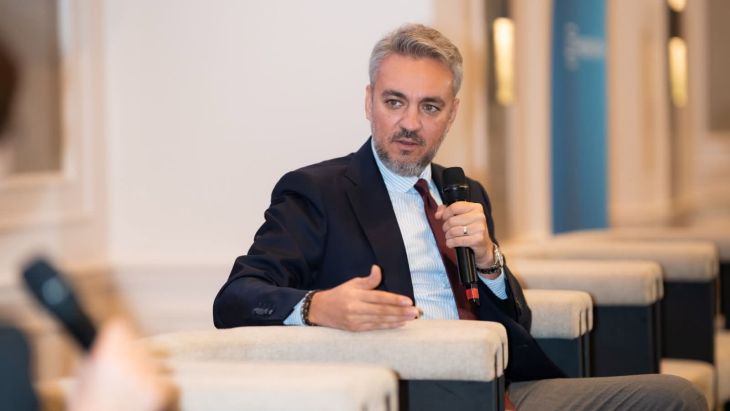
The discussion regarding the introduction of a two-part tariff in the gas market is still being analyzed by the regulatory authority—specifically concerning the cost impact on certain consumer categories— said George Niculescu, President of the National Energy Regulatory Authority (ANRE).
“The discussion on introducing a two-part tariff is still somewhat under review by the regulator regarding the costs this tariff might impose on specific consumer categories, because we all know there is no such thing as a free lunch. When we introduce a two-part tariff, one category of consumers might see a lower rate, while another might experience a rate increase. Ultimately, distributors will collect the same annual revenues; for them, it does not matter who pays, as long as the revenue is collected,” Niculescu said.
However, he emphasized that for ANRE, it is crucial that the revenues collected by distributors—whether for electricity or natural gas—are translated into investments.
The ANRE chief maintained that he is not waging a “battle” against distributors, as is sometimes claimed; rather, the challenge lies in encouraging them to invest in their networks. “I wouldn’t call it a ‘fight,’ but rather a challenge I have raised whenever the opportunity arose; I have also compared per-capita investment levels in distribution networks at recent events I attended. In Romania, as of 2024, ACER data shows per-capita investment in distribution networks at 32 euros. Austria stands at 187 euros, Poland at around 88, and Germany at over 90. We actually have—contrary to any notion that we lack them—rates of return comparable to those mentioned; in fact, after Poland, we have the highest regulated rate in the European Union, yet we lag at the bottom in terms of investment levels. So, I wouldn’t necessarily call it a war, but a challenge. As long as the methodology permits—and indeed incentivizes—investment (since merely allowing it isn’t enough; we must stimulate it), and yet the investments fail to materialize, then we have to ask ourselves why we are approving such tariffs,” stated George Niculescu at a forum organized by Financial Intelligence.
In his view, any future approach should go beyond merely incentivizing investment and include the application of coercive measures if those investments do not occur. “If we listen to the distribution system operators, it is obvious that the rate of return should be increased, as that is clearly what they want. However, if we look at how the methodology for the fifth regulatory period was structured and developed, a future approach might involve moving away from simply incentivizing investments and instead applying coercive measures if they fail to materialize. In other words, there are two schools of thought one can consider and implement in these situations: either investments increase and the operator receives an additional percentage—as the current methodology provides—or a much higher investment target is set, backed by coercive measures for non-compliance. In the latter scenario, the risk is not merely maintaining a fixed rate of return if investment targets aren’t exceeded, but rather facing actual losses. Consequently, shareholders would likely take action against company management if their returns were reduced. Yet, these represent different philosophies. I am a constructive person, and I have always believed—as a general philosophy of life—that you stand to gain far more by thinking constructively than by focusing on cutting, reducing, and penalizing,” he added.