


European investment in Romania’s energy sector is entering a new phase: beyond acquiring developed or permitted projects, a growing number of investors are now directly managing the challenges of construction and delivery. For them, selecting an EPC contractor has become a strategic decision.
From speculative bets to infrastructure
The year 2026 is shaping up to be one of the busiest for the development of new energy capacity in Romania. By the end of August, more than 2,500 MW of new generation and storage capacity had been added to the national power system, including 1,331 MW of solar PV, 663 MW of storage and 496 MW of wind power, according to Transelectrica. The transmission system operator expects approximately another 1,000 MW of solar and wind capacity and a further 1,000 MW of storage by the end of the year.
In January, solar PV overtook wind to become Romania’s second-largest power generation source by installed capacity. Including prosumers, total solar PV capacity exceeded 7,000 MW. The shift is not just about volume, but also about the profile of those building the projects. Recent developments include Dama Solar, Rezolv Energy’s 1,044 MW solar park in Arad County, with part of its output contracted at a fixed price for 15 years; Econergy’s 76.76 MW / 150 MWh Părău battery storage facility; and acquisitions by groups such as Switzerland’s MET Group and Greece’s Helleniq Energy. Austrian companies Verbund and Wien Energie, OMV Petrom and Israeli investors have also moved into the construction phase.
The second shift is technological. At peak solar output, photovoltaic generation has accounted for approximately 48% of Romania’s total electricity production, with prices following the same pattern: low at midday and high in the evening, when imports are needed. This explains the surge in storage capacity, from 989 MW on 1 August to more than 1,160 MW by mid-October. A solar park without batteries is becoming increasingly difficult to justify to an investment committee, while hybrid PV+BESS projects are becoming the standard.
Where projects get stuck: grid access, deadlines and execution
The gap between projects on paper and actual construction remains enormous. As of 1 May 2026, ANRE was monitoring 1,517 projects with valid technical grid connection approvals, totalling 87,220 MW. The regulator estimates that only around 11.7% of this capacity has a realistic chance of being implemented. Much of the remainder consists of grid connection approvals held in portfolios without actual investment behind them.
The authorities’ response has changed the rules of the game. New anti-speculation regulations introduce a guarantee of 30 euros/kW and increase the grid connection guarantee to 20% of the connection fee. For large projects, the establishment authorisation must be obtained within 12 months of signing the grid connection agreement and within 18 months of the issuance of the technical grid connection approval. The market is also moving towards competitive allocation of grid capacity through auctions.
For investors, the practical consequence is straightforward: time has become a financial variable. Grid capacity is scarce, reserving it costs money, and deadlines are firm. A construction delay no longer means only postponed revenue. It can also put guarantees and even grid connection rights at risk.
Added to these are the traditional risks of a large construction project: long lead times for equipment, from power transformers to battery containers, integration with grid operator substations, and the compliance tests required before commercial operation. Any one of these elements can push a project schedule back by several months. Risk is shifting from development to execution, bringing the EPC contractor into sharper focus.
What investors check before signing an EPC contract
An infrastructure fund or European utility does not select an EPC contractor on price alone. The process is closer to due diligence, in which lenders’ technical advisers often have a decisive say. In market practice, several criteria consistently come into play.
Single-point responsibility. The full turnkey EPC model brings engineering, procurement, construction and commissioning under a single contract. For investors, this eliminates interface risk: there are no longer grey areas between the designer, supplier and construction contractor where responsibility for a delay can become unclear.
Bankability. Banks want to see a contractor capable of providing performance and advance payment guarantees, accepting delay and performance liquidated damages, and demonstrating a balance sheet strong enough to support these commitments. A competitive price is not sufficient if the contractor cannot meet the guarantees and contractual obligations required by lenders.
Procurement capability. Access to tier-one suppliers, equipment warranties that can be transferred to the project owner, and logistics capable of absorbing supply chain disruptions are increasingly important, particularly for transformers and battery systems.
Proven storage experience. A BESS is not simply a photovoltaic plant with batteries added. Integrating the energy management system, meeting fire safety requirements and completing grid operator compliance tests demand capabilities that relatively few local contractors have already demonstrated.
Local knowledge. Permitting, technical coordination with Transelectrica and distribution system operators, subcontractor networks and the availability of local labour are difficult for an incoming foreign contractor to establish from scratch.
Continuity after handover. Many investors prefer the same partner to provide operation and maintenance services, ensuring that performance commitments extend beyond project acceptance.
Transparency. For European groups with their own compliance, ESG and anti-corruption requirements, the predictability of a business partner matters as much as its construction capabilities: audited financial statements, clear governance and verifiable information.
What contracts signed over the past year reveal
The criteria outlined above are not merely theoretical. They are reflected in investors’ actual choices. One example is the portfolio of EPC contracts signed over the past year by Simtel, a Romanian engineering group listed on the main market of the Bucharest Stock Exchange.
Several of the companies mentioned earlier appear among its clients. Vienna Energy, wholly owned by Wien Energie International, signed a 17.5 million euro turnkey EPC contract for a photovoltaic park in Alba County. OMV Petrom contracted a 20 MW / 40 MWh battery energy storage system at the Ișalnița solar park, with completion expected approximately seven months after signing. Verbund Wind Power Romania, part of Austria’s Verbund Group, also signed a contract for a solar park.
The most complex project in the portfolio is located in Sebeș and is being developed for HEPA Energy, an Israeli-owned company. It combines a 67.46 MWp photovoltaic park with a 180 MWh battery storage system under a contract worth approximately 43 million euros. The implementation period is 12 months, with maintenance services provided for at least ten years after handover. The Sebeș development ranks among the large-scale hybrid PV+BESS projects announced in Romania.
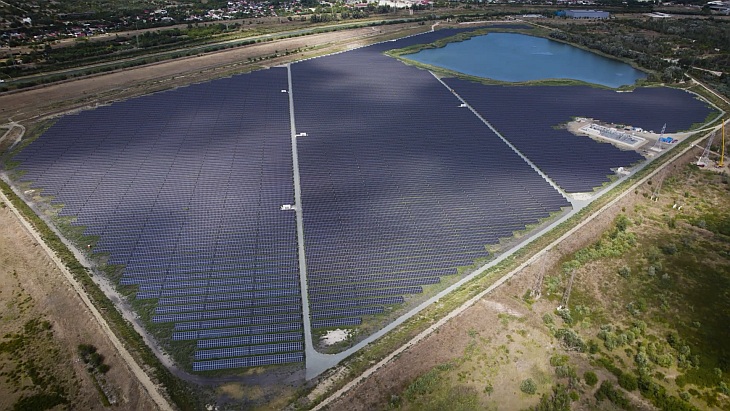
Behind these decisions are more than 500 MWp designed and commissioned for clients over the past five years, an operation and maintenance portfolio exceeding 450 MWp, and experience with unconventional construction sites, such as Simtel’s 52 MW solar park built on a former industrial ash disposal site in Giurgiu.
Another detail, less visible but relevant to the transparency criterion, is that each of the contracts mentioned above was publicly disclosed through the Bucharest Stock Exchange, including the client, scope and contract value. An investor evaluating a listed contractor can independently verify its project portfolio, quarterly financial results and corporate governance without relying solely on commercial presentations.
Taken together, the contracts illustrate Simtel’s ability to work with international investors and established energy groups on projects ranging from photovoltaic plants to battery storage systems and hybrid installations. They provide concrete examples for assessing EPC experience, technical complexity and post-delivery services.
The real test is only beginning
According to data reported to ANRE, more than 19 GW of capacity has estimated commissioning dates in 2026-2027. Not a single megawatt of this pipeline can be built without contractors capable of delivering on schedule, under increasingly stringent grid requirements and with ever more complex hybrid technologies.
Grid connection reform could favour projects backed by financing and genuine implementation capacity. Investors moving into construction will need partners capable of delivering under increasingly demanding technical and contractual conditions. Romania’s EPC market is therefore likely to consolidate around contractors that already meet these investors’ requirements: a proven track record of execution, verifiable financial strength and transparency.