

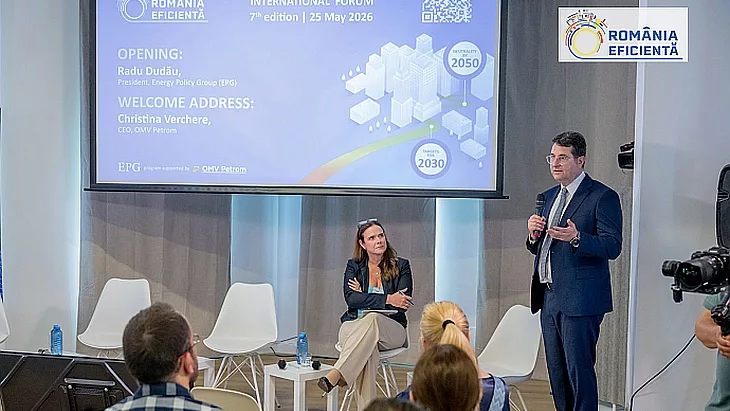
The Efficient Romania Forum, organized by the Energy Policy Group (EPG), with the support of OMV Petrom, on May 25, 2026, brought together experts in the field of energy and construction, representatives of national public authorities and civil society in a constructive dialogue dedicated to the decarbonization of the building stock and the role of the just transition in achieving the climate objectives assumed by the European Union member states for 2030.
At the opening of the conference, Radu Dudău, President of the Energy Policy Group (EPG), spoke about the contribution of the Efficient Romania program to the development of a culture of energy efficiency at the national level, both through the information component regarding the benefits for users and the technical measures and necessary behavioral changes, as well as through the practical one, of renovating schools in the public education system to nZEB standards. She also highlighted the three key topics of the moment, present on the Forum’s agenda: the National Building Renovation Plan (PNRC), the sustainability and circularity of the built environment, and the controversial ETS2, the new European system for charging carbon emissions from construction and transport.
Christina Verchere, CEO of OMV Petrom, highlighted the role of energy efficiency both from the perspective of a supporter of the Efficient Romania program and from that of an active actor in the energy transition: “The cleanest and cheapest energy is the energy we do not consume. The greatest opportunity for energy decarbonization lies in how we use it more efficiently.” Regarding the concrete involvement in the energy transition, Christina Verchere mentioned numerous company projects, concluding: “We contribute to decarbonization by promoting an energy transition carried out at a realistic pace and through pragmatic solutions.”
This year, the Forum also enjoyed the online intervention of Bogdan Atanasiu, expert of the European Commission (DG Ener), who presented the latest developments regarding the implementation of the EPBD at the level of the Member States, as well as the main stages that lie ahead. He also addressed the current state of Romania in the process of transposing and applying the EPBD, including the respect of the deadlines assumed for the transmission of strategic documents such as the PNRC. At the same time, Bogdan Atanasiu highlighted the scale of the transformations generated by the EPBD and their impact beyond climate objectives: “EPBD is not just about sustainability, reducing energy consumption or reducing emissions and pollution. It also means more affordable housing, jobs and economic competitiveness. It means better buildings that consume less energy, generate lower bills and reduce the financial pressure on users, as well as vulnerability to crises similar to those of recent years. At the same time, it contributes to security of supply, increasing energy independence and reducing the need for network investments, providing a more stable and flexible system.”
The first panel of the conference, dedicated to the development of the PNRC, combined the institutional vision with technical expertise and comparative experience from the region. The discussion began with interventions by Anca Ginavar, Director of the Ministry of Development, Public Works and Administration, Dragomir Tzanev, Executive Director of the Center for Energy Efficiency EnEffect and Alice Corovessi, Director of the Institute of Zero Energy Buildings, on the PNRC in Romania, Bulgaria and Greece. This was followed by technical interventions by Cătălin Lungu, President of the Order of Energy Auditors of Romania, who presented the methodology used, and by Theodor Bratoșin, EPG collaborating researcher, who addressed the minimum energy performance standards and the local renovation plan developed within the REDESIGN project.
Starting from the stage of transposition of the EPBD, the debate highlighted the common particularities of the three countries regarding the existing built stock. The challenges identified included: the complexity of the legislative and regulatory framework; the outdated built stock; the enormous investments needed to achieve the renovation targets; the dependence on public funds; the absence of effective cooperation between institutional actors and administrations, at multiple levels of governance. Beyond the obstacles, the panel also highlighted what is perhaps most important: accelerating and increasing the quality of renovations depends both on closer cooperation between neighboring countries, through the exchange of experiences, models of good practice and the development of a “common voice” at regional level, but also on real collaboration between central and local institutions, the private sector and building owners.
The second panel, dedicated to circularity and sustainability of the built environment, brought into debate the challenges generated by the mandatory calculation of the global warming potential (GWP) over the entire life cycle of buildings: from the development of a calculation methodology at national level and reporting to the European Commission, to the integration of the indicator in building permits, the use of low-carbon construction materials, deep renovation, energy efficiency and the management of materials resulting from demolitions. The discussion was attended by Raul Pop, Secretary of State in the Ministry of Environment, Waters and Forests, Eugen Pănescu, Vice President of the Architects’ Council of Europe (ACE), Mihai Moia, Executive Director of ROENEF and Andrei Ceclan, President of the Society of Energy Auditors and Managers of Romania (SAMER), guests who together cover the entire value chain in the construction field, from regulation and design to construction, renovation and monitoring of energy consumption.
From the calculation methodology and the implications of GWP, the discussion naturally evolved towards the taxation of emissions from the building sector in the third panel, dedicated to the role of ETS2 in ensuring affordable and energy-efficient housing. Ruxandra Chirilă, Director at the Ministry of Investments and European Projects, Laura Nazare, coordinator of the energy transition campaign of Bankwatch Romania and Constantin Postoiu, Coordinator of the data analysis department at EPG analyzed the impact of the new mechanism on consumers and the challenges it raises in terms of energy vulnerability, the need to integrate data obtained from multiple sources for the proactive identification of the vulnerable population and the solutions offered by the Social Climate Fund for its protection.