

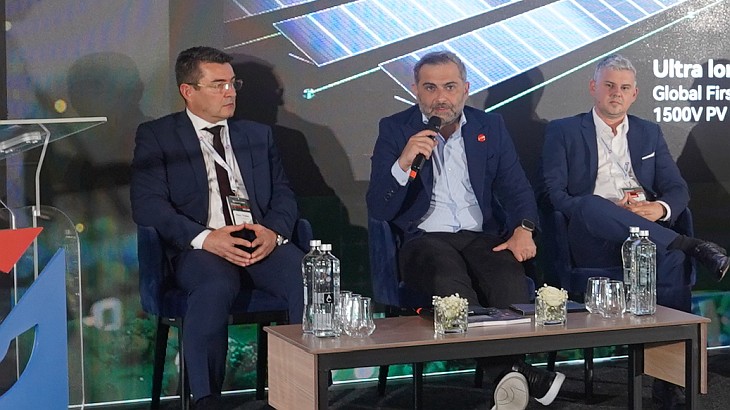
Demand for battery energy storage systems has accelerated sharply in Romania over the past six months, while in the commercial and industrial segment customer interest is shifting increasingly clearly from photovoltaic generation alone towards solutions that combine storage, consumption control and energy optimisation, said Adrian Sușcă, Country Manager Romania and Regional Manager Balkans at SAJ Electric, at the “Romania’s Green Momentum” conference, organised by Energynomics.
His message goes beyond simply describing rapid growth in battery sales. For C&I customers, a project must be treated as an integrated system, in which the battery, inverter, management platform, automation and optimisation tools work together. In a fast-developing market, the difference will not come only from the price of the equipment, but from the solution’s ability to operate reliably, adapt to the customer’s profile and generate value over the long term.
Sușcă said SAJ Electric remains focused on the residential and C&I segments, without entering the utility-scale market for now. The company has more than 21 years of experience in inverter manufacturing and, according to its representative, develops almost the entire technology package associated with its solutions in-house, with the exception of battery cells. The management platform and control components are developed in-house, while the solutions can also be integrated with SCADA systems and the company’s own artificial intelligence tools.
In the C&I segment, the shift in interest is already visible. Sușcă said that over the past year, and particularly in the past six months, batteries have become the central focus of customer discussions. The intended uses vary: trading, reducing consumption peaks through peak shaving, including with the help of AI, and increasing self-consumption. For an industrial consumer with its own generation, a battery can shift some of the available energy to hours when consumption is higher and reduce the amount drawn from the grid.
The impact goes beyond what appears on the electricity bill. By increasing self-consumption, an industrial consumer can also reduce pressure on the grid during certain intervals. From that perspective, distributed storage in the C&I segment can contribute to flexibility even if individual projects are much smaller than batteries developed at grid scale.
SAJ is also relying on artificial intelligence to operate these systems. Sușcă explained that the AI package it offers is developed by the company and includes learning and self-adaptation functions. According to him, analysis of systems already operating in Europe indicated an efficiency gain of up to 20%. The figure is a company claim, based on its own operating experience, not a general benchmark for all storage projects.
Beyond algorithm performance, Sușcă stressed an issue that is less visible at the time of purchase: the manufacturer’s ability to support the project after delivery. A battery that reaches the site but cannot be integrated, tuned or commissioned quickly ties up capital and delays the revenues or savings on which the investment was based.
“I have heard of batteries sitting for several months, which we do not consider normal,” Sușcă said. He linked the issue to the need to work with established manufacturers that can intervene and adapt the solution when integration or operational problems arise.
The warning becomes more important as the market attracts new suppliers and cost pressure can push investors towards choosing the cheapest product. For Sușcă, the relevant criterion is how long the system can continue to meet the customer’s needs and generate value. “The cheapest product will never be enough for their long-term needs. A battery should generate value for a customer for at least 15 years,” he said.
In that logic, the management system is not an accessory that can be added later, but part of the project’s economic model. The battery must be controlled according to the consumption profile, own generation, market prices and the equipment’s technical limits. For industrial customers, optimisation can mean moving from a battery used for a single function to an asset that addresses several needs, from self-consumption and peak shaving to participation in market opportunities, where the configuration and rules allow it.
Sușcă’s remarks therefore point to a new stage for C&I storage in Romania. Batteries are being requested increasingly often, but market maturity will depend on the quality of integration and suppliers’ ability to support the equipment throughout its lifetime.
The “Romania’s Green Momentum” conference was organised by Energynomics, with the support of Elektra Renewable Support, ADEX, Adrem Asset Management, Big Store, CBRE, Elnos Romania, Eximprod, Global Techniques for Energy, SAJ, Sermatec, Sigenergy, Solar Today, Sunotec, TBEA, Think Blu Solution, WALDEVAR Energy.