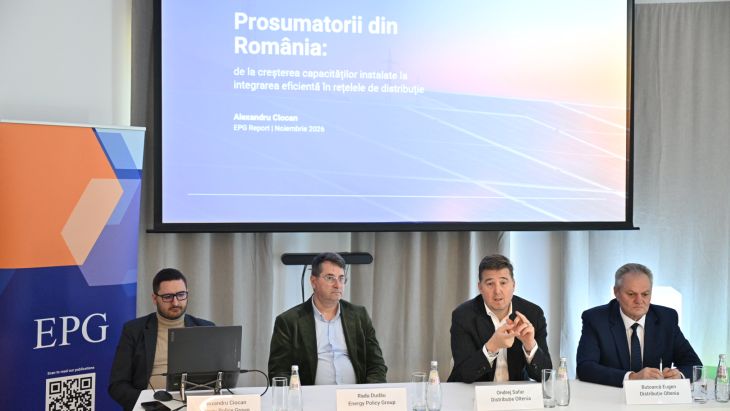
The unprecedented growth of the prosumer segment has, in certain situations, led to technical imbalances within the market, according to officials from Distribuție Energie Oltenia (DEO). They state that new discussions are underway with the regulatory body-ANRE-to identify solutions for mitigating these imbalances. One of the key objectives, according to DEO officials, is the establishment of a new Technical Grid Code.
“Don’t get us wrong: 99% of prosumers act in good faith and contribute positively to the market,” says Ondrej Safar, CEO of Distribuție Oltenia.
However, there are instances where inverters are tampered with, causing voltage levels to rise and effectively “cannibalizing” the grid capacity available to neighbors. This highlights the need for significant digitalization and more precise grid settings-in other words, a new Technical Grid Code.
When asked by Energynomics about the extent to which such prosumers impact the grid, Eugen Butoarcă, Head of the Distribution Network at DEO, explained that investments are being made in specialized transformers-which can be up to 60% more expensive than standard models-to address grid issues. Furthermore, DEO officials suggest that the current allowable voltage deviation range of -10% to +5% should be adjusted to -10% to +10%-a standard seen in Western countries-to better manage these imbalances. They hope the regulator will recognize this necessity. At the same time, new entrants to the grid who wish to inject energy should be required to have storage projects-a topic also under discussion for the coming year-Ondrej Safar noted in response to a question from Energynomics.
One solution adopted in other countries is for distribution operators to own their own storage projects; however, this is not currently permitted in Romania.
Finally, the thresholds for quantitative and financial compensation regarding balancing should be re-evaluated in light of market conditions; Romania’s current approach is extremely permissive compared to that of other states.
What solutions does a new EPG report propose
The number of prosumers has increased from 289 and an installed capacity of about 2.5 MW at the end of 2019 to over 400,000 by the end of 2026, with a total installed capacity of over 4.4 GW. This evolution brings new opportunities for renewable energy production, but also challenges for electricity distribution networks, which must be adapted to efficiently integrate increasing volumes of locally produced energy.
A new report by the Energy Policy Group (EPG), carried out at the initiative of Distribucie Oltenia, highlights the need for an approach that combines investments in network modernization with monitoring measures, voltage regulation, injection management and use of flexibility, inspired by European practices.
The increase in photovoltaic capacities installed at prosumers is changing the way electrical distribution networks work, especially at the level of low-voltage networks. They have to handle increasing volumes of injected electricity during periods of high PV production. Such situations can lead to the reversal of power flows, voltage increases beyond the permitted limits, imbalances between phases and overloading of some network elements. The problems are more pronounced in areas with a high concentration of prosumers and in networks with little capacity to integrate distributed generation.
The EPG report highlights that the impact of prosumers on networks differs depending on the characteristics of the infrastructure, the location of the facilities and the volumes of energy injected. Therefore, solutions must be adapted to local conditions, so that investments are effective and the development of prosumers is not limited.
Oltenia Distribution, as the initiator of the report, contributed to its realization by providing data and technical analyzes obtained within the Horizon 30 project, which highlight the challenges associated with the integration of prosumers, but also the solutions implemented or tested for their management, adapted to the local characteristics of the networks. For its part, Delgaz Grid contributed data resulting from its own technical analyses, and Retele Electrice Romania was involved in the consultation process and in the discussions regarding the challenges associated with the integration of prosumers, contributing to the completion of the perspective on this process at the level of distribution networks.
These contributions highlight the need for the comparative evaluation of available solutions and the substantiation of investments on technical-economic analyses. Thus, distribution operators could select the combinations of measures that provide the desired benefits at justified costs.
“The increase in the number of prosumers is a clear sign that the energy transition is already happening, and more and more Romanians are choosing to actively participate in the production of green energy. It is an evolution that we support and for which we are constantly preparing our networks. At Distribuție Oltenia, we want to facilitate the integration of as large a number of prosumers as possible, under conditions of safety and quality of the distribution service. For this, we need both investments in infrastructure modernization and intelligent solutions, adapted to the needs of each area. The EPG report gives us a valuable perspective on how we can better capitalize on the existing infrastructure and identify effective solutions for the future. We believe that the energy transition is built together, through collaboration between distribution operators, authorities and consumers,” says Ondrej Safar, CEO of Distribucie Oltenia.
The experience of other European states, such as Germany, the Netherlands and Poland, shows that the accelerated development of prosumers must be accompanied by the adaptation of support and compensation mechanisms, as well as the introduction of measures for more efficient integration of photovoltaic production into the electricity networks. These include the transition from quantitative to financial compensation, the introduction of limitations on the power injected into the network and the development of forms of flexible connection, depending on the particularities of the regulatory framework in each country.
These examples show that effective integration of prosumers does not depend solely on infrastructure investment, but also on smarter use of existing network capacity through monitoring, digitalisation, automation and flexibility solutions.
“Based on the analyses conducted, we have identified several priority areas for the efficient integration of prosumers into Romania’s electricity grids. These include introducing flexible grid connection mechanisms-such as limiting the power injected into the grid-leveraging the advanced functionalities of photovoltaic inverters (where feasible), developing infrastructure for the monitoring and digitalization of low-voltage networks, and establishing a framework that allows distribution system operators (DSOs) to procure flexibility services. Furthermore, tariff structures must be adapted to ensure a more equitable distribution of grid costs.
Implementing these measures requires improved coordination among the Romanian Energy Regulatory Authority (ANRE), distribution system operators, Transelectrica, and the authorities responsible for energy policy. At the same time, the regulatory framework must be adapted to facilitate technical and economic solutions that alleviate pressure on existing infrastructure-all while ensuring that the growth of prosumers is not unjustifiably constrained,” states Alexandru Ciocan, Senior Researcher at EPG.
The EPG report emphasizes the importance of developing electricity grids in tandem with the rising number of prosumers. Through investments tailored to local needs, digitalization, and smart energy management solutions, distribution networks can support the integration of an increasing number of prosumers and contribute to accelerating the energy transition in Romania.
The report-authored by Alexandru Ciocan, Alexandru Chivu, Corina Lazăr, and Radu Dudău-along with a public policy analysis outlining the study’s key takeaways, is available here.