

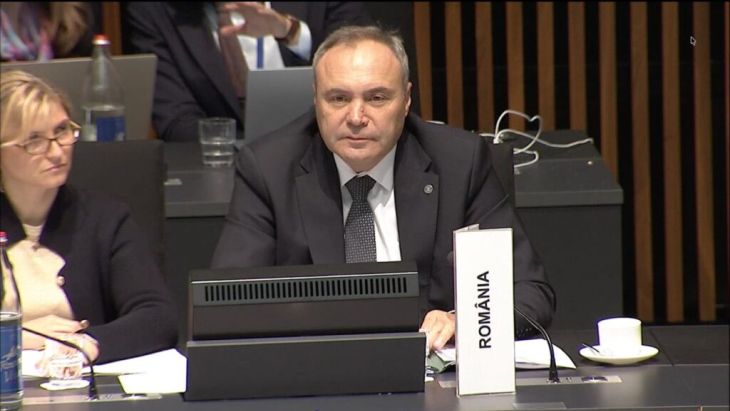
During the Energy Council meeting held on Thursday in Luxembourg, Minister of Energy Dumitru Chisăliță presented Romania”s priorities regarding the debate on network tariffs and the acceleration of electrification, with a focus on reducing costs for the general public and businesses.
According to a statement from the Ministry of Energy, the Minister emphasized that common European principles must allow for adaptation to the specificities of each energy system and its respective investment needs, while respecting the competencies of national regulatory authorities.
“For Romania, the essential criterion is the impact on the bills paid by citizens and companies. We support rules that encourage the efficient use of networks and reduce unjustified costs. At the same time, we need investments to modernize infrastructure, and European solutions must take into account the realities of the Romanian energy system. Together with other member states, we have advocated for an emergency meeting between Energy and Finance ministers to swiftly identify responses to the pressures faced by consumers ahead of the cold season,” stated the Minister of Energy, as quoted by Agerpres.
Romania has advocated for transparent tariff rules and better utilization of existing infrastructure. Network tariffs represent the portion of the bill that covers the transmission and distribution of electricity, including investments in infrastructure. Regarding fiscal measures, Romania maintained that energy taxation should be addressed within the framework of European tax legislation, while respecting national competencies and the requirement for unanimity. The objective of promoting electrification must be pursued with due regard for its impact on consumers, industry, and national budgets.
According to the cited source, discussions will continue at the European level, with Romania advocating for solutions that help reduce energy costs, encourage investment, and strengthen the competitiveness of the economy.
During discussions on security of supply and preparations for the 2026-2027 winter, Minister Dumitru Chisăliță emphasized the need for a coordinated European response to ensure the continuity of energy supply and protect consumers. The Minister drew attention to the strain placed on the general public and industry by high energy prices, stressing that winter preparedness must address both security of supply and the affordability of energy for consumers.
Furthermore, during the meeting, Romania advocated for the diversification of supply routes, the strengthening of regional cooperation, and investments in interconnections, storage, and the modernization of energy infrastructure.
The Minister of Energy highlighted the importance of adapting energy systems to extreme weather events, drawing on the experience of this summer”s drought. In this context, the Romanian official urged the European Commission to promptly present a legislative proposal to revise the EU framework on energy security, with a focus on climate-related risk preparedness, enhanced regional cooperation, and greater resilience of energy infrastructure. At the same time, the Romanian official advocated for a strategic dialogue regarding European refineries, highlighting their role in ensuring fuel supply security and maintaining economic competitiveness.
Particular emphasis was placed on supporting the Republic of Moldova, whose Minister of Energy, Dorin Junghietu, participated in the discussions. Romania reaffirmed the need for continued, EU-coordinated support-both for preparations for the cold season and for strengthening long-term resilience-through the diversification of supply, the development of interconnections, and integration into the European energy market.
“The energy security of the Republic of Moldova is part of European energy security. It is essential that we continue to provide support coordinated at the EU level, both for the upcoming cold season and to bolster long-term resilience. European solidarity can make a tangible difference for the most vulnerable consumers, including those in the Republic of Moldova,” the head of the Energy portfolio noted.
On the sidelines of the Council meeting, the Romanian minister also held bilateral talks with his counterpart from the Republic of Moldova, Dorin Junghietu.
During the public debate on the future European energy framework for the post-2030 period, Chisăliță argued that decarbonization goals must be aligned not only with energy security but also with economic competitiveness and the assurance of affordable prices for both the general public and industry.
“The European Commission is preparing the energy policy framework for the post-2030 period, which will guide future objectives and investments in energy production and consumption. The ministerial debate provided member states with an opportunity to present their priorities ahead of the European Commission”s legislative proposals-covering areas such as clean energy, energy efficiency, electrification, and interconnection,” the statement further notes.
Romania also advocated for technological neutrality, calling for the recognition of nuclear energy and renewable sources as complementary pillars of the European energy system. This approach, it argued, should be reflected in legislation, the definition of future objectives, and access to European funding.
“The future European energy framework must provide Romania with the conditions to invest, develop its industry, and ensure affordable energy. Nuclear energy and renewables are complementary, and this reality must be acknowledged within European regulations and in access to financing. We need greater ambition regarding grids, interconnections, and storage, so that the persistent price disparities affecting Southeast Europe can be reduced,” added Chisăliță.
Regarding energy efficiency, Romania supported objectives that encourage a reduction in consumption relative to economic performance, without constraining industrial development.
Furthermore, it emphasized that the pace of electrification must take into account the availability of affordable clean energy, grid capacity, and the investment capabilities of both households and businesses. The Minister also advocated for the simplification of rules and the avoidance of a proliferation of reporting targets and objectives. Furthermore, Romania called for adequate and non-discriminatory European financing instruments to support existing and new nuclear capacities, energy networks, storage, and innovative low-carbon technologies.
Regarding the resilience and competitiveness of European refineries-an agenda item introduced at the initiative of several Member States-Romania emphasized the need for a long-term European vision for this sector.
“Maintaining competitive and geographically diversified refining capacities is essential for the security of fuel supply, particularly in Central and Eastern Europe,” the source stated.
Finally, the Romanian Minister of Energy stressed that the European Commission”s strategic dialogue with the industry must encompass all European refineries-regardless of their size or location-and ensure the close involvement of Member States.
“Europe requires a competitive refining sector capable of ensuring fuel supplies, even during times of crisis. For Romania, it is crucial that future European measures take into account the needs of our region and the challenges faced by all refineries. The dialogue with the industry must lead to concrete measures that support investment and strengthen security of supply,” added Chisaliță.
During discussions on transport infrastructure and the CO2 market-an initiative brought forward by Belgium-Romania supported the development of a European framework designed to facilitate investment in carbon capture, transport, and storage. These technologies can contribute to reducing emissions in industries where decarbonization is challenging, helping to maintain their competitiveness.
Romania has emphasized that the storage obligations stipulated by the Net-Zero Industry Act (NZIA) must be realistic and proportionate to avoid placing excessive burdens on operators in Romania. Their implementation must take into account geological conditions, the availability of transport infrastructure, and the actual demand for CO2 capture.
“We support the development of carbon capture and storage technologies, but the obligations imposed on operators must be aligned with the practical possibilities for implementation. For operators in Romania, these requirements represent a significant burden, given that the necessary infrastructure is still under development. We need European funding and risk-sharing mechanisms to support the entire value chain-from capture to transport and storage,” noted Dumitru Chisaliță.
According to the Ministry of Energy, the European Commission is preparing a framework for the development of CO2 transport infrastructure and markets, designed to facilitate the transfer of captured carbon dioxide from industrial facilities to storage sites, including across borders between Member States.
The Energy Ministers discussed concerns raised in a joint statement by fuel industry associations from six European states (Bulgaria, the Czech Republic, Greece, Poland, Romania, and Slovakia) regarding the impact of regulatory requirements and emission costs on competitiveness and security of supply.
Romania argued that the implementation of European energy and climate legislation must be proportionate, realistic, and technologically neutral, taking into account national circumstances as well as the industry”s capacity to adapt and invest.
“The energy transition must go hand in hand with maintaining a competitive European industry. Companies need predictable rules and realistic timeframes for adaptation and investment. We must pursue decarbonization goals while considering the effects on security of supply, the economy, and consumers,” concluded the head of the Energy sector, Dumitru Chisăliță.