

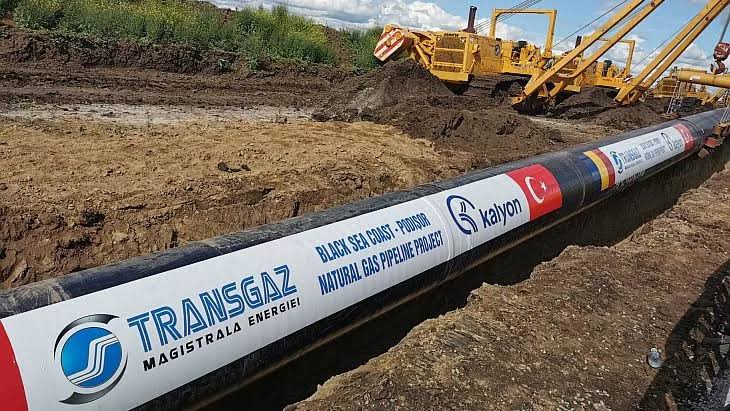
The High Court of Cassation and Justice (ICCJ) has rejected by final decision the main appeal filed by the Bankwatch Romania Association – Cluj Branch and the incidental appeal filed by Transgaz in the case regarding the construction authorization for the Tuzla-Podișor gas pipeline, according to a press release from the Ministry of Energy.
“On November 4, 2026, the High Court of Cassation and Justice (ICCJ) issued Decision no. 4768/2026, final, by which it rejected as unfounded both the main appeal filed by the Bankwatch Romania Association – Cluj Branch, and the incidental appeal filed by the National Natural Gas Transport Company ‘Transgaz’ S.A. (Transgaz), in the file regarding the construction authorization for the Tuzla – Podișor gas pipeline. In this dispute, the defendants were Transgaz, the Ministry of Energy (ME) and the National Agency for the Environment and Protected Areas (ANMAP). It is an important decision for a strategic project, worth over 500 million euros and with a length of approximately 308 km, which will take over the gas from Neptun Deep and introduce it into the National Transport System (NTS)”, according to the press release.
The pipeline is already completed and put into operation, and production in the Black Sea is scheduled to begin in 2027. According to the relevant ministry, any delay in this project would have meant a delay in Romania’s access to its own resource, with a direct impact on energy security and on the costs borne by consumers and the economy.
With this ruling, the High Court of Cassation and Justice upheld the solution of the Cluj Court of Appeal of May 29, 2025 (Judgment no. 279, file no. 139/33/2025), when the judges admitted the exception of the limitation of the substantive right to action. Bankwatch had filed several successive preliminary complaints, with the same object, at different intervals of time, in an attempt to keep the path of an action for annulment open and to be able to intervene at any time in the development of the project. However, the court found that the substantive right to action was time-barred, a solution that became definitive following the rejection of the appeals.
“Actions of this type, which aim to block or delay energy infrastructure projects that are already advanced and comply with legal procedures, generate additional costs, consume administrative and judicial resources and delay the valorization of own resources. Ultimately, those who bear the consequences are Romanians – through higher prices and greater dependence on imports,” the statement emphasizes.
Energy Minister Dumitru Chisăliță indicated, in this context, that in the case of the Neptun Deep project, the priorities are maintained, namely strengthening the security of supply and creating the premises for lower tariffs for consumers and industry.
“Regarding the Neptun Deep project, my priorities remain the same: to bring Black Sea gas to the Romanian economy, to strengthen security of supply, without having a significant impact on the environment, and to create the premises for lower tariffs for consumers and industry. I thank the legal teams at Transgaz and the Ministry of Energy for the rigor with which they managed this file,” said Dumitru Chisăliță.