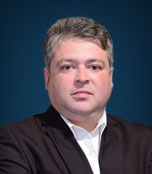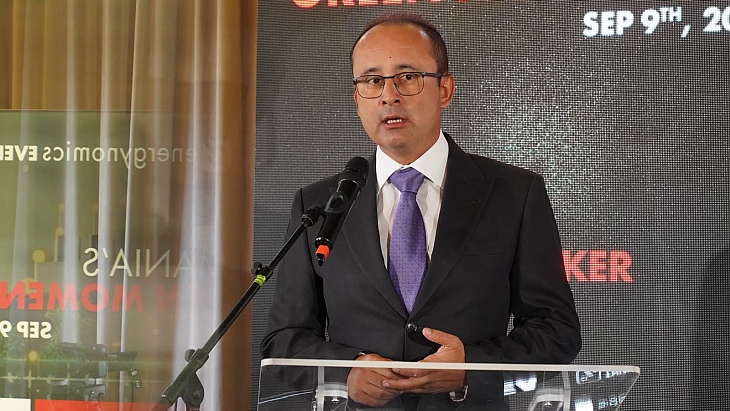
In the coming years, the European Union will invest and support electrification projects, especially from renewables, said Cristian Bușoi, Secretary of State in the Ministry of Energy, at the “Romania’s Green Momentum” conference, organised by Energynomics.
“The EU has very clear objectives, the 2030 Fit for 55 objective, the 2040 objective, a 90% reduction in emissions and certainly – an ambitious objective, but difficult to achieve but not impossible, the 2050 objective – net zero, the essential objective of the Green Deal. In fact, the European Union’s response to the global energy crisis accentuated by the conflict in the Middle East is that of electrification. This was very clearly stated by the European Commission and the majority of member states at the Council of Ministers in June in Luxembourg and then in Dublin, where the Secretary of State Sorin Elisei also participated, where this direction was reiterated. We will have an Informal Council at the end of the month. Therefore, in the coming years the European Union will invest and support electrification projects and obviously these projects are mainly in the area of renewable energy – wind, solar, obviously complemented by batteries, stand-alone batteries… Romania has less geothermal for electricity production, more for district heating, but the renewable area will continue to be the priority area for investment and support from EU public policy”, he said.
Bușoi claims that the level of acceptance for nuclear has increased, and small reactors are in the Government’s vision, but it is, perhaps, for the first time that there is talk about a possible other technology.
“Recently, there has been a rediscovery and a greater degree of acceptance for nuclear energy. Here too, Romania has a special interest in Cernavodă 3 and 4 and, obviously, for small modular reactors – this project or perhaps another American technology – it is a decision that Nuclearelectrica and obviously the Ministry of Energy and the Government of Romania will have to make this autumn”, adds Cristian Bușoi.
“I say it rediscovered because during the period when I was leading the Energy Committee in the European Parliament it was still very difficult and I remember the battle related to taxonomy and all the discussions from that period, it was still understood that without being renewable energy, nuclear energy can contribute to achieving the objectives. It is an energy with zero CO2 emissions, it is an energy in the band that can help the energy systems of the countries that use nuclear energy – half of the European countries and without seeing in the coming years European grants and funds to support investments in nuclear. There will be financing instruments, in the form of loans, and there will be greater openness – state aid will be approved for investments in nuclear”, said Bușoi.
Major interest in renewables, but order is needed in the projects
Although there is a lot of interest in renewables, there are a lot of virtual or unfinished projects.
“There is a big discussion about the permitting at Transselectica, here ANRE has made some decisions recently – of course, we need to see to what extent the new auction system will start working and how it will work, let’s see if it needs to be improved, if we need to move towards another solution… but obviously we need to put some order in the projects that block, at least on paper, the capacities of the transporter and distributors, because otherwise it will be very difficult to move forward, to reach our goal of 10 GW by the end of the decade”, he added.
During the crisis, the system benefited from help from ANRE, which accelerated the approval procedures of some projects that were in the final stages.
“We had important help from Transelectica and ANRE for the projects that were included in the PNRR and that had to be completed by August 31. I think there is a much clearer understanding in the area of public institutions, not only of decision-makers, but also of civil servants,… that we need to support and accelerate investments in renewables and here, obviously, YOUR feedback, of those who are involved in the projects, is extremely important, but my perception is that in recent weeks there has been an acceleration and dynamization of the way in which these projects are supported by institutions. The investment appetite still exists, and commercial banks have started to be much more open to projects in the area of renewables, they have started to gain some experience, to have a deeper understanding. We have great interest from some international companies and from this point of view, if we manage to regulate those dysfunctions that, unfortunately, we have had in recent years and in the recent period, I think that this Green Momentum – which, once again, the EU will have a very strong focus in the coming years, this boost in renewables that will bring many EU countries energy independence and less influence from international geopolitical events – will become a reality, not only in Western and Northern European countries, or in those around us, and we see discussions related to Bulgaria, but also in Romania,” concluded Cristian Bușoi.
About Schneider Electric
Schneider Electric creates impact by maximising the value of energy and resources, connecting progress with sustainability. We are a global leader in electrification, automation and digitalization, providing AI-driven IoT solutions for smart industries, infrastructure, data centres and buildings.
With 150,000 employees in over 100 countries we promote diversity and innovation. Schneider Electric România, with 27 years in business and more than 300 employees, runs operations in Armenia and Moldova and provides support in 17 languages for 26 countries through the Bucharest Hub.