

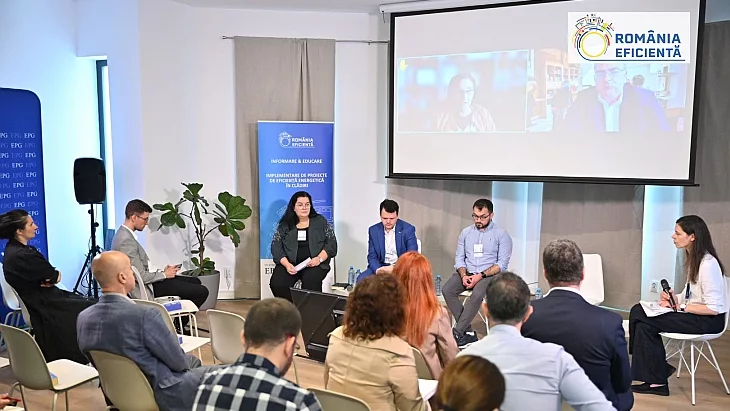
Decarbonizing the building stock does not depend solely on national plans, funding, and regulations. For energy-efficient renovations to accelerate by 2030, Romania and other countries in the region need closer cooperation, a skilled workforce, and a functional market for low-carbon materials and solutions.
One of the less-discussed conclusions of the Efficient Romania 2026 Forum is that the transition in the building sector cannot be achieved through national instruments alone. Romania, Bulgaria, and Greece face similar challenges: an aging building stock, multi-family housing that is difficult to renovate, energy vulnerability, a shortage of specialists, seismic risk, and limited administrative capacity.
In this context, regional cooperation can become a practical tool, not merely a diplomatic exercise. Anca Ginavar, director at the Ministry of Development, Public Works, and Administration, emphasized the need for a “common voice” among the region’s countries in their dialogue with European institutions, precisely because the characteristics of the built environment in Central and Southeast Europe differ from those of Western European countries.
Dragomir Tzanev, executive director of the Center for Energy Efficiency EnEffect in Bulgaria, took this idea further: the most useful lessons often come from neighboring countries, because they stem from similar administrative, social, and economic constraints. Instead of each country rebuilding the same mechanisms separately, the region can share solutions for financing, data, technical assistance, professional training, and quality standards.
This cooperation becomes all the more important given that one of the major barriers to renovation is not just a lack of funds, but a lack of implementation capacity. The targets set by the EPBD require a large volume of work to be completed in a short timeframe, and the construction market must be able to deliver this work to the required standard. However, as several speakers pointed out, the shortage of specialists, designers, auditors, energy managers, and skilled workers can slow down renovation just as much as the lack of funding.
Cătălin Lungu, president of the Romanian Order of Energy Auditors, warned that the renovation process will extend until 2050 and will require not only money but also trained personnel. Andrei Ceclan, president of SAMER, emphasized a specific issue: there is a need to improve skills not only among professionals who design nZEB or ZEB buildings, but especially among the workers who actually carry out the work.
This observation is essential. The quality of renovation is not determined solely during the design phase. It depends on execution, installation, commissioning, system calibration, and how the buildings are subsequently operated. Without sufficient skills on-site and without quality control, investments may fail to meet expected performance, even if the projects formally comply with technical requirements.
The skills shortage is compounded by another challenge: the market for renovation materials and solutions must evolve rapidly. Mihai Moia, Executive Director of ROENEF, noted that the construction materials industry has already begun to address sustainability requirements through ESG strategies, environmental declarations for products, and solutions with a lower carbon footprint. But these efforts must be supported by regulations, public procurement, demand from beneficiaries, and constant dialogue between authorities and industry.
For low-carbon materials and circular solutions to become competitive, it is not enough for them to simply exist. A market must be created. This requires clear procurement criteria, tailored technical requirements, verification mechanisms, and a joint strategy among the Ministry of Development, the Ministry of the Environment, the Ministry of Energy, the Ministry of Economy, and the coordination of sustainable development policies.
At the regional level, the opportunity is even broader. Dragomir Tzanev highlighted the potential of prefabricated components for renovation, which can reduce the duration of work and the complexity of on-site interventions. A common regional market for such solutions could help countries in Central and Southeast Europe overcome one of the biggest barriers to renovation: the fact that each project is treated as an isolated, slow, and difficult-to-standardize intervention.
In this sense, the decarbonization of buildings is not just an energy efficiency issue. It is also an industrial issue. The region needs manufacturers, distributors, designers, installers, auditors, energy managers, and local governments capable of working within a shared ecosystem. Without this market for expertise and solutions, the 2030 targets will remain dependent on pilot projects and the fragmented pace of public programs.
The Efficient Romania 2026 Forum demonstrated that the transition in the building sector must be viewed as a process of institutional and economic development. National plans are necessary, but not sufficient. Funding is essential, but not sufficient. Regulations set the direction, but they cannot replace people, materials, technologies, and the capacity for implementation.
The next phase of energy renovation will depend on Romania’s ability to better connect with the region, train professionals and workers, draw on the experience of its neighbors, and create a real market for sustainable renovation. Without this economic infrastructure, the building sector’s transition risks remaining sound on paper but too slow in reality.