Central and Eastern European economies, especially Hungary and Romania, are facing the biggest blow to GDP from the energy crisis triggered by the Iran war, given their acute dependence on energy imports, according to a new analysis by Allianz Trade. A disruption of traffic in the Strait of Hormuz for up to two months could increase average inflation in emerging markets by +0.8-1.0 percentage points, they say.
Hungary has already capped fuel prices, increasing pressure on the fiscal deficit, which already stands at -5.1%. Oil exporters such as Nigeria, Colombia and Brazil are protected while Indonesia remains resilient, given its significant domestic energy production capacity. For vulnerable economies, including Romania, this context emphasizes the need for macroeconomic balance and careful management of external risks, in an environment that is becoming increasingly difficult to predict.
If the blockade of the Strait of Hormuz is prolonged, the effects become systemic, transforming a price shock into a supply crisis, analysts say. Economies such as Romania, Poland or Tunisia, characterized by fiscal, external and energy imbalances, are the most exposed, while commodity exporters such as Brazil or Mexico are better protected.
Price increases
The 40% increase in energy prices in the first week of the conflict represented the fastest channel for transmitting the effects on the global economy. On March 9, the reference price of oil briefly reached 120 USD/barrel, later falling to 80 USD/barrel. At the time of publication, the price of oil remains about 15% above the pre-conflict level. Even if energy transport is only interrupted for a short period, the conflict will still have a lasting impact on energy prices, as it would take several weeks for production and supply to return to pre-conflict levels. Analysts expect prices to return to a level closer to $70/barrel, generating a 16% increase compared to the pre-conflict reference level.
The escalation of the conflict in the Middle East brings back to the fore one of the most sensitive vulnerabilities of the global economy, namely the dependence on energy flows transiting the Strait of Hormuz, Allianz Trade analysts argue. According to the company’s latest analysis, this strategic point is becoming the epicenter of a new economic shock, in which geopolitical tensions directly influence financial markets and the dynamics of economic growth. Even in a scenario of limited disruption, the effects are already visible, and the evolution of the conflict will determine whether the global economy experiences only an episode of volatility or enters a deeper regime change.
Duration of the blockade remains the decisive variable
The duration of the disruption of traffic through the Strait of Hormuz remains the decisive element in assessing the economic impact. Allianz Trade analysts estimate that a disruption of up to two months of traffic in the Strait of Hormuz, which is not only a trade route but also a critical infrastructure of the global energy system, could lead to an increase in average inflation in emerging markets by +0.8-1.0 percentage points. On the other hand, the fastest economic effects are felt in the states in direct proximity to the conflict, especially in the Gulf area and throughout the Middle East, where economic activity has been directly disrupted.
The first estimates made by Allianz Trade analysts for a limited-duration scenario indicate a GDP contraction of around 3 percentage points in Saudi Arabia and 4.3 percentage points in the United Arab Emirates, amid economic disruptions, a drop in tourism and a temporary reduction in energy exports. At the same time, a short-lived conflict would allow for a relatively rapid recovery, with growth rates estimated at 6.5% in Saudi Arabia and 7.6% in the United Arab Emirates, and for the entire Gulf Cooperation Council, the loss would amount to about 3.3 percentage points, followed by a significant rebound of about 6.4% in 2027. History suggests several scenarios for how conflict could affect the region. The 1980s oil war between Iraq and Iran, which threatened to close the Strait of Hormuz, had major long-term implications for Saudi Arabia, with the Kingdom recording an average growth of +0.5% between 1981 and 1988 due to falling oil exports. While both Saudi Arabia and the United Arab Emirates have some capacity to continue exporting oil through various pipelines that connect oil fields to ports outside the Gulf, a prolonged closure of the Strait of Hormuz would significantly reduce both countries’ hydrocarbon exports. Kuwait, Qatar, Bahrain, and Iraq, which do not have significant export capacity without passing through the Strait of Hormuz, would suffer the most.
Rising Energy Prices in Emerging Markets
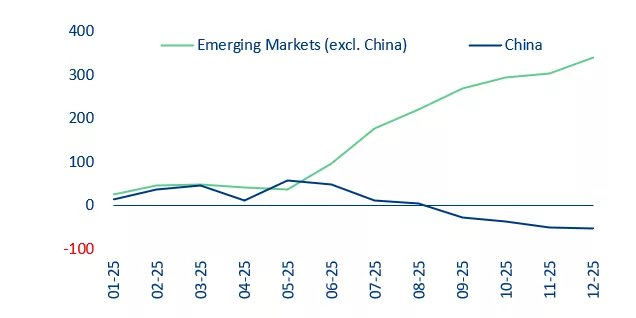
The renewed escalation of the Middle East conflict could wipe out the record gains recorded by emerging markets. 2025 began with massive capital outflows from emerging markets (excluding China), reaching a cumulative low of -$10.8 billion during the implementation of President Trump’s “Liberation Day” tariffs. However, this moment marked a turning point, as market confidence and the depreciation of the dollar played in favor of emerging markets, causing capital flows to return. As a result, 2025 ended with record portfolio flows ($410 billion), almost double the previous year, well above the historical average and a reversal of the capital outflows recorded after the pandemic. Emerging market bond funds ended 2025 with their first annual net inflows since 2021, totaling +$31.8 billion.
Source: LSEG Workspace, Allianz Research
Market effects and investor reaction
The impact was also quickly reflected in financial markets. Emerging market currencies depreciated significantly, especially in countries with high external deficits and energy dependence.
Thus, currency markets reacted quickly to the escalation of the conflict in the Middle East, with most emerging market currencies depreciating during the week. Between 27 February and 13 March, several currencies recorded significant declines, amid rising oil prices and the appreciation of the US dollar, which triggered a generalized trend of risk aversion. The Egyptian pound recorded the largest depreciation (-9.2%), reflecting its vulnerability as a large net energy importer with significant fiscal and external deficits. Central European currencies also depreciated notably, with the Hungarian forint (-8%), the Polish zloty (-4.9%) and the Czech koruna (-4.5%) under pressure, amid the region’s high dependency, combined with investor liquidation. In Latin America, the Chilean peso (-4.9%) stood out among the weak performers, given the country’s negative energy balance, while in Asia, the Philippine peso (-3.6%) and the Thai baht (-4.6%) also depreciated, in line with the region’s high dependency on Middle Eastern oil supplies.
Even in the context of the current shock, Allianz Trade analysts believe that emerging market fundamentals are solid, which is partially mitigating the impact of the war. Foreign exchange reserves remained high as many emerging markets took advantage of the 2025 conditions to rebuild them, despite the challenges posed by US tariffs. India, South Korea, Taiwan and several central banks in Southeast Asia recovered about $132 billion in foreign exchange reserves in late 2025 and early 2026, more than half of what they lost during previous defensive foreign exchange interventions, helped by a weaker dollar and capital inflows.
The outlook for capital flows to emerging economies in 2026 is highly dependent on the evolution of the conflict and, in particular, its duration. In a limited scenario of a few weeks, capital inflows would remain broadly robust and markets would return relatively quickly to conditions close to those before the escalation. However, investor behavior is becoming more cautious and more differentiated, with a selective allocation of capital depending on each economy’s exposure to energy risk and inflationary pressures. In contrast, a prolonged conflict would result in a clear repositioning towards assets considered safer, while economies with high vulnerabilities, such as Egypt or Pakistan, would be subject to significant capital outflows and currency depreciation pressures. The market adjustment would not be a generalized one, but would reflect the introduction of an energy risk premium applied differentially between issuers.
The analysis of long-term interest rates shows that this adjustment has two distinct components: one related to inflation and one to risk. In some markets, such as Chile, Turkey or South Korea, the increase in yields is mainly explained by higher inflation expectations. In others, such as Brazil or, more recently, South Africa, the increase in interest rates mainly reflects an increase in the risk premium, associated with investor aversion and liquidity conditions. In Central and Eastern Europe, the adjustment was among the most pronounced, with significant increases in yields in Turkey, Romania and Hungary, amid energy dependence and investor repositioning. Overall, markets do not react uniformly to the shock, but clearly differentiate between economies, depending on energy exposure, macroeconomic soundness and the capacity to absorb an inflationary shock.
On the other hand, the real estate sector in Dubai, one of the most dynamic globally in recent years, recorded visible corrections from the first week after the conflict broke out, with declines in the quotations of the main developers ranging between 13% and 17%. In the rest of the region, the most exposed economies remained Kuwait and Bahrain, whose dependence on the Strait of Hormuz, for both exports and imports, amplifies their vulnerability.