


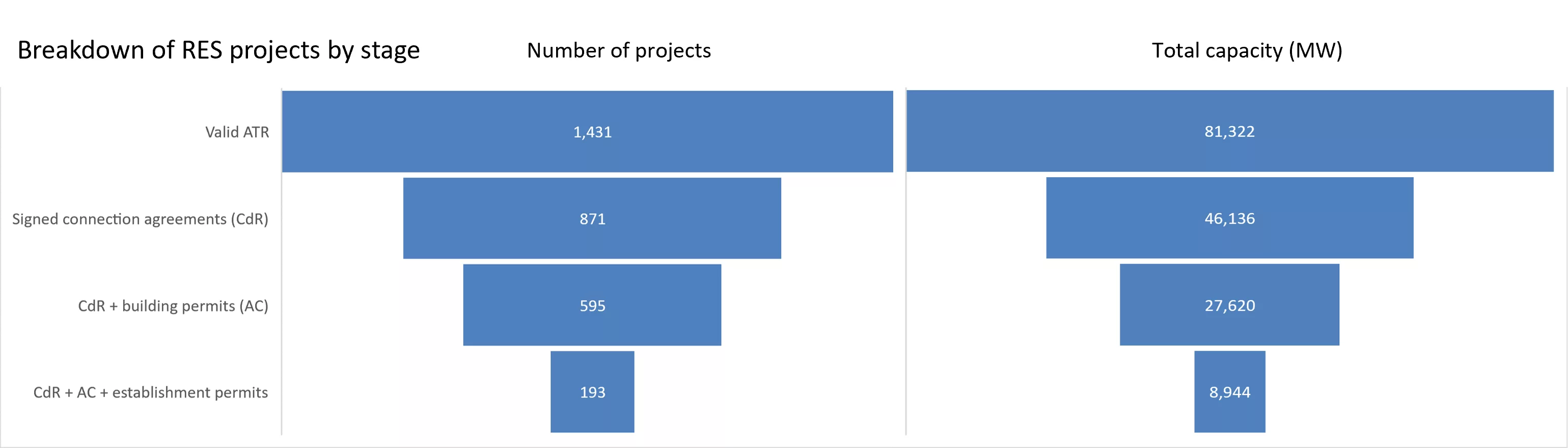
Electricity generation from renewable sources continues to grow in Romania. Based on data compiled as of March 1, 2026, ANRE indicates that 107 renewable energy projects in an advanced stage of development – with connection contracts signed and building permits submitted to the grid operator – are expected to come online in 2026. These projects have a total approved maximum output capacity of 3,843 MW and represent the most substantial segment of the immediate pipeline, in a context where the total portfolio of RES projects with valid grid connection agreements (ATRs) has reached 1,431 projects and 81,322 MW. Compared to the situation reported on February 1, 2026, this represents a 1.71% increase in the number of projects and a 1.44% increase in approved grid-connected capacity.
Of this total, 871 projects already had signed grid connection agreements, representing 46,136 MW, and 595 projects had reached a more advanced stage, with grid connection agreements and building permits, totaling 27,620 MW. An even more mature core of the pipeline consists of 193 projects that, as of early March, had all relevant approvals, including the establishment permit issued by ANRE, with a total capacity of 8,944 MW. The monthly trend is particularly significant in the most advanced segment: the number of projects with grid connection contracts, building permits, and establishment permits rose from 185 to 193, and the associated capacity increased by 9.09%, from 8,199 MW to 8,944 MW.
Of the 595 projects with building permits, 105 include storage facilities, with a total approved capacity of 7,385.9 MW. More relevant to the immediate future is the fact that 35 of these projects, totaling 1,764.42 MW, are expected to come online in 2026.
Major deliveries in the coming years
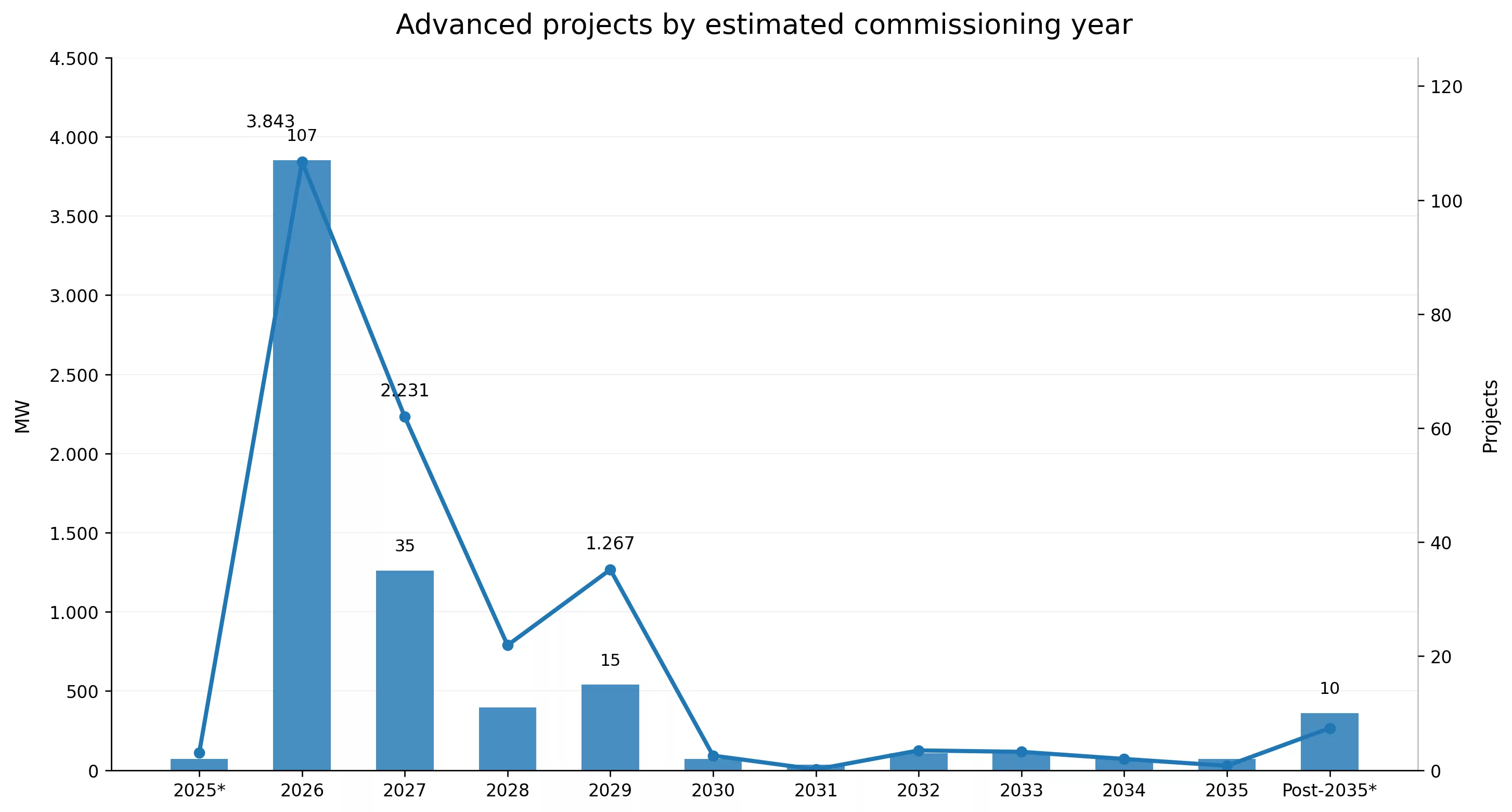
Taken as a whole, ANRE’s projection for estimated commissioning between 2026 and 2035 suggests a peak in capacity additions in the very early years of that period. The data shows that, for projects with grid connection contracts and building permits, 2026 accounts for 107 projects and 3,843 MW, followed by 2027 with 35 projects and 2,231 MW. Across the entire 2026-2035 period, this category totals 181 projects and 8,567 MW. Meanwhile, for all projects with estimated commissioning dates between 2026 and 2035, ANRE lists 575 projects and 26,953 MW, with the largest volumes scheduled for 2026 and 2027. The chart on page 2 of the document clearly illustrates this temporal concentration of the pipeline in the first two years of the decade.
The breakdown by grid operator also shows where the greatest pressure on the infrastructure is concentrated. For the 575 projects estimated to come online between 2026 and 2035, Transelectrica accounts for the largest approved transmission capacity, at 18.4 GW, followed by DEER with 3.25 GW, Rețele Electrice România with 3.13 GW, DEO with 1.41 GW, and Delgaz Grid with 0.73 GW. In the more advanced segment – projects that have already received a construction permit from ANRE – Transelectrica remains dominant, with 5.5 GW out of a total of 8.56 GW.
By comparison, Energynomics’ data reflects the same trend of pipeline maturation, even though the methodology differs. According to Energynomics, there are 51 projects estimated to come online in 2026, totaling 1.81 GW, of which 35 include storage. The difference from ANRE’s figure of 107 projects and 3.84 GW stems from the scope of coverage and classification criteria: ANRE has a more granular administrative view of projects with grid connection contracts, building permits, and, separately, establishment permits, while Energynomics tracks the pipeline strictly based on public available information. In addition, ANRE includes in its reporting projects with approved evacuation capacities of at least 1 MW, which contributes to a broader observation base.
On March 4, Energynomics released the “Report on the Photovoltaic Projects in Romania (March 2026)” based on information available at the end of January, and is preparing to release similar reports for the wind power and battery storage sectors on September 8.
