

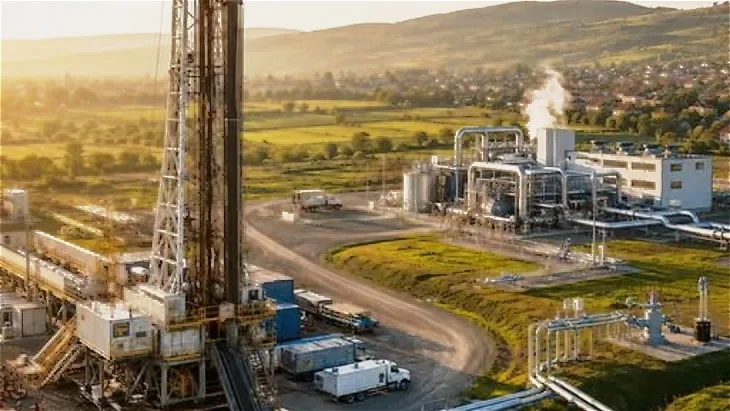
The City Hall of Turceni, Gorj County, took an important step towards the most ambitious geothermal exploration project in Romania by signing, on August 26, the exploration license issued by the National Regulatory Authority for Mining, Petroleum and Geological Storage of Carbon Dioxide. Turceni can thus chart a new direction for deep geothermal exploration (over 5,000 m) in Romania with the perspective of integrated use of the resource for city heating, agriculture, industry and significant potential in attracting investments for the economic diversification of an area hitherto dependent on coal exploitation.
This ambitious project is the result of a solid partnership that began in 2024, together with the Bankwatch Romania Association, with the aim of exploring and developing concrete local initiatives to advance a just transition in Gorj County.
“Turceni does not give up its energy identity, but continues it in a new form. For decades, the community has contributed to Romania’s energy sector and has borne the effects of industrial activity: dust, noise, pollution and pressure on the environment. Today, the city has the right to be supported to transform this experience into a clean energy pilot project,” said Turceni Mayor Constantin Popescu.
“The energy transition in this former industrial hub of Romania has been slowed down by illusory promises about the future of coal and the lack of commitment of successive national governments. It is important to focus our efforts on development opportunities that make economic sense and serve the long-term interest of communities, and the city of Turceni is taking an important concrete step in bringing the direct benefits of the transition to the local community. Romania is among the first countries in Europe in terms of geothermal potential, and against the backdrop of increasingly frequent external shocks, climatic or geopolitical, capitalizing on these local, clean and safe resources is more important than ever. We were happy to contribute to this project with strategic potential for the county and direct contribution to the just transition process”, added Eliza Barnea, Just Transition Campaign Coordinator, Bankwatch Romania.
A national first
Romania has limited experience in using geothermal resources for energy, the main landmark being the city of Beiuș, Bihor County, the only city heated entirely and exclusively by a centralized system based on geothermal water at a depth of approx. 2,800 m. This system provides the local community of Turceni with the cheapest gigacalories in the country. With a planned depth of 5,000 m, the city of Turceni is preparing one of the deepest and most ambitious geothermal exploration projects carried out so far in Romania.
It all started with the analysis of old wells for oil and gas research in the vicinity of the city. This analysis produced serious geological indications, which are to be confirmed in the exploration phase. This new phase must establish the real temperature, water flow, pressure, permeability of geological formations and chemical composition of the fluid. Efforts at the administration level continue in order to identify sources of financing, obtain the necessary approvals and carry out the exploration phase. In parallel, the technical documentation is being prepared with the support of the European Investment Bank, through the TARGET technical assistance.
If the results are favorable, future development may involve the use of these resources for heating homes and public buildings in Turceni. Depending on the temperature and flow that will be confirmed, geothermal energy could supply households, schools, public institutions, medical facilities and other objectives of the city with affordable, safe and clean energy.
Turceni, a reference point in Romania’s energy transition
Geothermal energy has the advantage of providing energy permanently, 24 hours a day, regardless of the weather, season, sun or wind. It is a local, stable and predictable resource, which can reduce the community’s dependence on fossil fuels, vulnerable to external shocks, and can contribute to lowering heating costs.
Geothermal heat can be used in a cascade and thus, can help the city’s long-term development and can lead to the creation of new jobs and local skills. For example, after using the highest temperature to heat the city, the remaining energy can be directed to greenhouses, drying and processing of agricultural products, production spaces, industrial activities or other investments that need constant heat. If the properties of the water allow it, uses in the spa, tourism, leisure or wellness fields can also be analyzed.
Turceni can become a national landmark for deep geothermal energy and an example of how an energy community can continue its mission in a modern and clean economy. The city does not abandon its energy past, but transforms it into the foundation of a new beginning.