

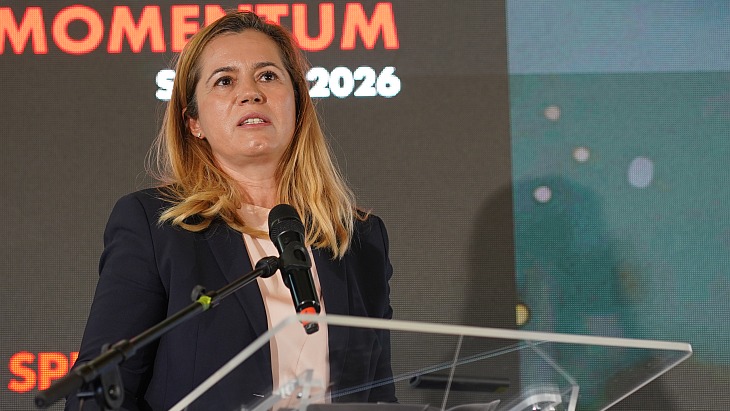
The European Bank for Reconstruction and Development (EBRD) is working with the Ministry of Energy to identify capacity needs and the support mechanisms required to develop long-duration energy storage projects and make them bankable, Mihaela Mihăilescu, EBRD Deputy Head of Romania, said at the “Romania’s Green Momentum” conference, organised by Energynomics.
“As you know, we are already working with the Ministry of Energy to develop support schemes similar to those developed for renewables. What we have tried to do so far is identify the market need in terms of capacity, how mature the projects already under discussion are and what type of support is needed to make those transactions bankable,” Mihăilescu said.
One of the technologies being considered in the first stage is pumped-storage hydropower, which EBRD sees as complementary to battery energy storage systems. Batteries can be deployed quickly and provide fast-response services to the power system, while pumped-storage hydropower allows larger volumes of energy to be stored and shifted over longer periods. According to Mihaela Mihăilescu, such projects can help reduce renewable energy curtailment, provide mechanical inertia and support the restart and restoration of the power system in the event of major incidents.
EBRD’s interest in long-duration storage comes as the financing institution gradually shifts its focus from already mature renewable projects towards technologies and projects that are more difficult to structure and finance.
“The issue is not a lack of capital. It exists, but it is indeed very selective,” Mihăilescu said.
For storage projects, the main issue for lenders is revenue predictability. Unlike renewable projects, where revenues can be supported through mechanisms such as Contracts for Difference (CfDs) or long-term Power Purchase Agreements (PPAs), storage projects rely on revenues from balancing, arbitrage and other services.
EBRD has already started financing storage projects in Romania. In 2026, the bank provided approximately 200 million euros in financing for around 800 MW of wind and solar capacity and 400 MW of storage. The institution’s pipeline includes projects totalling approximately 2.2 GW of renewables and 1.3 GW of storage. Another area EBRD is following is offshore wind in the Black Sea. The institution has contributed to drafting the legislative framework and defining the eligible areas, while the next step is to develop support schemes that will allow offshore projects to secure financing.
In parallel, EBRD is seeking to channel capital into smaller investments through commercial banks. The institution recently signed a portfolio facility with Libra Internet Bank under a programme financed through the PNRR, for projects of up to 2 million euros in areas such as sustainable transport, energy efficiency, renewables for self-consumption and storage. Since 2024, EBRD has financed approximately 3 GW of renewable capacity in Romania, while its storage project portfolio is growing.
The “Romania’s Green Momentum” conference was organised by Energynomics, with the support of Elektra Renewable Support, ADEX, Adrem Asset Management, Big Store, CBRE, Elnos Romania, Eximprod, Global Techniques for Energy, SAJ, Sermatec, Sigenergy, Solar Today, Sunotec, TBEA, Think Blu Solution, WALDEVAR Energy.