Russia’s invasion of Ukraine has not only changed Europe’s security architecture, but also the way NATO redefines its logistical priorities. Over the past three decades, the Alliance’s focus has been on the interoperability of armies, military technology and rapid troop mobility. Today, however, military planners are rediscovering an old lesson from the beginning of modern wars: without fuel, even the most advanced tanks, planes or ships are worth little, argues analyst Dumitru Chisăliță, president of the Smart Energy Association.
Logistics has once again become the backbone of military power
The experience of the war in Ukraine has demonstrated that transporting fuel by road or rail tankers is vulnerable, expensive and difficult to sustain in the event of a high-intensity conflict. Oil pipelines dedicated to refined products are thus once again becoming infrastructure of strategic importance.
In this context, NATO is analyzing the expansion of its pipeline system to the eastern flank, and Romania is starting to be viewed not only as a border state, but as a possible logistics center for the entire Black Sea region.
A little-known but essential system
Few Europeans know about the existence of the NATO Pipeline System (NPS), although it represents one of the Alliance’s most important logistical infrastructures.
The system does not transport crude oil, but refined fuels – aviation kerosene, diesel and gasoline – necessary for the operation of air bases, land units and military operations.
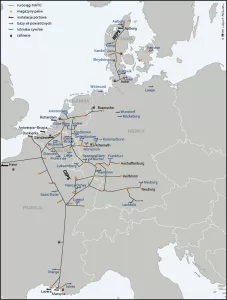
The most important component is the Central Europe Pipeline System (CEPS), which crosses Western Europe and connects refineries, seaports, strategic warehouses and air bases. The network totals approximately 5,300 km of pipelines and serves dozens of logistical facilities.
At the level of the entire NATO Pipeline System, the infrastructure exceeds 10,000 km of pipelines and approximately 4 million cubic meters of storage capacity. It is not just a transportation system. It is an infrastructure designed to enable the rapid deployment and long-term support of military operations.
Main features:
The Central Europe Pipeline System (CEPS), the main component of the NATO system in Western Europe, has approximately 5,300 km of pipelines, connects 29 NATO depots, refineries, ports, air bases and civil airports, and has a storage capacity of approximately 1.2 million cubic meters. The entire NATO Pipeline System (NPS) has approximately 10,000 km in 12 countries, with a total storage capacity of approximately 4.1 million cubic meters.
Estimated transportation capacity
Based on the diameters of the pipelines and the characteristics of similar petroleum product systems, CEPS could transport, in normal operation, 15–30 million cubic meters of fuel per year, i.e. approximately 40,000–80,000 cubic meters per day or the equivalent of 250,000–500,000 barrels per day.
Why NATO is looking east
Until 2022, the center of gravity of NATO’s logistics system was located in Western Europe.
Today, the threats have shifted. The eastern flank – from the Baltic Sea to the Black Sea – hosts the largest concentration of Allied troops in decades. New battle groups have been created in Poland, Romania and the Baltic states, and the Mihail Kogălniceanu air base is being expanded to become one of the most important NATO facilities in Eastern Europe.
All of these bases need something seemingly trivial, a continuous and reliable supply of fuel. Currently, much of this logistics relies on road, rail and naval transport. In peacetime, this is sufficient. In the event of a major conflict, however, the vulnerability of these means of transport becomes obvious. Hence the need to expand the pipeline network to the east.
Romania inherits an infrastructure built for another war
Paradoxically, one of Romania’s advantages comes from the communist period itself. During the Cold War, Romania built a complex system for transporting crude oil and petroleum products. It served both the national economy and the needs of the army.
Romania had a strategic system of pipelines and fuel depots built during the communist period, designed to ensure the supply of the army and the economy in the event of war.
Constanta – Ploiești, a corridor with strategic value
From NATO’s perspective, the most important Romanian infrastructure is represented by the connection between the Port of Constanta and the refinery area. Oil Terminal, Petrobrazi, Petrotel and Petromidia form one of the most important energy hubs in South-Eastern Europe.
The pipelines connecting these facilities could represent the foundation of a future logistics corridor intended to supply NATO bases in Romania and, subsequently, in Bulgaria and Turkey.
The estimates presented in the baseline analysis indicate that between 250 and 500 km of the existing infrastructure could have strategic value after technical assessments and modernization.
This does not mean that Romania already has a “Romanian CEPS”, but that it has an advantage that other states need to build from scratch.
Investments needed
The existing infrastructure is not sufficient. Integration into an allied logistics system would require new pipelines to the border with Bulgaria, direct connections to the Mihail Kogălniceanu base, new modern road and rail loading terminal pumping stations, high-capacity strategic warehouses in Dobrogea, and modern automation and monitoring systems.
Depending on the chosen technical scenario, between 300 and 400 km of new pipelines could complete the existing infrastructure.
The costs would be considerable, but there is the possibility of financing through NATO and European Union programs dedicated to military mobility and critical infrastructure.
The economic benefits may exceed the military component
The discussion is often presented exclusively in security terms. In reality, the economic impact could be just as important. The construction of such infrastructure would generate work worth hundreds of millions of euros.
More importantly, Romania could transform the existing infrastructure into a permanent source of income.
If the state were to retain ownership of the pipelines and opt for concession or partnership operation, it could obtain recurring revenues of 20-30 million euros/year, while the modernization costs could be largely covered by European and allied funds.
Constanta Port can become the energy gateway of the eastern flank
The importance of the Constanta Port has increased dramatically after the outbreak of the war in Ukraine. Cargo traffic has increased, and the port has become one of the main logistics routes for Ukrainian exports and for supplying the region.
Its integration into a NATO fuel transport network would give it an additional dimension. Constanta would no longer be just a large commercial port, but one of the Alliance’s main energy logistics hubs.
New terminals, warehouses, industrial facilities and logistics services could be developed around it with long-term economic effects.
But there are also costs
Any strategic infrastructure automatically becomes critical infrastructure. Pipelines and storage facilities should be permanently protected against sabotage, cyberattacks and hybrid threats. This requires additional investments in security, surveillance and intervention. In addition, the development of such a network can generate administrative difficulties, expropriations and internal political controversies.
These challenges should not be ignored, but neither should they be exaggerated. They are part of any major infrastructure project.
The great negotiation
Perhaps the most important question is not whether Romania should participate in the project, but under what conditions. If the infrastructure is built exclusively with Romanian money, the benefits may become questionable.
However, if the financing is mainly provided by NATO and the European Union, and Romania retains ownership of the infrastructure and actively participates in its operation, the balance changes radically.
The national interest would impose several clear conditions: ownership of the infrastructure should remain Romanian, use should be through concessions or operating agreements, modernization should be financed mainly from external funds, Romanian companies should participate in works and maintenance, and investments should also include civilian infrastructure – ports, railways and roads.
A historic opportunity
Romania has an advantage that few states in the region have simultaneously, a strategic port on the Black Sea, important refineries, a national pipeline network, an experienced energy industry and one of the largest NATO bases in Europe.
These elements already exist. The challenge is to transform them into a coherent system.
If this is achieved, Romania will no longer be just a beneficiary of the security provided by NATO, but one of the providers of the logistical infrastructure without which the defense of the eastern flank cannot function effectively.
What does the expansion of the NATO pipeline system mean for Romania?
1. Money invested in Romania. If the route passes through Romania, part of the investment (hundreds of millions of euros) would be spent here, on pipelines, pumping stations, depots, access roads, security and automation systems. Some of the contracts could go to Romanian companies, if they are competitive.
2. A more stable allied military presence. A permanent logistics infrastructure makes it easier to deploy and support NATO forces. This can encourage additional investment in bases, depots and logistics facilities.
3. More influence in NATO. Countries hosting strategic infrastructure usually have a more important role in logistical and operational planning. This does not mean a veto right, but it can increase Romania’s relevance within the Alliance.
4. Possible revenues. If Romania negotiates smartly and uses existing infrastructure, it can obtain:
• user fees or rents;
• funds for infrastructure modernization;
• related investments in energy and transport.
5. Greater responsibility. A strategic infrastructure must be guarded, maintained, and protected against sabotage and cyberattacks. This means additional costs and efforts.
“Major strategic projects are not measured only in kilometers of pipeline or in millions of euros invested. They are measured by a country’s ability to transform its geographical advantages and existing infrastructure into instruments of political influence, security and economic development. Romania has a rare chance to capitalize on an industrial legacy built during the Cold War and integrate it into a security architecture adapted to the challenges of the 21st century. Success will depend not only on NATO decisions, but also on the maturity with which the Romanian authorities will negotiate. If Bucharest manages to maintain control over the infrastructure, attract external financing and involve the national industry, then a pipeline network built half a century ago could become one of Romania’s most valuable strategic assets for the coming decades,” the analyst concluded.