

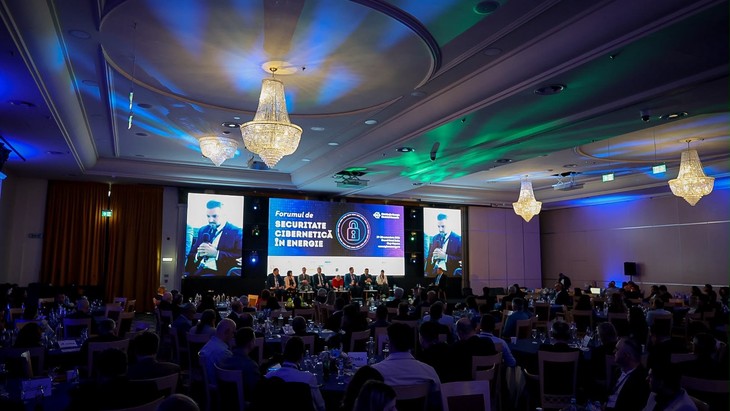
The 4th edition of the Cybersecurity in Energy Forum, organized by Distribuție Energie Electrică Romania (DEER)-a company within the Electrica Group-has concluded. Held from October 29-30, the event brought together over 450 participants and approximately 50 speakers, including representatives from central and European authorities, leaders of major energy companies, experts in technology and cybersecurity, and members of the academic community.
Throughout the two-day event, discussions highlighted current challenges within the energy sector-ranging from the need to accelerate investments and strengthen the security of critical infrastructure to the adoption of new technologies, the training of specialists, and the development of capabilities to respond to cyber incidents.
In her opening remarks, Mihaela Rodica Suciu, General Manager of DEER, emphasized that protecting distribution networks and ensuring the continuity of energy supply must remain top priorities during the modernization and digitalization process. “Security of supply cannot wait for the next budget cycle,” she stated, underscoring the need for concrete solutions, investments, and collaboration among energy operators, public authorities, and technology companies.
Maria Forna, Prefect of Cluj County, noted that cybersecurity represents “a strategic investment in the future”-one that is essential for the continuity of public services and the safety of communities. For his part, Dan Tarcea, Deputy Mayor of Cluj-Napoca, emphasized that “cybersecurity in the energy sector is a matter of public safety,” directly linked to the functioning of a city’s essential services. The first day of the Forum featured three thematic panels dedicated to public policy and regulation, the responsibilities of energy company management, and technological solutions for critical infrastructure.
Panel 1-“Cybersecurity in the Energy Sector: Public Policy, Regulation, and National Resilience”-brought together representatives from the European Parliament, the Parliament of Romania, the Ministry of Energy, the Romanian Energy Regulatory Authority (ANRE), the Special Telecommunications Service (STS), and the National Cyber Security Directorate (DNSC). Discussions focused on legislative adaptation, investment funding, and cooperation to protect critical energy infrastructure. Daniel Buda, a Member of the European Parliament, highlighted the role of European funds and the training of specialists, noting that security must be integrated into all energy projects: “Without it, it’s as if each of us were to build a house but fail to install any doors.” Sorin Elisei, Secretary General of the Ministry of Energy, advocated for prioritizing investments in infrastructure, digitalization, and cybersecurity within European funding programs for the 2028-2034 period.
“Infrastructure should become a priority,” the official stressed. Mircea Man, Secretary General of ANRE, described investments in power grids as “the only viable solution for Romania,” explaining that tariffs are determined according to a regulatory methodology and that the authority can examine potential financing solutions for cybersecurity. Sándor Bende, Chair of the Committee for Industries and Services in the Chamber of Deputies, emphasized that distribution tariffs reflect the costs incurred by each operator, rather than political decisions. He supported the possibility of incorporating cybersecurity-related costs into regulated tariffs and posed the question: “But what happens if we fail to make these investments?”
Mădălin Borș, Vice-Chair of the Committee for Information Technology and Communications in the Chamber of Deputies, presented a legislative initiative-recently approved by the Chamber-that expands the cybersecurity framework within the energy sector and allows for the inclusion of associated costs in future tariffs. “However, security is not merely a matter of procedure; it also entails action,” he noted. Ovidiu Cîmpean, a member of the Chamber of Deputies, advocated for the integration of digitalization and cybersecurity into investment programs, pointing out that “artificial intelligence will be ubiquitous in the energy sector.”
Gabriel David, First Deputy Director of the Special Telecommunications Service (STS), outlined the “Aurora” exercise, which tested communication systems under a national blackout scenario. “As of now, we are prepared; we know what needs to be done,” he stated, underscoring the importance of redundancy and cooperation. Gabriel Dinu, Deputy Director of the National Cyber Security Directorate (DNSC), warned of an increase in cyber incidents and the risks linked to the use of artificial intelligence, observing: “We are seeing more and more systemic vulnerabilities emerging.” He highlighted the necessity for both prevention and a coordinated response. The discussions confirmed the need for a joint effort by authorities and energy operators to fund cybersecurity, prevent incidents, and increase resilience.
Panel 2, “Cybersecurity on the CEO Agenda: Leadership, Investments and Business Continuity” brought to the fore the responsibility of energy company leadership in managing cyber risks. Leaders of companies such as DEER, Electrica, Evryo, Hidroelectrica, ELCEN and Adrem discussed the integration of security in investment strategies, protecting infrastructures and ensuring operational continuity.
Panel 3, “The Future of Cybersecurity in Energy: Innovation, Emerging Technologies and Solutions for Critical Infrastructures” was dedicated to new technologies and solutions to protect energy systems. The discussions covered the security of IT and OT environments, the use of artificial intelligence, the automation of security processes and the adaptation of infrastructures to emerging cyber threats. The program of the first day also included technical presentations of solutions, services, products and technological innovations, supported by the Forum’s partners and technology providers, offering participants the opportunity to explore concrete applications and tools for strengthening the security of critical infrastructures. The second day of the Forum included two thematic panels and specialized technical presentations.
Panel 4 – “Universities and Employers in the Age of AI: Who’s Preparing Tomorrow’s Cybersecurity Professionals?” highlighted the lack of specialized skills and the need to strengthen collaboration between the university environment and energy companies. The debates emphasized the importance of adapting educational programs to current industry requirements, as well as the role of internship, mentoring and practical training programs in preparing future specialists.
Panel 5 – “Energy System Cyber Resilience: How Fast Can We Recover After an Attack?” addressed the ability of organizations to prevent, identify and manage cyber incidents, as well as to safely restore the operation of critical infrastructures. The debates highlighted the importance of permanent monitoring, quick reaction and cooperation between technical specialists and management. An important focus has been placed on the use of artificial intelligence for the early detection of threats and supporting the decision-making process, with the responsibility of decisions and interventions remaining with the human factor.
At the same time, the need to comply with security rules by employees and partners was emphasized. The conclusions of the 4th edition of the Forum confirm that cyber security is a strategic component of energy security, which must be integrated in all stages of infrastructure development and modernization. Investments, high-performance technologies, the adapted regulatory framework and the training of human resources are essential elements for increasing the resilience of the energy sector. By organizing this event, Distribuție Energie Electrică Romania reaffirms its commitment to supporting the dialogue and cooperation between the authorities, the energy industry, technology companies and the academic environment, consolidating the Energy Cybersecurity Forum as a reference platform for the exchange of experience, best practices and the identification of the solutions necessary to protect critical energy infrastructures.
The success of the 4th edition of the Energy Cyber Security Forum was supported by the collaboration with the event’s partners, who contributed to the consolidation of a platform for dialogue and exchange of expertise in the field of cyber security, IT & Tech: Vodafone, Eximprod Grup, Arctic Stream, DataCore Systems, Fortinet, Cisco, Splunk, ADREM, certSIGN, Atos, Thales, Claroty, EnergoBit-VINCI Energies, Veeam, NTT DATA, HPE, Bitdefender, TrendAI, SPAN, Waterfall, UiPath, Trellix, Ingrammicro, Brinel, IQANTO, Crowdstrike, HP, ALEF, Dendrio, Kontron, Asee, One Software, SAP, Focality. The visibility and promotion of the 4th edition of the Energy Cyber Security Forum was supported by the media partners of the event: Focus Energetic, InvesTenergy, Financial Intelligence, The Diplomat, Transilvania Business, Energia.ro, Energynomics, NewsEnergy, Antena 3, TVR.