

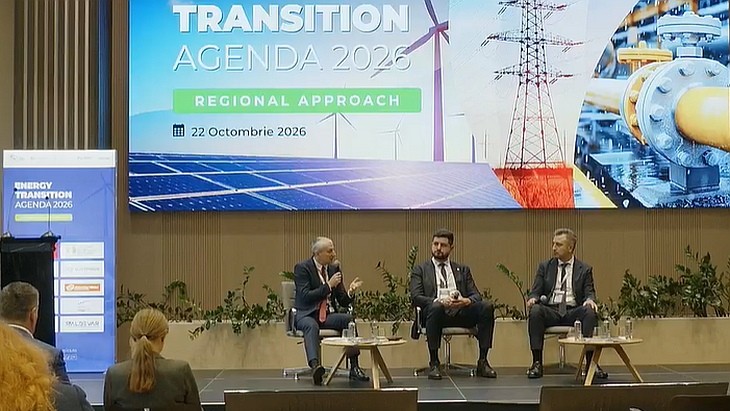
The Republic of Moldova has surpassed 1,000 MW of installed renewable energy capacity, but the next phase of its energy transition hinges on storage, tariffs, interconnections and consumers’ ability to adjust their electricity demand. The message was a recurring theme in the remarks delivered by Energy Minister Dorin Junghietu at Regional Approach Chișinău 2026, an event organised by Energynomics in partnership with the European Business Association (EBA) Moldova.
The minister’s diagnosis points to a problem of timing and grid infrastructure, rather than megawatts. “We generate electricity at times when it is not consumed. At present, we do not have sufficient interconnection capacity to export this electricity,” Dorin Junghietu said.
The capacity is there, but the market is not yet ready
In the second quarter of this year, renewable energy accounted for 46% of the country’s electricity consumption and 86% of domestic generation, according to the Energy Minister. The figures might suggest that the hardest part of the transition is over.
It is not, because electricity bills remain exposed to neighbouring markets. “We already have 1.1 gigawatts of renewable capacity installed in the country, yet we still import expensive electricity from regional markets at any given time,” the minister said.
Part of the mismatch originates in households themselves. According to Dorin Junghietu, 10,241 consumers have already installed more than 220 MW of photovoltaic panels, which generate electricity during periods of low demand. Without storage and consumption patterns that respond to prices, additional capacity increases generation precisely when the system needs it least.
Active consumers and the European timetable
Technology alone does not change behaviour. “Only around thirty consumers have switched to the new tariffs, although we have more than 40,000 smart meters installed,” Dorin Junghietu pointed out. His conclusion was that simply installing technology or approving new tariffs is not enough.
The minister’s proposed solution is to turn consumers into active market participants. “The end consumer must become an active participant in the market, able to adjust consumption according to prices and benefit from the flexibility of the system,” he said. Cost, however, remains a genuine constraint: recovering an investment over five years places a much heavier burden on electricity bills than spreading the cost over ten or fifteen years.
The government is seeking to attract private capital where flexibility is lacking. Battery storage is receiving temporary tax relief: “For the next 20 months, investors will not pay VAT or import duties on batteries.” Interconnection projects with Romania have been declared projects of public utility and benefit from VAT exemptions on equipment. The overall target is to reduce import dependence from 77% to 40% and ensure that renewable sources account for at least 85% of domestic electricity generation.
The European timetable adds further pressure. “Our objective is to achieve electricity market coupling with the European market by 2028,” Dorin Junghietu said. Legislative changes may advance faster than the country’s ability to implement them. European regulations are changing at an extraordinary pace, but the human capacity to put them into practice is limited, the minister acknowledged. His answer remains the same: people are the key to the energy transition.
Abordare regională Chișinău 2026 was organised by Energynomics, în parteneriat cu Asociația Businessului European (EBA) Moldova, with the support of our partners: Elektra Renewable Support, Alive Capital, Electroalfa, ELNOS, GoodWe, MET Romania Energy, SolarToday, WALDEVAR. Parteneri strategici AHK, CRE, RPIA, SAMER.