


Companies need an adequate, stable and predictable legislative framework before making the decision to invest in hydrogen technology, which is quite expensive at the moment, believe business people present at the round table “Green Hydrogen – Production and Use in Industry and Transport”, organized by AHK Romania.
The event was also attended by state secretaries from the ministries of energy of Romania and the Republic of Moldova, think tanks, as well as representatives of the Embassy of the Federal Republic of Germany.
The General Director of AHK Romania, Sebastian Metz, opened the debates, supporting the need for the sector to benefit from investments, both public and private: “I therefore invite you to an open, constructive discussion on this topic, as hydrogen can provide the key to decarbonizing industry and transport, the main sources of pollution”.
Business representatives say that the implementation of public policies related to hydrogen will attract new investments in the field. “We want to make concrete investments in Romania, and this is happening thanks to the hydrogen law; it creates the legislative framework for industries that will need green hydrogen. If there is no longer enough will to implement this law, then the investments will go to another sector,” said Alexandru Floriștean, from Hy24 Partners, an investment fund dedicated to hydrogen. He added that the European Green Deal has facilitated investments that reduce emissions in the steel industry, such as the first green steel plant, which is now being built in northern Sweden.
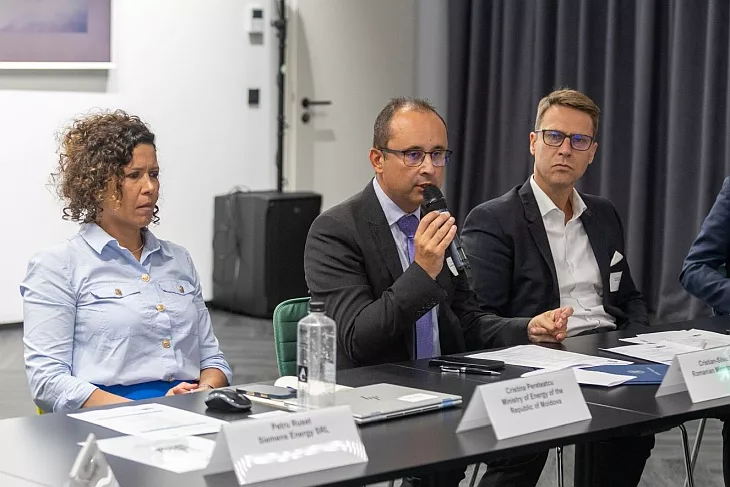
On behalf of the Ministry of Energy, State Secretary Cristian Bușoi pledged support for hydrogen-related projects.
“Hydrogen is also mentioned in Romania’s Integrated National Energy and Climate Plan, not only as an energy carrier, but also as a key element of long-term energy security. It is considered a solution for industrial sectors that are difficult to decarbonize. In the absence of other solutions, hydrogen could be the only solution for the steel sector or other sectors. Investing in hydrogen will allow us not only to achieve our climate goals and decarbonize these sectors, but also to create jobs and added value for the economy.”
For her part, the State Secretary of the Ministry of Energy of the Republic of Moldova, Cristina Pereteatcu, said that the Moldovan government is considering all existing possibilities to make the transition to green energy, but not at any cost. “Although no strategy is planned for the development of hydrogen energy, its use is being considered after 2030 to improve energy security, support the integration of renewable energy sources, and decarbonize transport,” she explained.
The Moldovan government also plans to integrate hydrogen into the Vertical Corridor Initiative, a strategic project that will transport natural gas from the south (Caspian Sea, Aegean Sea) to northern Europe, connecting gas terminals in Greece and Turkey with the networks in the EU, Moldova and Ukraine.
An example of good practice was given by Manuel Löw, from Deutsche Energie-Agentur, a public company of the German federal government. He presented Germany’s hydrogen strategy. It covers several areas, including transport, energy storage and distribution, research, education and innovation. The strategy also provides for the reduction of carbon dioxide emissions, which obliges diesel and petrol distributors to gradually increase the proportion of renewable fuels. Another point in the strategy stipulates that between 2025 and 2032, 9,040 kilometers of hydrogen pipelines will be put into operation (of which 56% will be converted from existing natural gas pipelines).
The roundtable was organized within a business delegation, organized by AHK Romania in Bucharest, from September 8 to 12, with financial support from the German Ministry of Economy and Energy.
Several German companies expressed their interest in finding business partners to implement advanced technologies in the field of green energy and hydrogen, as well as to enter or expand their presence on the hydrogen market in Romania and the Republic of Moldova. The companies participating in the delegation are: Siemens Energy AG, THOST Projektmanagement GmbH, Fichtner GmbH & Co. KG, Econtech-Theiss GmbH, ostermeier H2ydrogen Solutions GmbH.
This week, representatives of these companies met with their Romanian and Moldovan counterparts to explore cooperation opportunities, with the objective of expanding the use of hydrogen on a larger scale, both in industry and in the transport sector.